Houbigant — Raffinée
Essence
Raffinée (1982) is a quintessential big-shouldered 1980s floriental: an opulent, powdery, spicy-floral-amber in the lineage of Estée Lauder Cinnabar and Yves Saint Laurent Opium, beloved as a child of its time with a strong aura and high feel-good factor. Its modern story is inseparable from the tangled collapse of the Houbigant name - the original Houbigant juice is a cult vintage object, while later Dana and Prism Parfums versions bearing the same name are widely condemned as inferior or entirely different scents.
Scent Profile
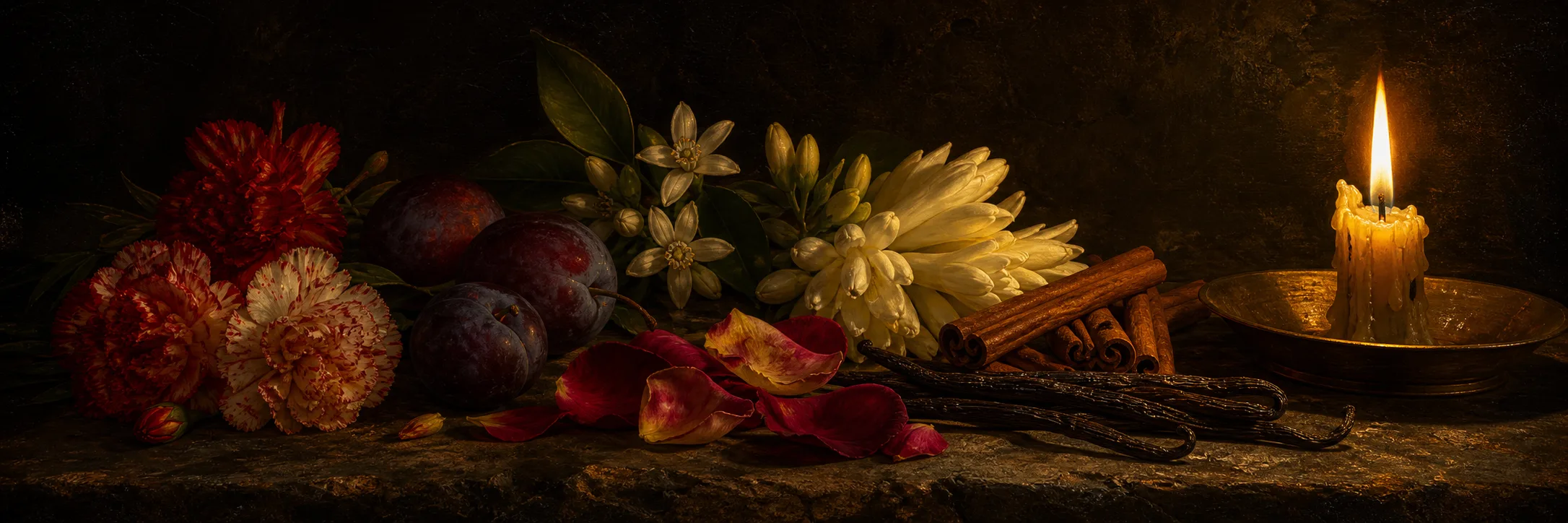
The opening is bright and fruity-spicy: a sweetened carnation laced with plum, with citrus (bergamot, lemon) and a hint of green over white florals. One blogger captures it as spicy and sweet carnation, a little bit of sweetness thrown in there to calm the flower down. The heart blooms into a dense, not-too-sweet floral bouquet - orange blossom, jasmine, rose, with tuberose, ylang-ylang and mimosa - over a persistent powdery, almost aldehydic veil that reviewers tie to the clean sharp personality of an aldehyde treatment. As it develops it warms toward amber, with cinnamon and incense emerging and a slight bitterness; the drydown is, per a fragrance blogger, a pleasantly green, warm cinnamon and vanilla amber fragrance with a bit of woodiness, anchored by sandalwood, tonka, musk and vetiver. The signature accord is powdery spiced-carnation over a warm amber-incense base. It is complex and shifting rather than linear, with reviewers praising the balance among its spice, floral and base auras. vintage connoisseurs class the original as a fruity floral chypre, subtle but solidly present over many many hours, reminiscent of the Krizia scents.
Performance
Vintage Houbigant Raffinée is repeatedly described as a long-lasting, high-aura 1980s powerhouse - excellent longevity, apply in the afternoon and still smell it in the evening, with above-average projection and sillage on wearers. Multiple wearers warn it can be a near-sillage-bomb if oversprayed and recommend a light hand. The bath-oil/parfum oil version is reported as softer and more muddled/rounded. As with most vintages, performance refers to original-formula bottles, not the later Dana/Prism reissues.
Wearing Context
Cold-weather, evening and special-occasion wear - reviewers place it at an evening party, dinner party, or black tie gala, wedding, or big awards ceremony. It carries an unmistakable 1980s glamour signature (one reviewer summons shoulder-pads, hairspray, full face make-up). Socially it reads as sophisticated, mature and feminine - 100% as a sophisticated, educated, attractive woman should smell, and a noted compliment-getter. Not an office or hot-weather scent; its richness can overwhelm in heat.
Comparisons & DNA
The most-cited peers are Estée Lauder Cinnabar and the broader Opium-era oriental wave of 1981-82. Within powdery sweet-spiced florals, wearer members repeatedly liken it to Cacharel LouLou (Raffinée described as a more gentle, sweeter and easy wearing relative, or LouLou without the strong jasmine) and to Gloria Vanderbilt Vanderbilt (along the lines of Vanderbilt, with added depth from subtle woody and spicy notes). One bath-oil wearer connects its powdery warm-floral character to Coty L’Origan and, by extension, Guerlain L’Heure Bleue. For carnation-forward classic florals, Caron Fleurs de Rocaille is offered as a similar alternative. The Krizia fruity-floral chypres are named as kindred works.
Reception
Strongly beloved among vintage devotees and classic-floriental fans - wearers forum threads exist of wearers who have used nothing but Raffinée for decades and mourn its discontinuation. The recurring, emphatic wearer message is to seek the original Houbigant formula and avoid the later reissues: the Dana version is not the same at all, and the Prism Parfums version is panned by forum reviewers as much heavier, very pungent, likened unfavorably to a Caron/Vanderbilt mash. A separate 5 Star Fragrances remake is flagged as a totally different light fruity-floral (watermelon water, nothing like the oriental floral original). Detractors of even the original find it too dated/80s and perfumey.
Versions & Reformulation
Heavily complicated lineage. Original by Houbigant (1982), available in EDT, EDP and parfum plus ancillary soap, talc and bath oil. Following Houbigant’s corporate collapse, the trademark passed through Renaissance Cosmetics (which acquired Parfums Parquet in 1994, then Dana in 1995), and Raffinée has since been issued by Dana and by Prism Parfums, both widely judged inferior or different. Identification guidance from reviewers: seek the art-deco red-and-gold diamond-shaped bottle with the patterned cap; avoid plain caps and anything labeled Dana. A later 5 Star Fragrances reformulation is a wholly different fruity-floral.
Acquisition Notes
Prices for vintage have historically been modest - wearers recall original bottles around $30 at retail, and vintage finds are still described as bargains, though dwindling stock is pushing prices up. The perfumer of the original is undocumented; reviewers have openly wished to know who the nose was.
Notable Facts & Lore
- Houbigant is one of the oldest names in perfumery, founded in Paris in 1775 by Jean-François Houbigant of Grasse (1752-1807), who opened his shop À la Corbeille de Fleurs at 19 rue du Faubourg Saint-Honoré at the age of 23.
- Raffinée’s lore in wearers is bound up with the house’s long, sad story - the decline of a great French house whose formulas were cheapened and name licensed out, a narrative vintage lovers find romantic (the eccentric great aunt who, used to model for Salvador Dali).
- Reviewers note its packaging variety, with the prized original a dark-red diamond-shaped glass flanked by fingerprint-like sinuous gold lines.