Houbigant — Quelques Fleurs l'Original
Essence
Quelques Fleurs l’Original is one of the most historically important fragrances ever made. Created by in-house perfumer Robert Bienaimé for Houbigant and launched in 1912–1913, it is widely credited as the first true multi-floral bouquet — the perfume that broke from the soliflore tradition to build an abstract, composed bouquet of many flowers held together with aldehydes and animalics. In doing so it founded a whole floral classification and seeded a lineage running through Chanel No. 5 and Jean Patou Joy. Its name means “a few flowers” — wry understatement for what is in fact an enormous, opulent floral.
Scent Profile
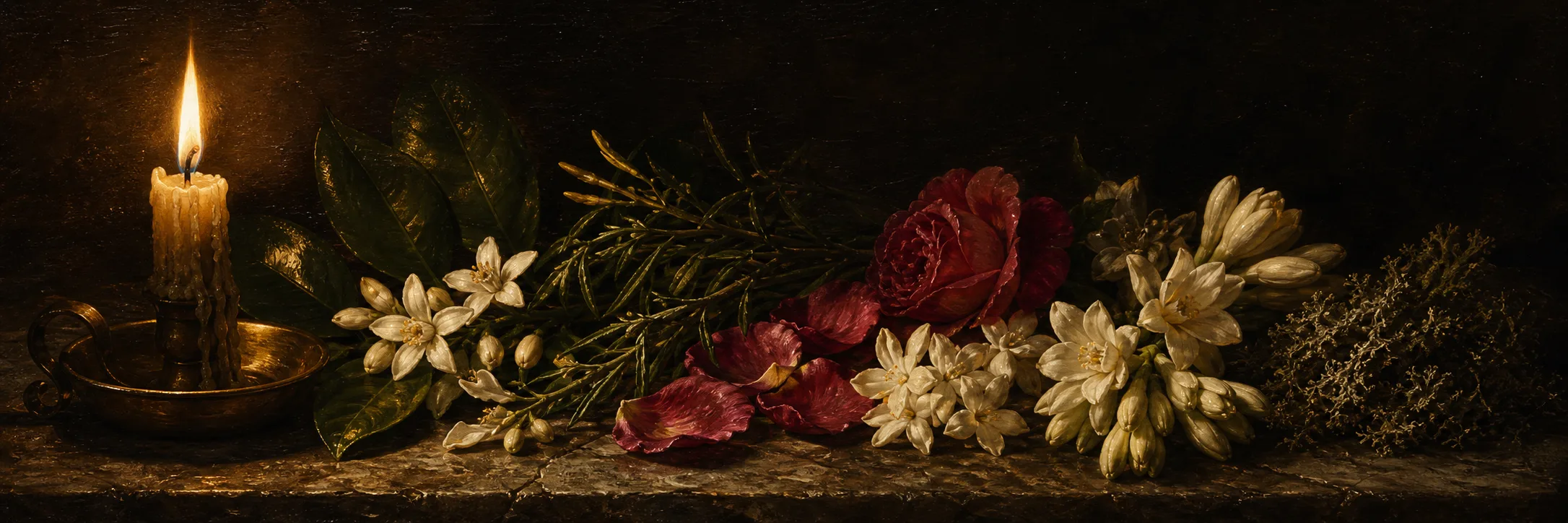
Quelques Fleurs is, above all, a profusion of flowers. The opening is bright and citrus-green — bergamot, lemon, tarragon, and a galbanum-like greenery riding over sparkling aldehydes — with lily-of-the-valley, rose, and lilac giving an almost soapy freshness. One vivid description has the flowers “punch you in the face and then continue to do so for a few hours.”
The heart is the famous “triple threat” of rose, jasmine, and tuberose, fleshed out with carnation, ylang-ylang, violet, iris, and heliotrope. It reads as a composed bouquet rather than any single identifiable flower, and what keeps it from cloying is the green, dewy lily-of-the-valley freshness and the airy lift of the aldehydes.
The base reveals its classical animalic-chypre bones: oakmoss, honey, civet, musk, sandalwood, vanilla, tonka, and ambergris. Beneath the basket-of-flowers motif runs a honeyed, slightly carnal underpinning — one wearer described synthetic civet and honey with “more than a suggestion of erotically dosed sweat.” In the drydown it turns slightly powdery, settling on smooth honeyed animalic warmth, orange-blossom soap, sweet rose, and an oakmoss chypre bite.
Performance
Quelques Fleurs is a powerhouse in the classical mode — potent, long-lasting, and considerable in sillage. Reviewers warn to apply with care: “wear time is all day and sillage is considerable.” One or two sprays suffice. The current EDP holds well, while the extrait and vintage parfum are denser and longer still. The honeyed-civet-musk base ensures it lingers on skin and especially on fabric. Like many great florals of its school, it rewards being worn close over a full day rather than judged on a quick in-store spritz.
Wearing Context
This reads as a grand-occasion floral, feminine to the highest degree and classic, even formal — “perfume with a capital P.” Yet reviewers stress its versatility: many find it wearable across every season, holding its own against summer heat and reading like a promise of springtime in winter, and suitable for both work and play when applied sparingly. Its associations are unabashedly elegant and bridal, making it a natural for weddings, celebrations, and dressy daytime-to-evening wear. Modern noses may find it girly and sweet; one reviewer judged it would suit men only “of the most dandy of natures.”
Comparisons & DNA
Quelques Fleurs is less a member of a family than the progenitor of one. The critic Victoria Frolova traced the lineage directly: smelling the original, “one glimpses the outlines of the future Jean Patou Joy” and even later heady florals like White Shoulders and Charlie. Joy is the most direct comparison, sharing the rose-jasmine-tuberose richness — though where Joy turns full-bodied and womanly, Quelques Fleurs keeps a lighter flutter. Several reviewers flag a startling resemblance between its fresh green opening and Chanel Cristalle. Within Houbigant it is the feminine counterpart to Fougère Royale, with Demi-Jour a lighter, sweeter descendant of the same floral sensibility. Its own flankers — Royale, Jardin Secret, and the Collection Privée — should not be confused with l’Original.
Reception
Quelques Fleurs occupies a secure place in the canon as a historically pivotal work, broadly beloved among classical-floral devotees who call it a “gilded time machine.” Its critical record has a curious gap: despite its importance, it does not appear to have received a documented star rating from Luca Turin and Tania Sanchez, and the frequently quoted “outlines of the future Joy” passage is the work of the critic Victoria Frolova, not Turin — a misattribution worth correcting. The Scented Salamander’s three-stage review traces how the fragrance shifted across its 1985, 2009, and current incarnations toward a honeyed, peachy character. Sentiment is largely admiring; the recurring reservations are that the tuberose-jasmine white-floral heart can dominate uncomfortably for some, and a persistent lament that the modern formula, while lovely, is a reformulation of a once-greater original.
Versions & Reformulation
Quelques Fleurs has one of the most layered version histories in perfumery. Houbigant traces the name to a 1775 creation that Robert Bienaimé reformulated and relaunched as Quelques Fleurs L’Original in 1912–1913. The fragrance survived the house’s twentieth-century decline and ownership turmoil, reportedly disappearing in the 1970s before being revived. Distinct 1985 and 2009 versions are documented, the latter a recreation entrusted to Roja Dove working with the Perris family, who acquired Houbigant rights in 2005; the 2009 jus is sweeter and more honeyed. A centenary extrait appeared around 2012–2013, and a 250th-anniversary limited edition was announced for 2025. The original 1912 formula is preserved at the Osmothèque in Versailles. The crucial buyer’s caveat: the current EDP differs from the vintage extrait, and “l’Original” should not be conflated with the simpler vintage “Quelques Fleurs.”
Acquisition Notes
The current Quelques Fleurs l’Original is readily available new in EDP and extrait, across a range of sizes and price points within the accessible-to-luxury tier. For the canonical experience, seek out l’Original specifically rather than the gourmand Royale or the modern flankers. Collectors chasing the older, richer character hunt vintage Houbigant bottles, verifying era by packaging and the “l’Original” designation. Because the modern juice is potent and the white-floral heart divisive, sampling before a full bottle is wise.
Notable Facts & Lore
- Its most famous association is Princess Diana, said to have spritzed it before her 1981 wedding and accidentally spilled some on her gown.
- Houbigant is the oldest surviving French perfume house, founded in 1775.
- Its royal roster reputedly includes Marie Antoinette, Napoleon, Empress Joséphine, Tsar Alexander III, and Queen Victoria, who granted it “Perfumer to Her Majesty” in 1838.
- François Coty so admired Quelques Fleurs that he reportedly tried more than once to buy Houbigant and created his own “Paris” in response.
- The original 1912 Bienaimé formula survives at the Osmothèque conservatory in Versailles.
- Houbigant’s marketing claims the fragrance draws on “upwards of 15,000 exemplary flowers and 250 prestigious raw materials” per ounce — romantic hyperbole, not literal formulation.