Houbigant — Quelques Fleurs Royale
Essence
Quelques Fleurs Royale is the 2004 flanker that trades on the prestige of one of perfumery’s foundational scents. The 1912 original, Quelques Fleurs l’Original, is credited as the first true multi-floral bouquet and a genuine landmark; Royale is its modern, sweeter, fruitier descendant. Where the original is clean, green, and radiant, Royale is honey-glazed and softer — pretty and well-made, if a little safe. The critic Angela of Now Smell This memorably summed it up: “It smells pretty and not cheap, but it belongs in someone else’s perfume cupboard.”
Scent Profile
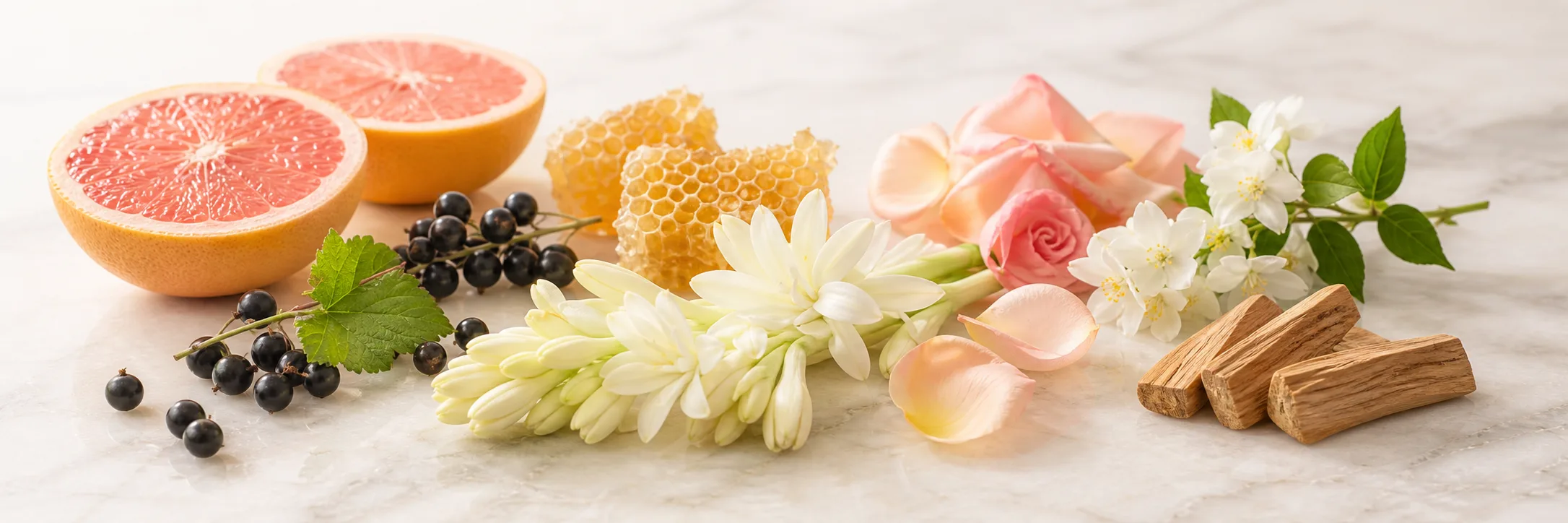
Royale opens with a brief sparkle of grapefruit and blackcurrant — tart, juicy, and fresh — before the composition’s defining feature takes hold. That feature is honey: a rich, waxy note the brand attributes to white mimosa honey and beeswax absolute, draped over the white-floral heart.
The heart pairs tuberose, jasmine, and Moroccan rose with violet and orris, the latter two lending powder. The honey is the love-it-or-leave-it pivot. At its best it reads as honeycomb, giving the rose petals a warm shimmer; at its worst, on warm skin or when over-applied, it tips into a powdery, grapefruit-tinged register that several wearers flag as veering toward “diapers.”
The drydown is soft, powdery, and musky — orris, sandalwood, white musk, and amber — with a quality one wearer likened to “a softer guerlinade.” Set against L’Original, Royale is dustier and more decadent; where the original is clean and radiant, this is plusher and sweeter.
Performance
Performance is good but not aggressive. Sillage and longevity both land in solid territory — present without being overwhelming, sitting at a comfortable arm’s length rather than dominating a room. Wearers report long wear, often well beyond five hours, with moderate projection. The main caveat is heat: a heavy hand in muggy weather amplifies the powdery honey and the risk of cloy, so a restrained application is the smart approach.
Wearing Context
This is a cool-weather, feminine, mature-leaning floral. One critic’s archetype for it is “an older woman with good manners and understated dress” — elegant and composed rather than youthful or loud. It shows best in spring and on cooler days, since the honey-vanilla warmth can read heavy in high heat. Notably, several wearers make a case for it as a gender-ambiguous scent, with some men finding its floral heart more compelling than expected. It suits casual daytime through dressier evening wear.
Comparisons & DNA
The essential reference is its own ancestor, Quelques Fleurs l’Original, of which Royale is the sweeter, fruitier, less green descendant; opinions genuinely split on whether the flanker improves on or cheapens the classic. Beyond Houbigant, it has been likened to Lancôme Poême and Rochas Alchimie, and described as “a softer guerlinade” for its powdery warmth. Patricia de Nicolaï’s Number One comes up as a similarly elegant, often better-value honeyed floral alternative. Men who wear it tend to connect its floral heart to the softer side of YSL L’Homme.
Reception
Reception is warm but not rapturous — “likeable if unspectacular” is a fair summary. Admirers love it as a soft, compliment-getting, classic-feminine floral with surprising longevity; detractors find it too sweet, too powdery, or generic in the honeyed opening. The clearest critical read is Angela’s review for Now Smell This: high-quality and genuinely pretty, but not for her, with that recurring warning that the honey-powder can turn diaper-like in heat. For the record, a review sometimes attributed to this fragrance was in fact Persolaise’s praise of Houbigant’s separate Fougère Royale, and no Turin or Sanchez star rating for either Quelques Fleurs could be confirmed.
Versions & Reformulation
Three things share the “Quelques Fleurs Royale” name and should not be confused: the 2004 EDP that is the subject of this page; a 15 ml Parfum and, since 2011, limited crystal-bottle Extrait presentations designed by Elisabetta Perris; and a 2018 Collection Privée version with a revised pyramid that several wearers find richer and dustier than the 2004 EDP, though one tester found her sample surprisingly weak for an extrait-billed edition. The flanker honors a Houbigant scent said to have been composed for Princess Adélaïde of Orléans, sister of King Louis Philippe I.
Acquisition Notes
Royale is widely available and frequently discounted, sitting in an accessible price tier despite the heritage branding; the 100 ml is the common size, with a smaller 50 ml and a 15 ml Parfum also offered. Some buyers have reported batch-to-batch and counter-to-counter variation, so smelling before committing and noting your source is worthwhile. Given how divisive the honey-forward profile is, a sample or small size is the prudent entry point. Seek L’Original if you want the landmark; reach for Royale if you want the sweeter, cozier modern read.
Notable Facts & Lore
- Houbigant is one of perfumery’s historic houses, official perfumer to several European courts.
- Its Fougère Royale (1882) is credited as the first fougère and an early “modern” fragrance through its use of synthetic coumarin.
- The 1912 Quelques Fleurs l’Original, which Royale flanks, is credited as the first multi-floral bouquet.
- The original is documented as a favorite of Princess Diana, reportedly worn on her wedding day in 1981.
- Royale’s name honors a Houbigant scent said to have been composed for Princess Adélaïde of Orléans.
- The house served as official perfumer to Adélaïde’s family from 1829, lore the “Royale” branding leans on.