Houbigant — Orangers en Fleurs
Essence
Orangers en Fleurs is a luminous, fully-realized orange-blossom soliflore-with-spice, composed by Jacques Fleury and released in 2012 as the fragrance that signaled the historic house of Houbigant (founded 1775) reclaiming the luxury market after decades of drugstore associations. It is, in the words of a published review a fully realized orange blossom fragrance that presents the honeyed floral note in a tableau of leaves and twigs - and its defining critical fact is that it is, by near-universal agreement, an airier, cleaner answer to Serge Lutens Fleurs d’Oranger, swapping that scent’s hot cumin for green nutmeg.
Scent Profile
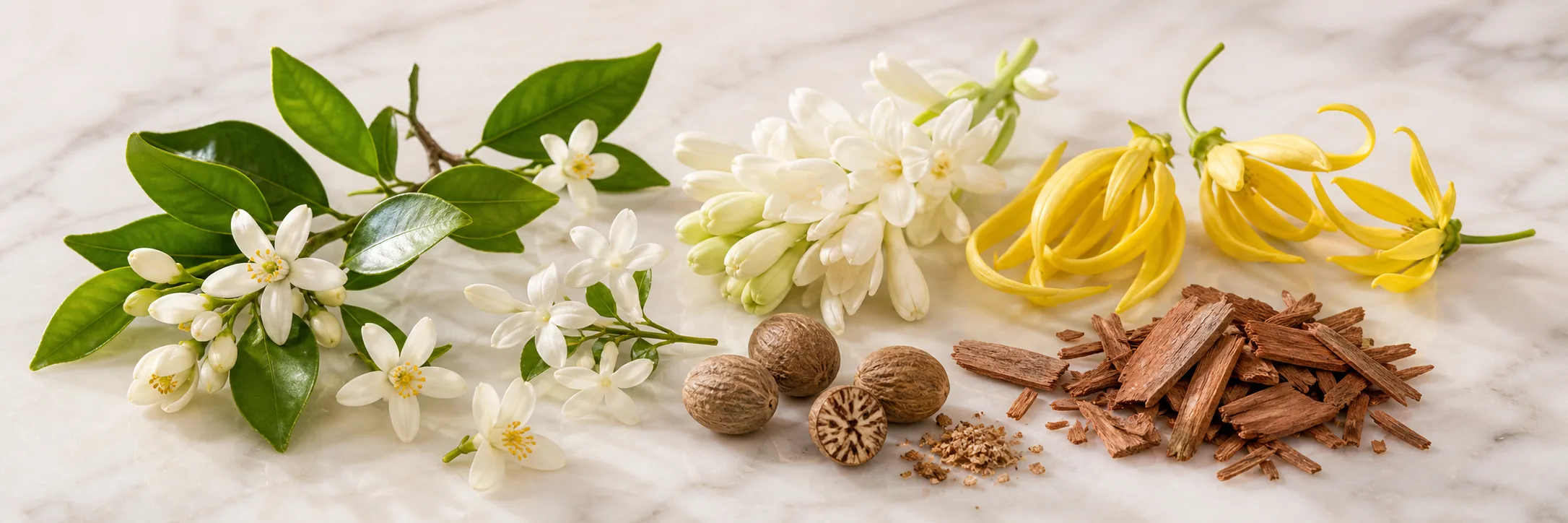
The composition opens with orange blossom fused immediately to spice - Oranger en Fleurs presents its spice immediately, fused to orange blossom, per a published review - and supported by Egyptian jasmine and Turkish rose. The house’s signature touch is Eau de Brouts (a Robertet orange-leaf/twig absolute with a sharp, green orange-blossom aroma), which keeps the floralcy from going soapy or syrupy and lends a leaves and twigs greenness. The heart adds a toothsome and chewy buttery tuberose and Comoros ylang-ylang, though reviewers note the tuberose is largely obfuscated by the wow factor of that orange and spice combo. wearers frequently report that jasmine reads as loudly as - sometimes louder than - the titular orange blossom in the early going, with the orange blossom asserting itself after an hour. The nutmeg is the signature divergence from the Lutens: where cumin in Fleurs d’Oranger is hot and human, Houbigant’s nutmeg is green and gourmand, keeping the whole thing succulent yet clean. The base is light and more musk than wood - what wood there is passes as a part of the tree, rather than being a fully fixed basenote. memorable structural observation is that the scent doesn’t develop so much as it does swell on the skin; the rose is burrowed into the orange blossom as a late bloomer. Net effect: a creamy, spiced, just-clean-enough white floral with lift and a hint of cologne in its feel.
Performance
Outstanding longevity is the consensus, paired with moderate sillage. a published review reports it lasts forever on the skin with only moderate amplitude; a fragrance blogger cites incredible tenacity (twelve hours minimum) with an assertive sillage. wearers corroborate prolonged wear, with one noting longevity and projection extend further in warm climates. The flip side, flagged by multiple wearers, is that its strength can become too much in heat - one reviewer developed nasal fatigue within a few hours wearing it in desert heat, finding it suffocating, while the same scent was much more lovely in cooler Pacific Northwest weather. Go light on the trigger.
Wearing Context
A spring and autumn floral above all, with cooler weather flattering it more than peak summer heat (despite its sunny character). a published review calls it casual and summer-appropriate; others specifically champion it as a lovely daytime autumn fragrance and a spring scent. wearers frames it as elegant, feminine and broadly wearable - even suitable for social or professional occasions, confidence-boosting yet comforting - and notably more daytime/office-friendly than the heavier, narcotic white florals because it stops a step before things get heady and narcotic. Several wearers tie it to its bridal/orange-blossom heritage. The bottle, with its plastic faux-stopper cap, drew mild criticism as under-luxe for the price point.
Comparisons & DNA
The reference point, raised by virtually every serious reviewer, is Serge Lutens Fleurs d’Oranger - formulation is that you can substitute Lutens’ cumin for nutmeg and give the composition some airiness and you have, for the most part, Oranger en Fleurs. a fragrance blogger extends it: if the thing that keeps you from committing to Serge Lutens is the cumin note, there’s a good chance that Houbigant just solved your orange blossom problem. Both noted it cleaner and lighter, though in no way is it soapy. It launched in what a published review called the summer of orange blossom, alongside L’Artisan Séville à l’aube (orange blossom + ashy lavender) and Ramon Monegal Entre Naranjos (orange blossom + powdery amber) - a useful triangulation, with Orangers en Fleurs taking the spice route. wearers also reach for comparisons to a more citrus and elevated version of Gucci Bloom, and place it against Houbigant’s own aldehydic-floral landmark Quelques Fleurs as evidence of the house’s modern repositioning. Tom Ford’s white-floral treatments come up loosely among wearers (Jasmine like TF did it).
Reception
Well-received critically and warmly regarded by orange-blossom devotees. a published review awarded it a favorable assessment stars (Suzanna: I’ve been wearing it nearly continuously, docking a point only for lack of utter originality given the Lutens resemblance). a fragrance blogger was enthusiastic, calling it a great perfume, just creamy enough, just clean enough and oh so very pretty, while wishing a scent of such incredible tenacity developed a little more. The polarization axes are mild: (1) originality - its closeness to the Lutens keeps some critics from loving it with abandon, and it’s described as a bit flatter; (2) strength in heat - beloved in cool weather, potentially suffocating in summer; (3) jasmine vs orange blossom dominance - wearers disagree on which flower leads. It reads as a critics-and-connoisseurs floral rather than a mass hit.
Versions & Reformulation
Released 2012 as an Eau de Parfum, initially exclusive to Neiman Marcus and Bergdorf Goodman in the US as part of Houbigant’s deliberately tightened, upscale relaunch strategy. It remains in the Houbigant lineup and has since been extended into additional presentations, including an Extrait de Parfum and travel formats. No major reviled reformulation surfaced in accounts; the principal historical note is the brand’s distribution and positioning shift rather than a formula change. Ingredient lists in circulation show the usual EU allergen declarations (and, in some older listings, Lyral/Lilial) consistent with the era - wearers of newer batches should expect IFRA-driven tweaks over time.
Acquisition Notes
Positioned as French haute-luxury floral. a published review cited $180/100ml at the 2012 launch; current presentations include 100ml EDP and an Extrait travel set, with extrait pricing around the $220 mark at specialist retailers. Authentic channels are Houbigant’s own boutiques/site, Les Senteurs (London), and high-end department stores. Given the strong longevity, a smaller format goes far; sampling is wise specifically because of the heat-sensitivity issue and the jasmine-forward opening that some don’t expect from an orange blossom scent. Those who own and love Fleurs d’Oranger but find its cumin difficult are the prime candidates for a full bottle.
Notable Facts & Lore
- The fragrance is steeped in Houbigant’s bridal-heritage marketing: the house notes that historic client Queen Victoria wore orange blossoms at her 1840 marriage to Prince Albert, after which Victorian brides adopted orange-blossom coronets - the orange tree being a symbol of fertility and eternal love. - Houbigant’s lineage gives the relaunch weight: the house gave perfumery the fougère family via Paul Parquet’s 1882 Fougère Royale (the first major use of a synthetic, coumarin) and the multi-floral landmark Quelques Fleurs (1912) - context the brand explicitly invoked in positioning Orangers en Fleurs as a return to form. - The composition uses Eau de Brouts, a Robertet orange-leaf/twig absolute, illustrating Houbigant’s celebration of the orange tree concept - the tree yielding orange oil (peel), orange-blossom absolute and neroli (flowers), and petitgrain and eau de brouts (leaves and twigs). - It arrived in a notable 2012 cluster of orange-blossom launches that a published review dubbed the summer of orange blossom.