Houbigant — Fougère Royale
Essence
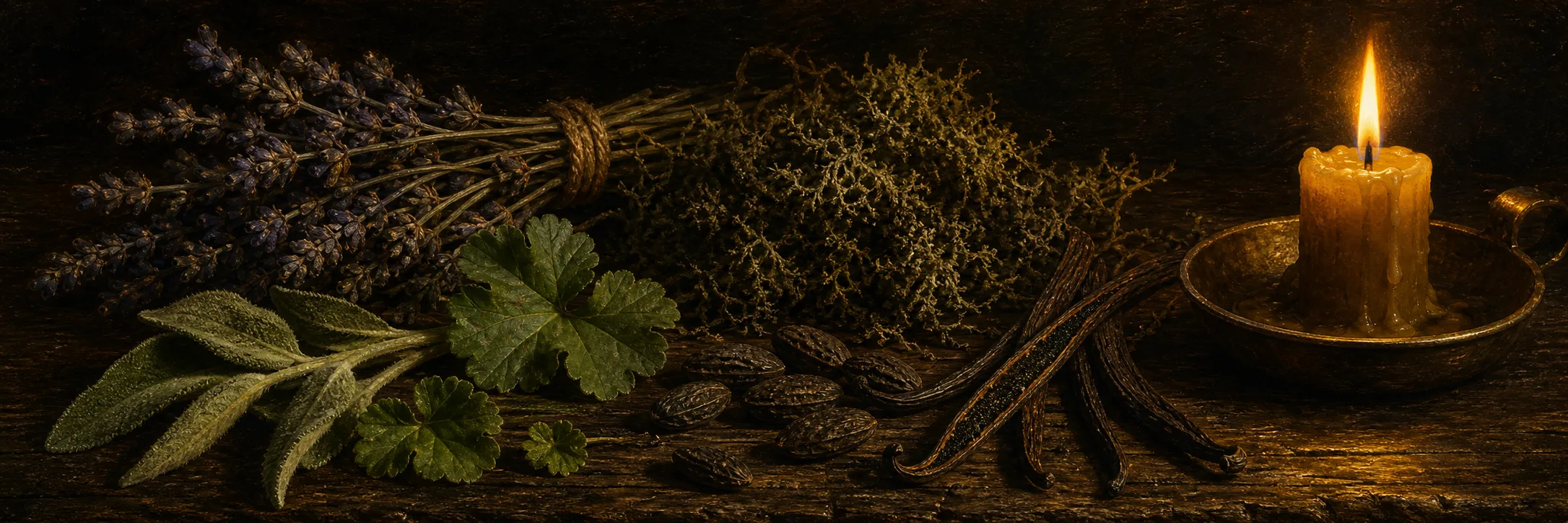
Fougère Royale (1882) is the most historically consequential fragrance in this batch: the first modern fougère, the fragrance that named and founded an entire olfactory family, and - by widespread account - the first commercial perfume to deploy a laboratory-synthesized aromachemical, coumarin. Created by Houbigant’s Paul Parquet, it married lavender, oakmoss and the hay-sweet, almond-and-tobacco facets of synthetic coumarin (a tonka-bean isolate) into an abstraction a fragrance bloggers like no single thing in nature - fougère means fern, and ferns have no scent. That conceptual leap, from perfumes that imitate a flower or a place to perfumes that compose an idea, is why critics date modern perfumery to this bottle. The original is long discontinued and now a collector’s relic; what is sold today is a 2010 re-creation overseen by Roja Dove and composed by Rodrigo Flores-Roux, which - crucially - does not attempt to clone the original but reinterprets it.
Scent Profile
Accounts of the genuine 1882/vintage material describe a dry, bracing, sprightly aromatic fougère: crisp lavender and bergamot up top; a powdery floral-herbal heart of geranium, heliotrope, carnation and rose; and a drydown built on oakmoss, tonka/coumarin, vanilla and musk, with a hay-like sweetness and a faint animalic civet warmth. Luca Turin, recounting his encounter with the perfume at the Osmothèque in his own writing (relayed by Persolaise), described it opening with a muted pianissimo of strings, giving an impression of tremendous ease and quiet power, the reference smell of scrubbed bathrooms, suggestive of black and white tiles, clean, slightly damp towels, a freshly shaven daddy - before noting a touch of natural civet lurking within. Kevin, who owned a 1950s bottle, recalled it as dry and bracing, with a wonderful harmony created by the lavender, heliotrope, oakmoss and vanilla, prizing its chutzpah. The signature accord is the foundational fougère triad - lavender + oakmoss + coumarin/hay - rendered with a powdery, civet-laced softness that Persolaise, smelling the Osmothèque reconstruction, found startlingly humane and gentle rather than the aggressive powerhouse the genre later became.
Performance
Performance data for the genuine vintage is necessarily anecdotal and degraded by age; surviving-bottle reports describe the classic structure but with diminished, short-lived top notes typical of century-old material. For the practical modern reference point - the 2010 re-creation - the consensus is average-to-below-average longevity (roughly 3-6 hours on skin in side-by-side wearers testing) and above-average-to-moderate sillage, with a soapy, citrus-forward opening that outlasts the moss. Çafleurebon summarized the 2010 version as having average longevity and above average sillage. A side-by-side wearers comparison found the vintage EdC opened on aromatic lavender with oakmoss and hay-like coumarin rising quickly from the base, lasting only about three hours, while the 2010 EdP foregrounded bergamot, lavender and cinnamon over a soapy base with the oakmoss surfacing only late. Weather behavior: as a fresh-aromatic outdoors evocation, it reads best in mild-to-warm daytime conditions; Persolaise framed the 2010 reissue as a fresh evocation of the outdoors anchored by potent citrus oils.
Wearing Context
The fragrance - in both its historic and modern forms - is coded masculine and was, in Persolaise’s reading, the very essence of masculinity for decades, though its powdery, floral, civet-touched gentleness makes it far softer than the brutalist fougères it spawned. Best worn in spring and the first warm weekends, daytime, in any setting from casual to formal; the 2010 reissue is frequently described as a refined, distinguished, barbershop-adjacent scent suitable year-round and especially flattering on older wearers. Social-perception skew: classic, elegant, noble, safely conventional. Persolaise’s most striking cultural note is that this revolutionary scent was embraced precisely because late-19th/early-20th-century society was far more willing than we are to let men get in touch with their less antagonistic sides - it is a tender masculine, not a domineering one.
Comparisons & DNA
Fougère Royale is not best understood through comparison to other fragrances but as the ancestor of an entire family - Houbigant’s own marketing and reviewers alike note that Brut by Fabergé, Paco Rabanne Pour Homme, Azzaro Pour Homme, Boss and countless drugstore aftershaves descend from its template. The most useful concrete comparison is generational: the original/vintage versus the 2010 re-creation, which by the perfumer’s own admission do not smell alike (the 2010 dispenses with the powderiness and opts for a far more floral approach, per Persolaise). For period traditional fougères that approximate the old-school character, reviewer Mark Behnke cited the best fougeres I owned; Penhaligon’s English Fern and Trumper’s Wild Fern as the references he reacquainted himself with before testing. wearer comparisons for the 2010 version reach toward Roja Dove’s own Scandal and, more loosely, modern barbershop-fresh masculines - but these are descendants and cousins, not models.
Reception
Reception splits cleanly between the historical artifact and the 2010 reissue. The original is treated with near-universal reverence as a landmark; collectors warn against opening surviving bottles. The 2010 re-creation is genuinely polarizing. Çafleurebon praised it as a spectacular example of how to succeed at re-formulating a classic and one of the best releases of 2010, crediting the Dove/Flores-Roux pairing. Persolaise admired the simple, expensive approach (Robertet naturals, Givaudan synthetics, emphasis shifted to the floral middle). But Kevin, who knew the vintage intimately, was unconvinced: he found the 2010 respectable and well-made but ultimately unnecessary, and a bit opportunistic, concluding the genre had been duplicated so often and so well that a new expensive version filled no need - advising nostalgics to sniff before you buy. The major polarization axis is expectation: those expecting a faithful resurrection of 1882 were disappointed, while those judging it as a new aromatic fougère on its own terms rate it highly. Blind-buy verdict for the modern bottle: safe for lovers of refined, classical, barbershop-fresh masculines; sample-first for anyone chasing the genuine vintage character, which it does not reproduce.
Versions & Reformulation
This is the rare entry where versioning is the central story. (1) The original 1882 Parquet composition (the catalog subject): Persolaise reports, via Osmothèque staff, that it likely first appeared circa 1883 as a soap with the bottled scent emerging around 1884, and that it did not achieve real popularity until the second decade of the 20th century; this is discontinued, surviving only as vintage bottles and the Osmothèque’s archival reconstruction. (2) The 2010 relaunch, composed by Rodrigo Flores-Roux of Givaudan under Roja Dove’s creative direction - an explicitly modern reinterpretation, not a clone, in a Lalique-inspired flacon; listed notes include bergamot, Mediterranean herbs, lavender, chamomile, a Rondeletia floral-spicy accord, geranium, Rose de Mai, carnation, cinnamon, oakmoss, patchouli, tonka and clary sage. (3) Subsequent concentration variants within the modern Collection Royale: an EDP (historically ~$170/100 ml), a limited pur parfum presentation, plus later Eau de Parfum Extrême and Extrait de Parfum tiers. The coumarin overdose that made it historically pivotal is variously cited at roughly 10% of the formula (one secondary source) up to a claimed 50% overdose - the latter relayed by Flores-Roux via Çafleurebon, who noted Some sources state that it was used in an overdose of 50% of the total formula - figures best treated as approximate industry lore rather than verified formula data. Beware: bottles of H Pour Homme are reportedly passed off as Fougère Royale in secondhand listings and are not the original.
Acquisition Notes
The currently purchasable product is the modern Houbigant Collection Royale Fougère Royale, sold through Houbigant directly and authorized niche retailers such as Les Senteurs, in 100 ml EDP and higher-concentration (Extrême, Extrait) tiers; the modern line is marketed by Perris Group. Sampling is strongly advised given the vintage-vs-2010 gulf.
Notable Facts & Lore
- The defining fact is its primacy: Fougère Royale is traditionally considered to be the first fragrance to use a synthetically produced ingredient (coumarin), in Flores-Roux’s words, and the founding object of the fougère family - the first perfume not trying to recreate a scent of nature, but creating an abstract idea.
- Luca Turin’s celebrated description of smelling it at the Osmothèque (the perfume museum at Versailles) - the freshly shaven daddy and hidden civet passage - is the most-quoted critical appraisal and helped cement its mythos among enthusiasts.
- Persolaise’s broader cultural reading is part of the lore: that a non-literal, abstract masculine was embraced as passionately as it was speaks to a late-Victorian openness, and that its later coarsening into aggressive powerhouse fougères represents a cultural loss.
- The 2010 relaunch added its own modern lore: Flores-Roux has called the commission a one-in-a-lifetime gift and, a decade on, reported family members still asking him for refills.