Houbigant — Chantilly
Essence
Chantilly is a mid-century classic that refuses a single lane, reading as floral oriental, soft chypre, powdery lace and warm balsamic all at once. The vintage Houbigant version is consistently described as richer, smoother and more structurally interesting than the later Dana continuation, opening on bright citrus and flowers over a creamy, woody, moss-tinged base that feels elegant rather than bombastic.
Scent Profile
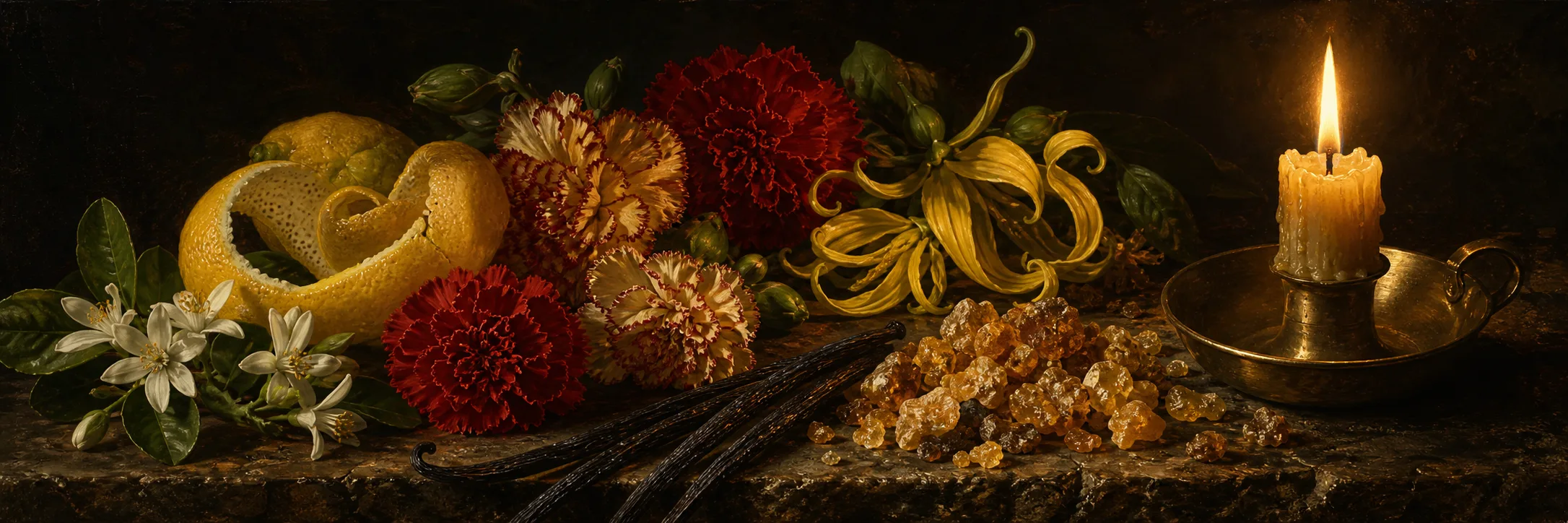
The vintage Houbigant profile opens with lemon, bergamot, neroli and a fruity brightness, a fresh and warm entrance that sets up the rest of the composition.
The real signature is the transition into a white-spiced floral heart, where carnation, orange blossom and ylang-ylang lend a powdered, clove-like sheen rather than a lush bouquet. This powdery-floral character holds for a long stretch and is the part most wearers remember.
Beneath it sits a silky sandalwood-vanilla-benzoin base, with oakmoss and tonka giving a darker undertow that only fully reveals its chypre-like shadow late in the wear. Modern commentary suggests that leather can be overstated in some note lists, since many vintage wearers barely perceive it.
Performance
Performance is solid but not enormous, in keeping with a vintage classic. The eau de toilette tends to draw moderately favorable longevity marks and slightly softer sillage, and detailed reviewers describe projection, sillage and longevity as middling-to-good rather than overpowering. Older commentary notes the scent does not last especially long despite the quality of its drydown, so expect moderate wear, with bottle age and storage affecting individual vintage examples.
Wearing Context
Chantilly sits most naturally in autumn and winter, though not because it is heavy: it is warm, powdery and composed enough to wear year-round if you enjoy vintage profiles. It is often called suitable for virtually any venue and non-offensive despite its age, with imagery closer to bridal powder, velvet curtains and old formal femininity than to nightlife glamour. In modern social terms it reads elegant, nostalgic and unmistakably dressed rather than casual or contemporary-clean.
Comparisons & DNA
The most useful references are Guerlain Shalimar, Dana Tabu and Youth-Dew, the broad pre-gourmand amber register Chantilly belongs to. Against Shalimar it is softer, creamier and more floral-powdered, without the tarry or leathery aggression; against Tabu and Youth-Dew it is far less punishing and dark. Vintage writing also places it in the Emeraude-Shalimar family but with reduced resinous heft and a greater sense of white powder, carnation and orange blossom, which is the cleanest way to picture its DNA.
Reception
Among those who actively chase old bottles, the vintage Houbigant version reads as an underappreciated classic, holding a strong and broadly favorable standing across many opinions and earning descriptions like an antique gem and a beautiful, warm, feminine classic, with several singling out its base. The main criticism is not that the original is crude but that it is unmistakably old-fashioned, and that the later Dana continuation has blurred the name’s reputation by smelling thinner, cheaper and less spiced. As a blind buy it is only safe for someone who actively wants a powdery floral-oriental vintage with citrus lift; anyone expecting a contemporary vanilla floral should pass.
Versions & Reformulation
Chantilly is very much a versions story. Houbigant produced it from 1941 to 1989, followed by Parquet Parfums from 1989 to 1993, then Renaissance Cosmetics and Dana from 1993 to 1999, with Dana continuing the name from 1999 onward. It also appeared in many concentrations and formats, from parfum and eau de toilette to powders, soaps and solid compacts, across several bottle designs. Consensus is strong that vintage Houbigant and later Dana are meaningfully different scent experiences rather than minor batch variations.
Acquisition Notes
For the catalog fragrance, the discontinued Houbigant EDT, the real market is vintage and secondary-market hunting. Chantilly is described as the easiest Houbigant perfume to find, and older Houbigant bottles still turn up relatively readily; those are the ones to prioritize for the original warm-spiced, sandalwood-vanilla, mossy structure rather than the Dana continuation. Acquisition is mostly about learning bottle eras and buying from reputable vintage sellers, since no reliable counterfeit or batch-code decoding guidance surfaced.
Notable Facts & Lore
- It was launched in 1941 by Marcel Billot and named after Chantilly lace.
- It was heavily advertised across decades and sold in enough forms and bottle designs to become a cross-generational object rather than a single perfume.
- Archival material shows its image shifting over time, from polished romantic femininity to more intimate, body-adjacent advertising.
- The vintage Houbigant version and the later Dana continuation are widely treated as meaningfully different fragrances.
- Its signature powder-over-velvet-curtains aura is still recognized instantly by vintage enthusiasts.