Houbigant — Fougère Royale (2010)
Essence
Fougere Royale (2010) is Houbigant’s high-budget reinterpretation of the 1882 Paul Parquet original, the fragrance universally credited as the first true fougere and the birth of modern perfumery through the first commercial use of synthetic coumarin. The 2010 release is not a faithful restoration but a re-mastering: perfumer Rodrigo Flores-Roux of Givaudan, overseen by creative director Roja Dove, rebuilt the lavender-oakmoss-coumarin skeleton with IFRA-compliant materials and pushed the floral-spicy heart forward. The result is a polished, slightly old-fashioned barbershop aromatic fougere that carries enormous historical weight, and a name that, by critical consensus, sets expectations the juice cannot fully meet.
Scent Profile
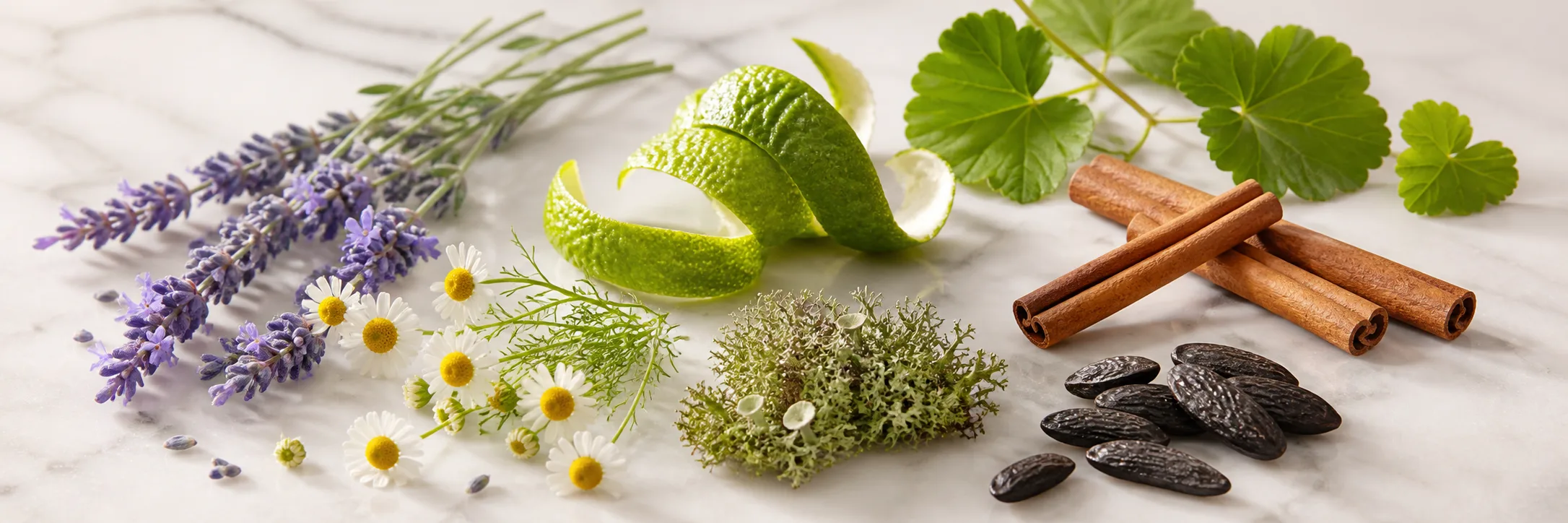
The opening is the most praised phase: a bright, almost lemon-squeezed bergamot burst over aromatic Mediterranean herbs, with lavender and a notably prominent Moroccan chamomile setting the tempo. Several critics single out the chamomile as the signature, lending a green, herbal-tea, almost woodruff quality that sets it apart from generic barbershop fougeres. The heart turns floral-spicy. Geranium leads, with reviewers noting a heavy dose of its rosy facet, supported by rose, carnation and lilac, and a cinnamon that some find pushes too far forward in the first hour. The drydown resolves the fougere structure into warmth: a restrained oakmoss, much reduced from the vintage by IFRA, joined by patchouli, amber and a sweetish coumarinic glow from tonka and clary sage. The blending is seamless to the point of having no rough edges, with the base presenting a unified warmth rather than distinct notes. Two recurring criticisms are a faux-orange sweetness some find cheapening, and a clean, soapy modern facet, akin to the shampoo accord of Cool Water and Green Irish Tweed, that a minority dislike.
Performance
Performance is the most divisive practical issue, and reports genuinely contradict one another, likely a function of batch, concentration and skin chemistry. A large faction finds longevity disappointing, sometimes around five hours, sometimes a gorgeous opening that collapses to a powdery wood within the hour. A countervailing faction reports the opposite, with the scent still audible the morning after a heavy application. The honest synthesis is that sillage runs intimate to moderate, the bright top is fleeting, and longevity is highly variable but trends moderate at roughly four to seven hours for most wearers, with the EDP outperforming the discontinued vintage cologne. The Extrait runs woodier and spicier but is not meaningfully stronger. It is best in mild weather, reading well from spring through fall.
Wearing Context
Fougere Royale is versatile but distinctly grown-up, repeatedly described as elegant, classy and distinguished, the signature of a put-together adult man and often pitched as ideal from the 40s upward, though younger wearers adopt it freely. It reads conservative and unambiguously masculine, a deliberate nod to the era when men’s scents could not be mistaken for ladies’ perfume, yet its floral-forward heart gives it a Parisian-dandy refinement some find intriguing on women. The bright citrus-herbal opening and moderate sillage make it office-safe and daytime-friendly, while the warm mossy-ambery drydown extends it to cooler evenings and formal occasions. It is a refined daily signature or a collector’s reference piece rather than a club or compliment-chasing scent.
Comparisons & DNA
As the genre’s archetype, Fougere Royale invites comparison in two directions. Against vintage barbershop fougeres such as Penhaligon’s English Fern and Geo F Trumper Wild Fern it is smoother and more wearable but less coumarin-saturated and mossy, reading markedly cleaner and more floral. Persolaise framed it against the other major 2010 fougere event, Penhaligon’s Sartorial, casting Sartorial as the more daring deconstruction and Fougere Royale as the straightforwardly classical statement. Against the canonical Azzaro Pour Homme and YSL Rive Gauche Pour Homme, built on the same lavender-coumarin-moss spine, it is more floral, more expensive-smelling and less hairy-chested. In the modern era it is read as a more traditional cousin to barbershop-adjacent scents like Dior Sauvage Elixir, while Amouage Bracken Man is cited as the more photorealistic fern.
Reception
Reception splits cleanly between a high historical-and-quality verdict and a skeptical does-it-earn-the-name verdict. Mark Behnke was the most enthusiastic, calling it a spectacular example of how to re-formulate a classic and one of the best releases of 2010. Persolaise was positively impressed, praising its calm, cultured, simple-and-expensive approach with an emphasis on the heart rather than the dad’s-aftershave drydown. Kevin at Now Smell This was the notable skeptic, judging it respectable and well-made but ultimately unnecessary and a bit opportunistic given how often the fougere has been duplicated, advising wearers to sniff before buying. Broader reception averages positive-to-mixed. Praise centers on the blending, the chamomile-herbal opening and the historical gravitas; criticism centers on performance, excess sweetness, and the gap between a legendary name and a juice some find generic. On value, the niche-luxury price combined with the performance lottery is the chief sticking point, which is why the prevailing advice is to sample first.
Versions & Reformulation
This release is itself a reformulation, the 2010 re-mastering of the 1882 original, which had been discontinued and revived several times across the 20th century. Within the 2010 line there are several concentrations: the standard Eau de Parfum used as the catalog reference, an Extrait that runs woodier and spicier with a clearer wood structure though not stronger in projection, and an early limited pur parfum in a lacquered wooden box. Reviewers note minor drift across batches over the years. The vintage cologne and aftershave formulations are a genuinely different, more moss-and-coumarin-driven experience, prized but extremely rare.
Acquisition Notes
Fougere Royale sits in the niche-luxury tier, with the 100 ml EDP listing around the $170 mark at launch and the limited pur parfum far higher; it is now marketed by Perris Group and sold through legitimate niche retailers, with the Extrait positioned well above the EDP. The weighty Lalique-inspired flacon is widely praised as a collector object. Decants and samples are readily available and recommended as the entry point given the performance variability. The main acquisition pitfall is vintage-market confusion, where buyers seeking the original are frequently sold an unrelated H Pour Homme or various mid-century reformulations, so vintage purchases require care.
Notable Facts & Lore
- The 1882 original is credited as the first fragrance to use synthetic coumarin, making it the conventional first modern perfume and the origin of the fougere family.
- The famous and likely apocryphal Paul Parquet line, that ferns would smell like Fougere Royale if God gave them a scent, is endlessly repeated.
- Guy de Maupassant reportedly said the original reminded him not of flowers but of the greenery of forests, a description that sits oddly with the floral-forward 2010 version.
- The original is preserved at the Osmotheque in Versailles, where Luca Turin memorably described it as the reference smell of scrubbed bathrooms with a faint shock of intimacy.
- The 2010 reissue paired creative director Roja Dove with Givaudan’s Rodrigo Flores-Roux as a deliberate move to reposition Houbigant into the luxe-niche era.