Comme des Garcons — Avignon
Essence
Avignon is the reference Catholic-church incense fragrance: a near-photographic rendering of a Gothic cathedral’s interior - frankincense and myrrh smoke, cold stone, beeswax, the dusty hush of pews that have absorbed centuries of liturgy. Part of Comme des Garcons’ 2002 “Series 3: Incense” (the Catholicism entry, paired with cities representing five faiths), it is conceptual perfumery that reads as devotional realism. More than two decades on it remains the yardstick against which every “smells like a church” scent is measured.
Scent Profile
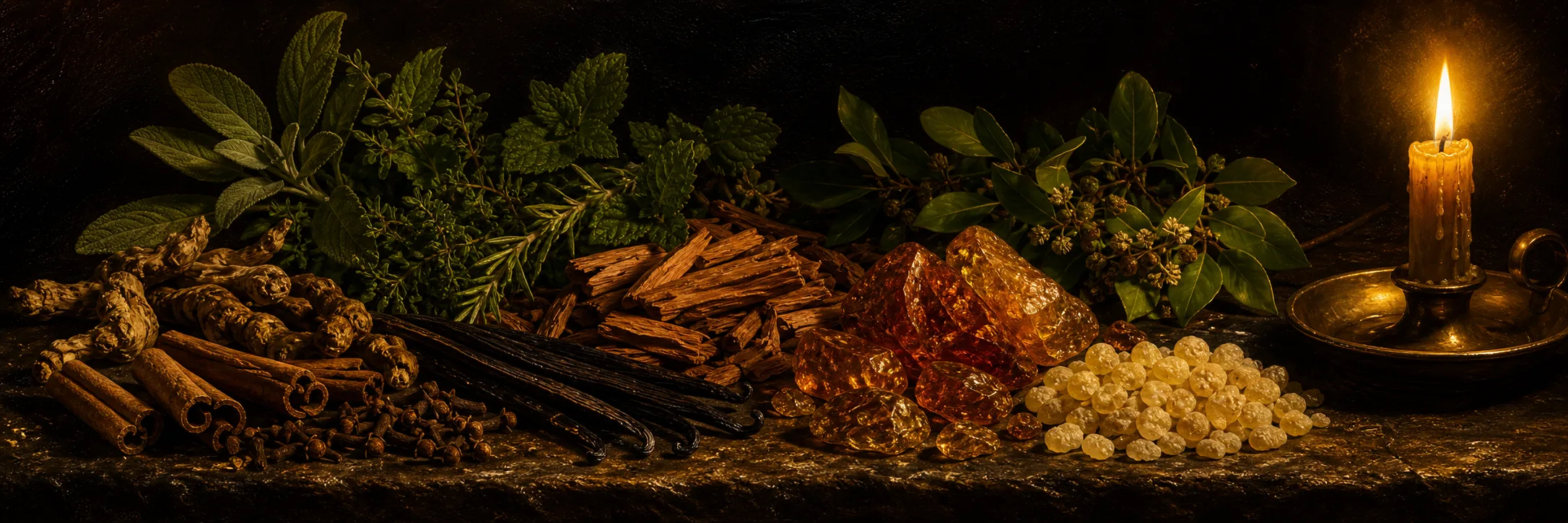
The opening is a cold, resinous blast: frankincense (olibanum) and myrrh arriving almost simultaneously, lifted by a spiky, coniferous aldehyde C-12 and the lemony-peppery sparkle of elemi. For the first ten to twenty minutes it reads dark, balsamic and slightly eye-smarting - the immediate impression of a censer being swung. The listed Roman chamomile is genuinely perceptible and important: a honeyed, faintly bitter yellow-floral thread that runs through and keeps the smoke from turning purely funereal. Cistus/labdanum supplies a leathery, sun-warmed-shrub facet that many reviewers read as the “damp old stone” or mineral coolness of the composition. Into the heart (one to three hours) the sharp top recedes and the resins settle into a rounder, smoky-sweet core. The frankincense remains the dominant character throughout - this is a fragrance built around a single overwhelming idea - but patchouli and the woody palisander (rosewood) base begin to ground it, lending a dry antique-wood facet. Vanilla is present only as an edge-softener, a faint sweetness on the periphery rather than a gourmand statement. The ambrette/musk in the base is subtle and vegetal, contributing a mild animalic warmth.
Performance
Projection is light-to-moderate - Avignon is atmospheric rather than loud, forming a quiet aura of roughly an arm’s length rather than filling a room. Sillage is modest; consensus is that it stays fairly close after the first hour. Longevity reports vary by skin: many cite a solid all-day presence as a skin scent, while a minority report below-average 5 - 6 hours. On clothing and in hair it lasts considerably longer and is a common application trick (spraying into hair is reported by users). It performs best applied generously.
Wearing Context
Avignon shines in autumn and winter, in cold weather, and at quiet or contemplative moments - evening, cool grey days, indoor settings where its meditative character can be appreciated. It is genuinely tied to occasion for many wearers, who treat it as something applied deliberately rather than casually. It works beautifully for those who want a solemn, intellectual, anti-mainstream signature. Where it falls flat: hot crowded environments, office settings where the overt “church” association can feel out of place, and anyone expecting compliments or a crowd-pleaser - this is a love-it-or-hate-it, deeply polarizing scent. Several reviewers note it can feel “too much and not enough” - overwhelming in its incense yet austere - and recommend never blind-buying.
Comparisons & DNA
Avignon sits at the center of a tight cluster of church-incense references, and the wearers endlessly cross-compares them. Heeley Cardinal is the most cited alternative: lighter, brighter, more lemony and “polite,” reading as a modern church versus Avignon’s Gothic cathedral; many find Cardinal smoother and more wearable. Montale Full Incense is described as roughly in between Avignon and Cardinal, sweeter and reportedly the better performer of the trio. Giorgio Armani Prive Bois d’Encens is warmer and more peppery-woody, a drier “ashy thurible” rather than Avignon’s resinous sweetness, but far pricier with limited projection. Within CdG’s own Series 3, Zagorsk (pine/birch, Orthodox) and Kyoto (drier, Japanese-temple) are siblings; some find Zagorsk even more literally church-like. Other relatives named by enthusiasts: CdG 2 Man (incense plus snuffed candles), Etro Messe de Minuit, Jovoy La Liturgie des Heures, L’Artisan Passage d’Enfer, and Filippo Sorcinelli LAVS.
Reception
Avignon enjoys near-universal critical acclaim as the benchmark church-incense scent. On wearers it is praised as a “timeless masterpiece” and “the reference incense,” with the chamomile/vanilla drydown singled out for keeping it airy. Common criticisms are entirely about wearability and performance: too literal, too “churchy,” low sillage, and divisive (one wearer discussion reviewer called it “a parody of church incense”; another evoked “a freshly opened Pharaoh’s crypt”). The axis of polarization is association - those with Catholic childhoods tend to love it, others find it gloomy. critics are strongly positive: Victoria Frolova at Bois de Jasmin wrote that “the fragrance opens up with a surge of myrrh and frankincense - dark, balsamic, somber, with an underlying resinous sweetness… I can almost hear the Gregorian chant.” critical coverage’s coverage noted it “starts dark, gloomy, and rather strong, approximating the immediate effect of a priest swinging the censer during prayers.” Sampling guidance: not recommended blind - sample first, because the genre and intensity are exactly what divide people, but for incense lovers it is close to essential.
Versions & Reformulation
Avignon is sold as an Eau de Toilette (the only concentration), part of the Series 3: Incense five-bottle set, typically in 50 ml. No officially documented major reformulation exists, though the Series has been in continuous production for over two decades (rumors of discontinuation around 2008 were explicitly denied by the brand via Luckyscent). Long-term wearers occasionally remark on batch variation, but there is no widely confirmed reformulation event. Treat it as essentially a single ongoing composition.
Acquisition Notes
Avignon is priced in the accessible-niche level - among the more affordable serious niche incenses, typically sold in a 50 ml EDT. It is widely carried by Luckyscent and CdG stockists, and the decant ecosystem covers it well: Surrender to Chance and other splitters carry it, making sampling easy and advisable given its polarizing nature. Counterfeiting is far less of an issue here than with high-demand designer blockbusters, but “inspired-by” clones circulate from clone houses and are reported to underperform badly. Buy from CdG boutiques, Luckyscent, Dover Street Market, or established niche retailers for authenticity. The whole Series 3 set is worth sampling together to understand Avignon’s place in it.
Notable Facts & Lore
- The Series 3: Incense concept assigned each fragrance to a world faith and a city: Avignon for Catholicism (the southern French city that was the seat of the papacy 1309 - 1377), alongside Ouarzazate (Islam), Zagorsk (Orthodox Christianity), Jaisalmer (Hinduism) and Kyoto (Buddhism/Shintoism).
- Avignon is the most beloved of the five.
- A documented authorship discrepancy persists: the catalog and most databases credit Bertrand Duchaufour, and Duchaufour’s own biographical profiles list Avignon among his signature incense works (alongside Timbuktu, Dzongkha and Amouage Jubilation XXV); however, critical coverage’s 2006 coverage published an update stating Avignon “was developed by perfumer Mark Buxton” (Buxton being the nose behind CdG’s foundational releases).
- The wearers remains split on attribution.
- Per critical coverage (January 9, 2006), fashion designer Matthew Williamson stated in an interview that his favorite scent was Avignon, before the launch of his own eponymous fragrance.
- The scent is a perennial fixture on “smells like a church” recommendation threads and is frequently cited as the gateway drug into incense perfumery and into niche fragrance generally.