Comme des Garçons — Comme des Garcons Series 3 Incense: Kyoto
Essence
Kyoto (2002) is one of the five fragrances in Bertrand Duchaufour’s landmark Series 3: Incense, each devoted to a spiritual tradition and named for a city - Avignon (Catholicism), Zagorsk (Orthodox Christianity), Jaisalmer (Hinduism), Ouarzazate (Islam) and Kyoto (Buddhism and Shintoism). Where Avignon recreates the smoky chill of a Catholic cathedral, Kyoto is the airy, meditative, evergreen-and-incense counterpart - “calm and wise,” in the house’s framing, evoking the temples and cypress forests of Japan. It is a foundational work in Duchaufour’s career: critic coverage traces the perfumer’s entire incense evolution back to this 2002 pair, calling Kyoto “a Japanese minimalist aesthetic. Clean woods matched with the sweeter resins make for a truly meditative harmonious, soothing incense accord,” and identifying it as the seed from which his later masterworks (Timbuktu, Dzongkha, Amouage Jubilation XXV) grew.
Scent Profile
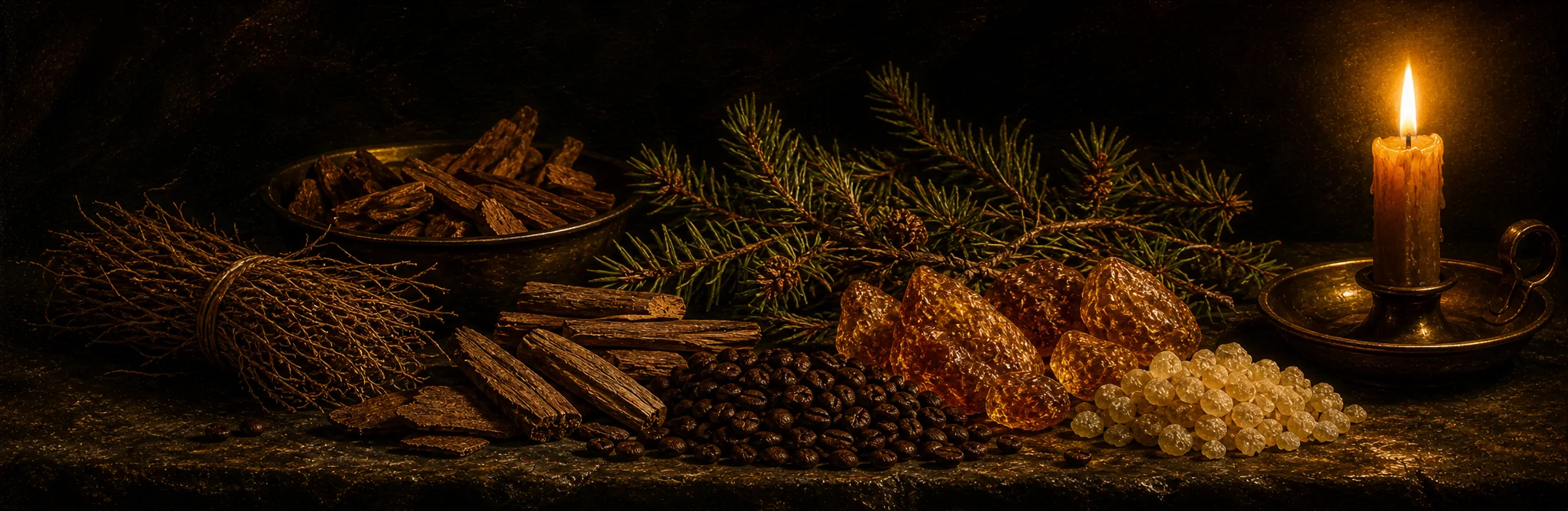
Kyoto opens with fresh, green, aromatic cypress that places you among evergreens, joined by dry teak and cedar. The incense here is the key distinction from Avignon: it is subtle, smoke-free or barely smoky, reading - as one widely-shared wearer discussion review put it - like “crushed sticks of unburned incense” rather than a lit thurible, or like fine Japanese kodo incense heated rather than burned. Bois de Jasmin’s Victoria Frolova described Duchaufour’s central conceit precisely: “In Kyoto, Duchaufour chose to explore the contrast between the woods and incense by searing them with a toasty, nutty coffee. At first, it smells cool and smooth… One moment the fragrance smells like cedarwood shavings, and the next you distinctly smell the smoky, peppery darkness of incense, as if someone waved a burning joss stick around you.” The listed coffee is faint-to-undetectable for most wearers (many report “no detectable coffee”); immortelle adds a thread of yellow, hay-like warmth, and vetiver and patchouli ground the base. The drydown is a clean, sometimes soapy amber over dry wood. Several reviewers note a heavy hand of Iso E Super giving the misty, airy, hard-to-place persistence.
Performance
Modest, as befits an austere EDT - and a common complaint. Reports range widely: some find “good staying power and fairly big sillage,” but the more frequent verdict is soft sillage and short longevity, with one wearers reviewer of a 2022 bottle reporting “skin scent in 30min; gone in 60min,” and a 2025 retail buyer noting “virtually zero sillage” and inability to smell it after 30 - 60 minutes. It performs best on fabric - multiple wearers spritz a scarf and report it lasting well there. Expect a soft, close, meditative presence rather than projection.
Wearing Context
Fall and cooler months, daytime, contemplative settings. The wearers descriptors are remarkably consistent: meditative, serene, grounding, “bottled meditation/mindfulness,” a “pleasant short forest walk.” It is genuinely unisex - “omnisex, or perhaps even asexual,” as one wearer discussion reviewer put it - and reads as calm and refined rather than loud or seductive. Ideal for those who want incense without churchy heaviness; explicitly recommended as an entry-level incense for people who like clean freshies and florals but want to branch out.
Comparisons & DNA
The defining comparison is internal: Kyoto vs. Avignon, the eternal Series 3 debate. The consensus is that Kyoto is the more wearable, woody, “sunnier” and lighter-hearted of the two, where Avignon is the purer, smokier, more “in the dark” frankincense bomb. Duchaufour built them on what one wearers reviewer noted is “an identical structure,” differentiated by treatment. Beyond the series, the most cited external comparisons are to Lalique Encre Noire and Azzaro Visit pour Homme - Kyoto being “like a slightly more restrained version of Encre Noir,” with the shared Iso E / vetiver woodiness - and Diptyque Tam Dao for clean woods. Persolaise’s wearers-quoted framing places it among “the Duchaufour-Buxton style of 2000s-era minimalist incenses.” Critics have also bracketed it with Armani Prive Bois d’Encens and (for a milkier take) Parfumerie Generale Cadjmere.
Reception
Critically and popularly esteemed, with a notable strain of “it’s good but not Kyotoan” revisionism. Bois de Jasmin’s Frolova names it among her personal favorite incense fragrances and calls the whole series “worth exploring,” singling Kyoto out for “its contrasted quality.” critical coverage’s Robin lists it among her beloved older CdG incenses (alongside Avignon and Ouarzazate). Within the wearers it has passionate devotees (“possibly my favourite scent of all time”). The recurring critiques are two: that it doesn’t actually smell like Japanese temple incense (several Japan-familiar reviewers insist there’s “nothing ‘Kyoto’… about the smell”), and that the clean, soapy amber base plus weak performance undercut the mood.
Versions & Reformulation
Kyoto has been in continuous production since 2002 as a 50ml (and historically other sizes) EDT, now marketed by Puig. wearers comparing older and newer bottles report the recent formulation reads cleaner, soapier and weaker, with some lamenting that “it doesn’t smell like incense at all” anymore and wishing for a return to the older, more incense-forward profile - informal reformulation chatter rather than documented fact, but consistent enough across reviews to mark. The note listing has also been standardized over the years (CdG at one point changed all Series 3 entries to simply say “incense”).
Acquisition Notes
Readily available through CdG stockists and niche retailers - Luckyscent lists the 50ml EDT at $125, and it has been stocked closer to $105/50ml elsewhere. It is the easiest of this batch to acquire and among the most affordable serious incense fragrances. Given the modest performance and the older-vs-newer formulation debate, sampling is sensible if you specifically want a smoky incense - and if you do, Avignon may suit you better. For a clean, meditative, evergreen incense, Kyoto remains a benchmark. Buying a backup of an older batch is the move only for those who already know they prefer the vintage profile.
Notable Facts & Lore
- Kyoto’s lore is inseparable from the Series 3 concept - five cities, five faiths, one note - which remains one of the most admired thematic projects in modern perfumery and helped establish both incense-as-genre and Duchaufour’s reputation.
- A frequently repeated observation, raised by an analytical wearers reviewer, is that CdG kept the incense material “intentionally vague” for Kyoto (unlike Avignon’s explicit olibanum), with the reviewer suspecting the real Kyotoan signature - oud, ubiquitous in Japanese temple incense - is precisely what’s missing.
- framing is the most durable piece of critical lore: Kyoto and Avignon together were “the foundation of where M.
- Duchaufour would start to refine the accord,“ making this quiet, short-lived little EDT a genuine historical hinge point.