Comme des Garçons — Comme des Garcons Series 1 Leaves: Calamus
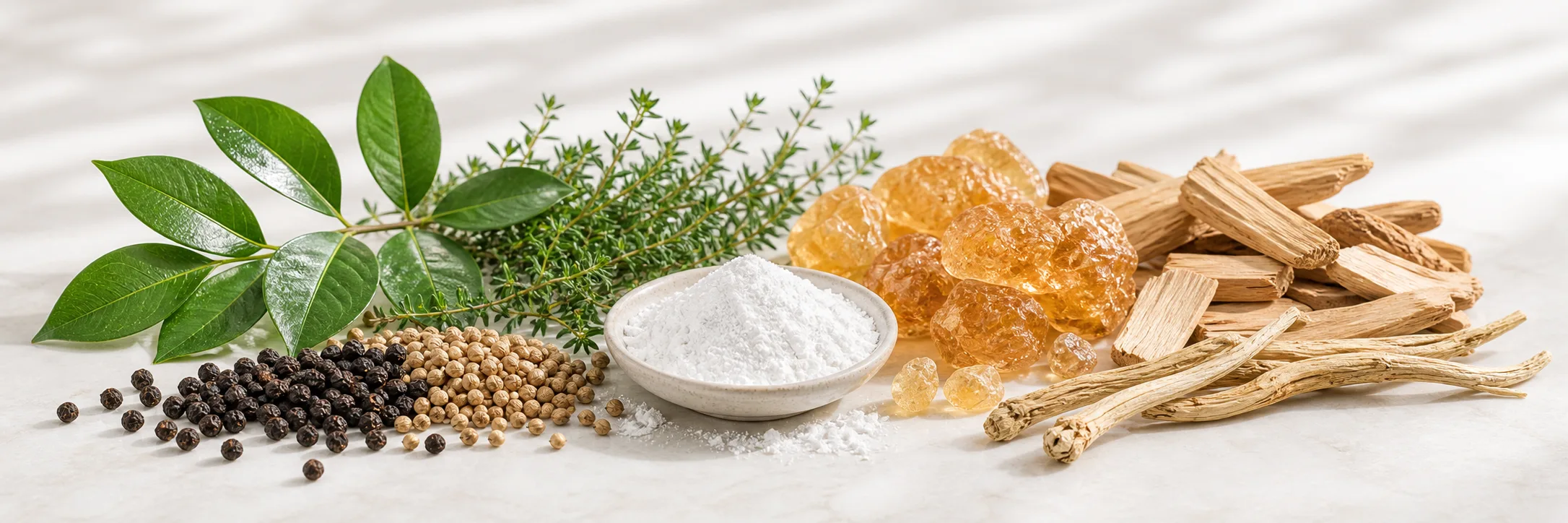
Essence
Calamus is one of five eaux de toilette in Comme des Garcons’ debut fragrance series, Series 1: Leaves (2000), built on the brand’s concept of “The Seven Sensations” and the idea of green. It is an unconventional, naturalistic-yet-synthetic green fragrance evoking damp marsh reeds, young bamboo and celery, named for the sweet flag plant Acorus calamus. It is widely regarded as a green fragrance for people who do not normally like green scents: light, milky and strange rather than the sharp galbanum-green of classic chypres. It is discontinued in its original form, though reissued in 2017.
Scent Profile
The catalog lists Calamus’s materials only as a base accord, but in practice this is a near-linear, lightly evolving composition rather than a classic pyramid. The most consistent description is of a green enveloped in a noticeably milky, slightly sappy accord that reads as damp leaves, grass and bamboo rather than citrus or moss. The opening shows a fresh, realistic green and cucumber facet.
The celery seed is the strong, polarizing signature, and once noticed it is hard to ignore. One frequently cited description captures the oddness perfectly: “It’s naturalistic, but doesn’t smell like anything in nature. It’s chemical, but still smells like something alive,” with impressions of broken aloe vera, hot plastic, and a faint living, almost sweaty human note. The effect is the milky-green bamboo and celery reed accord that defines the scent.
The drydown is soft, powdery, milky and faintly sweet, with several wearers noting a plasterboard or wet-stone mineral facet and a few reading a soapy-musky, mildly floral water-lily quality. Linearity is high throughout, and the overall impression stays quiet and close rather than developing in dramatic stages.
Performance
This is a light, low-projection, intimate fragrance, in keeping with the modest performance of the Series scents generally. Many wearers wish it lasted longer or projected more strongly, while a minority report good longevity with moderate projection. The honest reading is to expect a close-to-skin wear of a few hours; apply generously and do not expect a room-filling sillage. It rewards anyone who treats softness as part of its meditative character rather than a flaw.
Wearing Context
Calamus is at its best as a warm-weather, daytime, casual green, repeatedly tied to spring and summer mornings, fresh reeds on a lake, and a clean tropical breeze. It is easily unisex, reads clean and natural, and is often called office-appropriate precisely because it is quiet and inoffensive. It would feel wrong anywhere a statement or strong projection is wanted, and its strangeness, the celery and plastic-like facets, can misfire on some skin, occasionally collapsing into a powdery sweetness with little of the leaf left. It is a low-key scent for tuning into your own surroundings rather than a crowd-pleaser or a seduction fragrance.
Comparisons & DNA
Within its own family, Calamus is most often anchored against other CdG greens and against L’Artisan Parfumeur Premier Figuier, which one wearer found strikingly similar through the shared milky-green, sappy quality. CdG Concrete comes up for the mineral, plaster-like facet that the two share. Profumum Roma Victrix is cited as a kindred green favorite by those who love this register. For anyone trying to understand the effect from a single material, violet leaf absolute is offered as the closest starting point, with the caveat that Calamus is much milder, sweeter and drier. There is no designer clone or dupe; it is a singular, niche-conceptual scent that smells like nothing else.
Reception
Consensus admires Calamus as original, naturalistic and Zen-like, with a devoted minority who name it a favorite and the first CdG fragrance they truly liked. Common praise centers on its uniqueness, realism, easy wearability and true-green character. Common criticism centers on weak performance and a celery, plastic, almost pencil-sharpener oddness that some find off-putting or that turns powdery and sweet on certain skin. The real axis of polarization is simply whether the strange milky-green-celery effect reads as fascinating or merely odd; even ambivalent wearers admit to sniffing it compulsively because it is so intriguing, regardless of whether they think it smells good. Because it is discontinued and pricey on the secondary market, it is hard to recommend as a blind buy without a sample, and it is best understood as a connoisseur’s curiosity.
Versions & Reformulation
Originally launched in 2000 as part of Series 1: Leaves, Calamus was later among the long-discontinued scents that CDG Parfum brought back in 2017, with the composition reportedly intact but the packaging given a new look, sometimes referenced as part of the Olfactory Library. As a result, two physical versions circulate: the original 2000-era bottles and the 2017 reissue. The perfumer is Bertrand Duchaufour, corroborated by the brand’s own retail copy, though attributions across the CdG Series are sometimes confused with Mark Buxton given his strong association with the house.
Acquisition Notes
Discontinued in its original form, Calamus circulates through the 2017 reissue and remaining stock at niche prices, sold as a 50 ml eau de toilette. Decant and sample houses carry it for anyone wanting to try before committing to a hard-to-find bottle. There is little documented evidence of counterfeiting or a batch-code system, so the practical risk with vintage bottles is age and oxidation of old stock rather than fakes; buyers should rely on reputable sellers.
Notable Facts & Lore
- Series 1: Leaves embodied “The Seven Sensations” and the idea of green, with Calamus framed as a marsh reed plant evoked by young bamboo leaf and celery grains.
- Real Acorus calamus oil contains beta-asarone, which is banned for perfumery use in the EU.
- Bertrand Duchaufour reconstructed the calamus impression using angelica root plus celery seed, making the scent far more angelica-forward than literal sweet-flag.
- The angelica-forward reconstruction is a large part of why the fragrance smells so unlike anything in nature.
- The calamus plant carries literary lore through its association with Walt Whitman’s Leaves of Grass.
- It is widely described as a green fragrance for people who do not usually like green fragrances.