Comme des Garçons — Scent One: Hinoki
Essence
Scent One: Hinoki is the first product of an unusual publishing-meets-perfume collaboration between Comme des Garcons Parfums and Monocle, the global-affairs-and-design magazine founded by Tyler Brule in 2007. Composed by CdG’s house perfumer Antoine Maisondieu, it is a photorealistic woody fragrance built around hinoki - the Japanese cypress (Chamaecyparis obtusa) prized for temple-building and traditional wooden soaking tubs. Its stated inspiration is precise and oft-quoted: “a perfectly still, slightly chilly spring morning spent soaking in an indoor/outdoor tub at the Tawaraya,” the 300-year-old ryokan in Kyoto, pulling together the memory of outdoor moss and trees with the sharp notes of the boxy hinoki tub. It belongs spiritually to CdG’s revered Incense Series, trading incense exoticism for a cool, camphoraceous, coniferous “wabi-sabi” minimalism.
Scent Profile
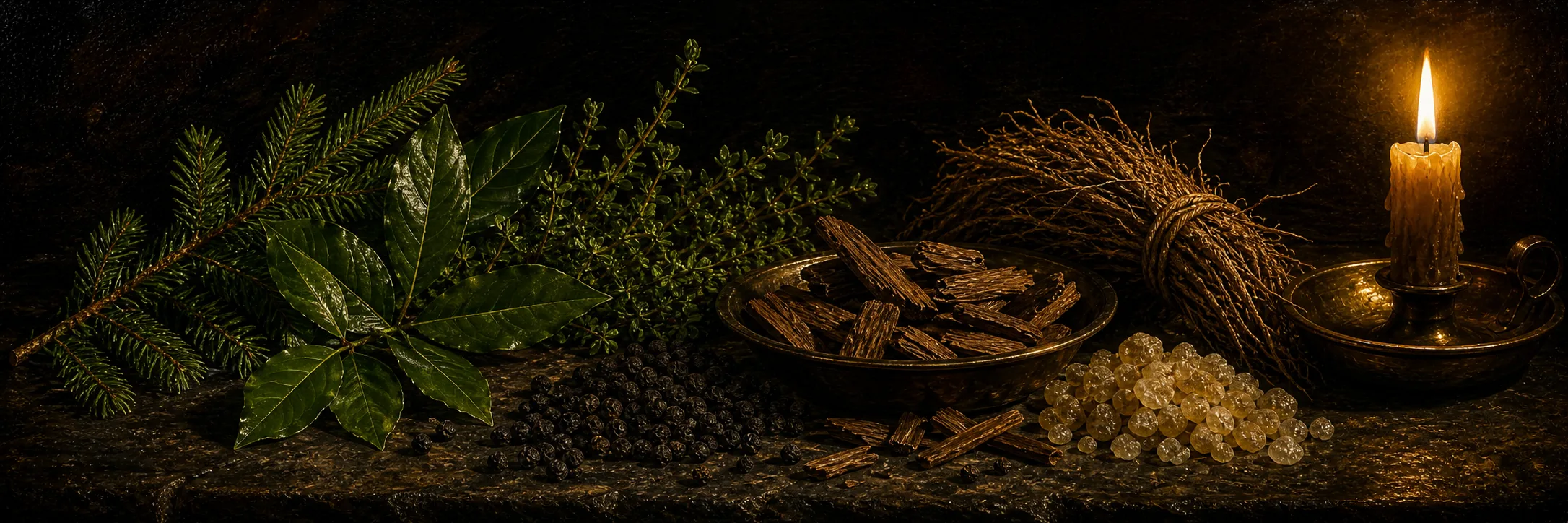
Hinoki reads to most noses as a single, remarkably cohesive woody accord rather than a developing pyramid - “a rich, singular fantasy wood, a lush conifer glittering with dew with a warm and spicy heart.” The opening is camphoraceous and terpenic: cypress, pine, thyme and a big dollop of camphor giving a fresh, green, almost wet, sometimes “industrial,” turpentine/glue/wet-paint quality that reviewers consistently find bracing and outdoorsy. The heart is the hinoki/cedar core - damp, cool, slightly lemony wood with a warmer, spicier, “finely aged old wood” facet evoking temple timber and ritual baths. A dry frankincense/olibanum note, oakmoss and vetiver anchor the base into a “drier than dry,” earthy, faintly smoky finish. The signature effect is of cool, wet, sauna-like wood - “you’ve just stepped into a wooden sauna” or “a green forest after rain.” It is essentially linear, fading rather than developing. The most-repeated technical criticism, voiced by skeptics on wearer discussion, is that the realism rests heavily on Iso E Super (cedar/woody-amber aromachemical) - one user calling it “a thin, hollow pseudo-cedar… high-end hamster bedding… it smells cheap” - and that there is “just pine, mint, and iso e super smoke.” (NB: that “hamster bedding” line is a wearer discussion user’s thumbs-down review, not Luca Turin’s verdict - Hinoki does not appear to have been reviewed in Turin & Sanchez’s The Guide at all, plausibly because it was a Monocle-exclusive niche release.)
Performance
The near-universal wearers complaint is poor-to-average performance, which dampens enthusiasm given the niche price. critical coverage noted that lasting power is “less than fabulous.” wearers reports cluster around modest projection for ~2 hours and total longevity often in the 4-hour-or-less range - a wearer discussion reviewer put it at “4 hours or less” and a wearers reviewer at “between 1 and 2 [hours]… the shortest-lived scent I have come across” - with many users, including fans, saying it fades to a faint skin scent quickly (“completely gone within two hours,” “I bought a bottle at first sniff but sold it because of its poor longevity”). A minority report stronger output (one wearer discussion critic found “tremendous sillage and projection,” suggesting batch or skin variance). Recommended approach is generous, liberal application, and several note cooler weather helps it last.
Wearing Context
A transparent, meditative, “soul-stirring rather than head-turning” scent. Reviewers wear it year-round but say it performs best in cooler weather; it suits crisp spring mornings (per its own inspiration), autumn and winter. It is unobtrusive enough for any occasion and reads as office-safe and contemplative rather than seductive. Marketed and widely worn as unisex, though Western noses tend to read it as masculine; CdG’s Japanese sensibility frames it as gender-irrelevant.
Comparisons & DNA
The single most-cited comparison is to CdG’s own Series 3 Incense: Kyoto - repeatedly called Hinoki’s “sister scent,” sharing the green, camphoric, woody-incense character, with wearer discussion critics bluntly advising that Kyoto (and Avignon) “offer a similar olfactory experience at a fraction of the price.” One useful wearers triangulation: “Kyoto - airy, grey smoke on a mountain, dry temple incense; Hinoki - camphor, dampness, cypress, green forest incense; [Aesop] Hwyl - deeper, more resinous, mossy forest floor.” Aesop Hwyl and Heretic Dirty Hinoki are named as same-family relatives (one fan layers Hinoki with Dirty Hinoki). It is also likened to Amouage Memoir Man’s woody-incense register (though judged thinner and more monotonous), and grouped with the broader CdG “dry, dark, slightly medicinal” woody-minimalist school pioneered by Mark Buxton and Bertrand Duchaufour.
Reception
Polarizing but generally well-regarded among woody-fragrance and CdG devotees. critical coverage’s Robin found it the most covetable of CdG’s then-recent releases - “this is the one I’d very much like to own” - while puncturing the romance: “to me, this is the smell of your father’s woodshop, assuming you had a father with a woodshop.” Fans on wearers call it the most natural, photorealistic conifer scent they’ve encountered (“whatever’s in here… it’s real. Deep heavy wood real”), praising its serene, sophisticated minimalism. Detractors split into two camps: (1) performance is too weak for the price; (2) it is artistically thin/boring - a wearer discussion critic argued it “illustrate[s] the dead end nature of minimalism” and “smells cheap… very, very cheap,” demoting it to a thumbs-down.
Versions & Reformulation
Single composition; no documented reformulation. It has been sold continuously via Monocle and CdG channels (notably 50ml EDT) and a matching candle exists. Note the recurring naming/branding variants - “Monocle Scent One: Hinoki,” “Monocle 01 Hinoki” - refer to the same juice. (Some retailer note-lists add “Georgian wood/Georgywood” and “turpentine” to the published pyramid.)
Acquisition Notes
Sold as a 50ml EDT through Monocle’s own shop and CdG boutiques/stockists; it is a continuously available niche release rather than a discontinued grail (a point of relief to reviewers who had assumed it was gone). Decants and samples are readily available through niche splitters. No widespread counterfeit or batch-code lore is documented. Because distribution runs through Monocle and authorized CdG retailers, buyers are generally advised to purchase through those channels.
Notable Facts & Lore
- The Monocle x Comme des Garcons tie-up is the headline story: a magazine and an avant-garde fashion house co-creating a fragrance, designed in a Monocle-designed bottle and box, developed in Paris by Antoine Maisondieu.
- The Tawaraya ryokan in Kyoto and its open-air hinoki ofuro is the explicit muse, with Monocle’s own copy referencing “the mosses and trees outdoors and sharp notes of the boxy hinoki tub” and “distant smoke of temple incense.” It was the first (“Scent One”) of an ongoing Monocle scent series.
- Reviewers repeatedly compare the publisher-perfumer concept to Geza Schoen’s Paper Passion (with Steidl, Wallpaper* and Karl Lagerfeld).
- No celebrity or viral-moment lore beyond the Brule/Monocle connection is documented.