Comme des Garçons — Comme des Garcons Series Luxe: Patchouli
Essence
Series Luxe: Patchouli is the great “patchouli that isn’t” - a 2007 Antoine Maisondieu composition that takes the most loaded name in perfumery and then refuses to deliver the expected note, substituting instead a thick, bitter-green, curry-and-immortelle distillate that has been arguing with its own label for almost two decades. It was the more substantial of two fragrances (alongside Champaca) in CdG’s deliberately provocative, ultra-priced Series Luxe line, sold for $290 per 45ml at Luckyscent - roughly three times the cost of the brand’s regular 50ml releases. The fragrance’s whole reason for existing is conceptual friction: it is named for a note most experienced wearers struggle to find in it, and the resulting decades-long “where’s the patchouli?” debate is itself the most documented fact about the scent.
Scent Profile
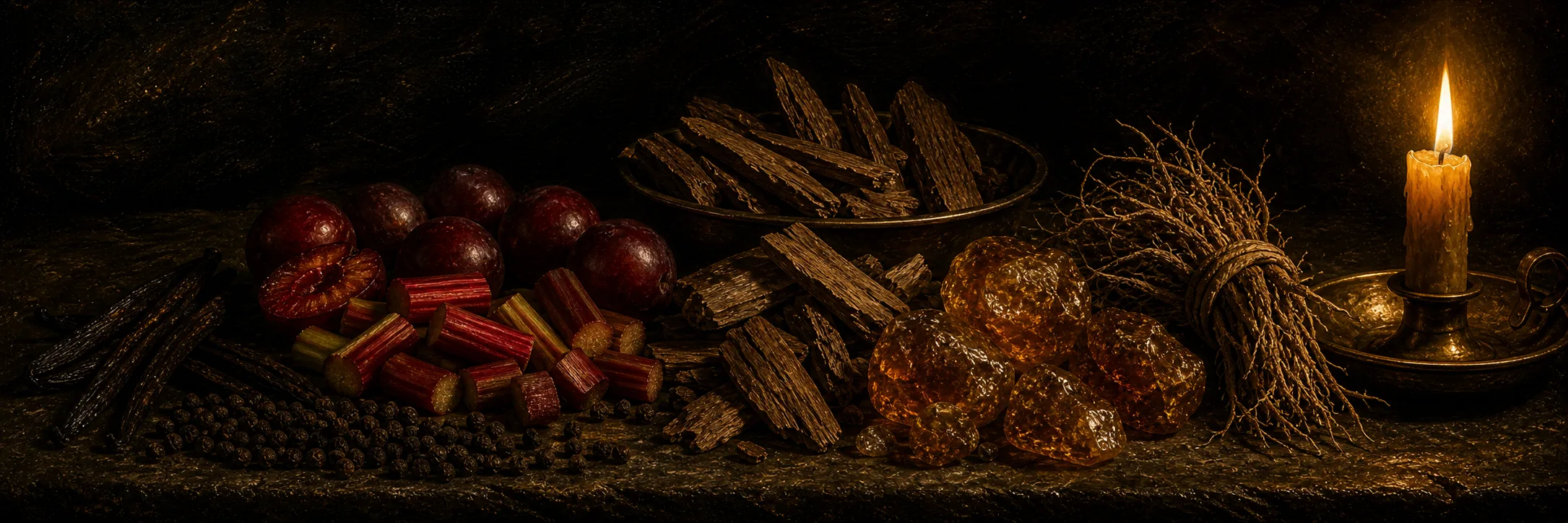
What the catalog calls patchouli, opoponax, fenugreek and white pepper reads on skin as something stranger and more culinary. The dominant impression for most careful reviewers is immortelle - the everlasting flower, with its burnt-sugar, maple-syrup, dried-curry-leaf tonality - flanked by fenugreek, which pushes the whole thing toward what several critics independently describe as Indian or Persian cooking. The patchouli that gives the scent its name is, paradoxically, the hardest thing to isolate; when it surfaces it is the de-hippified, smooth, high-grade Sumatran sort, scrubbed of its damp-earth grunge.
The architecture is front-loaded by consensus. The opening is a monumental, velvety balsam of fenugreek, smoky opoponax, dry cedar and a searing white pepper that several note vanishes within ten minutes. Critics repeatedly call the opening the best part: a complex riot of opoponax, cedar, teak, pepper and herbal patchouli.
The drydown is where opinion splits - admirers find a smooth, peppery, woody-sweet patchouli nestled in vanilla and creamy faux-sandalwood; detractors find it staid and over-endowed, collapsing into molasses-thick immortelle sweetness with abstract woods. There is a strong undertow of fermented, savory funk early on - yeast, Marmite, smoked fish, soy sauce - that is challenging but, most agree, not unpleasant.
Performance
This is one of the better-performing things CdG has made, and even critics agree on that point. Longevity is consistently described as enormous - ten hours from two sprays, overspray smelled on a winter coat for days. Sillage is the more debated axis: some find it a powerful, room-filling projector you cannot wear and hide, while others report it settling into a refined, near-conservative, skin-close hum with weak sillage but tenacious longevity. The realistic read is a big, dense opening that announces itself, then settles into a long, lower-projecting woody-sweet base. Given that strength, a light hand and a small bottle go a long way.
Wearing Context
This is cold-weather and evening territory, overwhelmingly. The dryness, smoke and herbal density make it an autumn and winter scent - reviewers reach for imagery of campfires, fall hikes, dark downtown clubs and an oriental palace on the Sahara. It is functionally unisex but skews masculine in perception, though a few women reviewers read it as definitely feminine, underscoring how polarizing its gender signal is. It is not an office-safe crowd-pleaser in its opening, though its quieter drydown could pass in a conservative setting. It is best understood as a connoisseur’s statement piece for someone who already owns several patchoulis and wants the weird one.
Comparisons & DNA
The reference points cited again and again are the genre’s aristocracy. Chanel Coromandel is the powdery, gourmand-leaning luxury patchouli it is most often measured against - and value-minded critics note Coromandel delivers more for less money. Serge Lutens Borneo 1834 is the closest cousin: multiple reviewers swear Luxe: Patchouli uses the same raw patchouli, but reads drier, more savory, and less sweet than Borneo. Within the immortelle family it gets compared to Annick Goutal Sables and to the immortelle facet of Serge Lutens Chypre Rouge. Dior Patchouli Imperial rounds out the luxury-patchouli set it sits beside. Across all of these, the distinguishing trait is its savory, curry-and-fenugreek strangeness.
Reception
Reception is best summed up as critically respected, commercially polarizing, and forever defined by the naming controversy. Luca Turin and Tania Sanchez gave it three stars out of five in Perfumes: The A-Z Guide, with the pointed genre tag “everlasting flower” - itself a quiet acknowledgment that the dominant note is immortelle, not patchouli. The critic Kafkaesque devoted a full essay to the thesis that it is not patchouli at all, arguing it should be called Luxe Immortelle, and long-running threads have wearers detecting angelica root, valerian and labdanum amber instead. The 2007 launch coverage became a referendum on CdG’s aspirational pricing. Yet the same fragrance has ardent defenders who call it the best patchouli they ever smelled and a masterpiece, making it a genuine love-it-or-loathe-it object. The clearest value criticism is simply that rivals deliver a more conventional luxury patchouli for less.
Versions & Reformulation
There are two documented concentrations: the original 2007 Eau de Parfum, reportedly around 20% concentration and the version most critics reviewed, and a 2013 Eau de Toilette. Contrary to expectation, the EDT is not a watered-down version - a direct comparison found them nearly identical in smell and performance, with the EDT arguably letting the opening ring out more clearly and showing a touch more vetiver late. The line has since changed corporate hands. The packaging itself became a talking point: each scent shipped in a black-crystal bottle housed in a notorious two-conjoined-boxes presentation, one of them empty, that reviewers found either brilliantly inscrutable or trying too hard.
Acquisition Notes
This is a low-distribution luxury release that was always hard to find and pricey, surfacing and disappearing from the US market more than once. Because the EDP and EDT smell so alike, there is little reason to chase the rarer, costlier original EDP at a premium; the EDT is the pragmatic buy if found. Sampling before committing is strongly advised, since the naming controversy means a meaningful fraction of buyers end up disappointed and the savory fenugreek-immortelle-soy character is genuinely divisive. Given the strong longevity, a small format goes a very long way.
Notable Facts & Lore
- The single most persistent piece of lore is that this “Patchouli” barely smells of patchouli - documented widely enough to inspire an essay retitling it Luxe Immortelle.
- Antoine Maisondieu, the perfumer, is the same nose behind Gucci Rush for Men and Armani Code.
- Turin and Sanchez’s three-star genre tag “everlasting flower” is a literal botanical nickname for immortelle (Helichrysum), a sly endorsement of the it’s-really-immortelle reading.
- The Series Luxe line was widely interpreted as CdG’s commentary on the mid-2000s luxury-flanker arms race - Dior Privee, Armani Prive, Chanel’s Exclusifs - even as it participated in it.
- The Sumatran patchouli used is frequently described as the highest grade available, contributing to the polished, de-hippified quality that distinguishes it from drugstore patchouli oil.