Comme des Garçons — Comme des Garcons Series 3 Incense: Jaisalmer
Essence
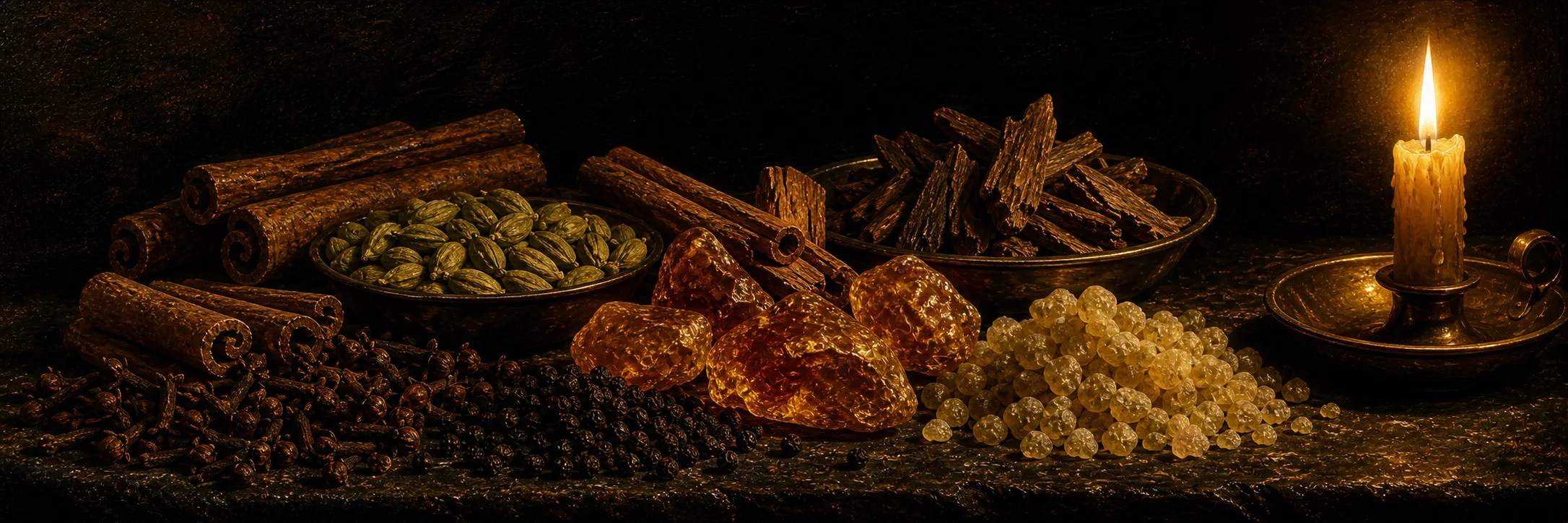
Jaisalmer (2002), composed by Evelyne Boulanger, is one of the five fragrances in Comme des Garcons’ landmark Series 3: Incense - a conceptual quintet, each scent representing a world religion and its sacred city (Avignon/Catholicism, Zagorsk/Orthodoxy, Kyoto/Buddhism-Shinto, Ouarzazate/Islam, and Jaisalmer/Hinduism). Jaisalmer is the spice-route interpretation: an incense skeleton overlaid with a warm, dry, masala-like accord of cinnamon, cardamom, and red-hot pepper over guaiac wood and Indian ebony. Within a series widely considered a high-water mark of modern incense perfumery, Jaisalmer is the most spice-forward, “edible,” and approachable - and, by reputation, the least essential of the five.
Scent Profile
The opening “ignites with cinnamon,” as Bois de Jasmin’s Victoria Frolova puts it - a sweet-hot cinnamon led by cardamom and a genuinely piquant pepper/pimento (red-hot chili) kick, often with a tiny fruity tinge from red berries. Many wearers also report a striking fresh, conifer/“pine sap” quality in the top that isn’t in the official pyramid; one perfumer reviewer attributes it to a pine-sap material, and a camphoraceous, almost liniment-like facet appears on some skin (the wearer discussion “Genre” critic calls it “balsamic-astringent… smells a lot like liniment”). The heart is the defining accord: a warm “Indian masala chai” of cinnamon, cardamom, and pepper over a transparent woody-incense base - repeatedly described as “cardamom milk tea,” “chai latte,” or mulled wine. The incense itself is comparatively discreet here; this is the least “churchy” of the five. The drydown softens into sweet, slightly ambery spiced woods - guaiac, ebony, benzoin, and amber - with the cinnamon and pepper mellowing. Linearity: largely linear, the masala-over-incense structure holding with “little to no transformation,” only softening and turning ambery late. Octavian Coifan (wearer discussion) frames the concept as “holy yet human…
Performance
Performance is the near-universal knock on Jaisalmer, as it is across much of the Incense series. The dominant report is poor-to-moderate longevity (commonly 3 - 6 hours on skin) and modest, close-to-skin sillage - “there really is no lasting power to this,” “sits close to my skin,” “Jaisalmer simply disappears.” A meaningful minority experience the opposite, calling it the longest-lasting of the line (“over 8 hours,” “even more so than Kyoto or Avignon”) with extreme longevity and “pungent” early strength requiring cautious application. This split is chemistry-dependent. It is potent and spicy enough up close that several warn a heavy hand could be “easily offensive.” Best in cool weather; apply generously and expect an intimate-to-moderate wear. A cool-weather, autumn/winter performer for most.
Wearing Context
An autumn and winter scent by overwhelming consensus - “heavily spiced woods, deep and comforting,” cozy, meditative, evocative of Christmas/mulled spice for many. Genuinely unisex though it reads slightly masculine to some and “feminine and sensual” on others’ skin. Settings: casual, contemplative, cold-weather daily wear; a few find it gourmand-adjacent enough (“foody”) to be a comfort scent rather than a serious/meditative one like Kyoto or Avignon. Social perception: warm, exotic, spicy, and approachable; the “most compliment-generating” CdG for at least one wearer, though its quiet projection limits its compliment radius.
Comparisons & DNA
The essential comparisons are internal to the series. Versus Avignon (Bertrand Duchaufour’s dark, somber frankincense-and-myrrh “Catholic cathedral”), Jaisalmer is far warmer, spicier, sweeter, and more wearable - many who “can’t handle Avignon” find Jaisalmer the approachable alternative. Versus Kyoto (cool, woody-cypress, “zen,” coffee-and-teak meditation), Jaisalmer is sweeter and spicier. Versus Ouarzazate (sweet, peppery, vanilla-labdanum), it shares an approachable sweetness. Versus Zagorsk (cold, pine-and-incense Russian forest), it is its warm opposite. Outside the line, reviewers liken it to a polished, less-raw CdG Sequoia/woods in the drydown, and the camphor/liniment facet invites a contrast with Heeley Spirit of the Tiger - though the wearer discussion critic argues Jaisalmer avoids the literal “Tiger Balm” trap.
Reception
Critically, the Incense series is revered; Jaisalmer specifically draws warm but qualified praise. Bois de Jasmin’s Victoria Frolova is its highest-profile champion, writing verbatim that “Jaisalmer the fragrance is the sleeper of the Series 3: Incense line. It’s my favorite of the set and one that I reach for each fall when the weather turns cooler.” critical coverage, by contrast, ranks it last of the five (Robin: “Jaisalmer is my least favorite too, but not sure if it is the pepper or something else that keeps me from adoring it”). That captures the polarization perfectly: it is simultaneously a sleeper favorite and the consensus “least essential” of the series. Polarization axes: (1) the spice/pepper - beloved as masala warmth, disliked by those who get “green peppers,” dill, or “Thai food”; (2) the pine/camphor top - fresh-conifer joy vs. medicinal/“Pine-Sol”; (3) performance.
Versions & Reformulation
The Series 3: Incense line has been in continuous production since 2002 (a 2008 discontinuation rumor was explicitly debunked at the time, confirmed by Luckyscent/CdG). It is now produced and marketed under Puig, which holds the CdG fragrance license. wearers discussion centers on batch-to-batch consistency and the general IFRA-era trajectory of oakmoss/incense materials rather than any single named reformulation; no specific reformulation is documented for Jaisalmer itself. Treat as a single composition with normal production-era variation.
Acquisition Notes
In continuous production and easy to find. EDT, sold mainly in 50 ml (a 100 ml exists). Pricing level is accessible niche - roughly $75 - $95 at retailers like END., with Luckyscent/ZGO-type listings around $100 - $175 depending on size; it was famously a relative bargain in the early years ($54 for 50 ml in 2006, ~$80 by 2009 per critical coverage). Channels: stocked by most major niche retailers and the CdG Parfum site. Decants and the five-piece Incense sampler are widely available and the recommended entry point - critical coverage and others stress trying all five before committing.
Notable Facts & Lore
- The Series 3: Incense concept is the lore: launched 2002, five scents mapping incense’s role across five faiths and five cities.
- Jaisalmer represents Hinduism, named for the Rajasthani desert “Golden City” that sat on the ancient India - Egypt trade route - the conceit being the caravan of spices and woods (notably the Indian ebony note) crossing the desert, “a maharaja’s regal scent.” The series is celebrated for pairing avant-garde house concept (Rei Kawakubo’s CdG, with fragrances treated “more like artworks than products”) with serious perfumery - Avignon by Duchaufour, Ouarzazate by Mark Buxton, and Jaisalmer/Zagorsk by Evelyne Boulanger.
- Luca Turin, writing on the series, singled out Zagorsk and Avignon as favorites while noting Jaisalmer “references Hindu rituals” - a reminder that even among critics, Jaisalmer is the quietly admired one rather than the headline act.