Comme des Garçons — Comme des Garcons Series 5 Sherbet: Rhubarb
Essence
Series 5 Sherbet: Rhubarb is Bertrand Duchaufour’s near-monochrome study of one difficult note — rhubarb — rendered tart, green, and almost photorealistic before it softens into a creamy-woody fade. Released in 2003 as part of CdG’s three-piece Sherbet line (alongside Cinnamon and Peppermint), it is widely treated as the standout of the trio and one of the most convincing rhubarb fragrances ever composed. Now discontinued, it keeps a devoted following among rhubarb-lovers who prize its brilliant opening and forgive its famously short lifespan.
Scent Profile
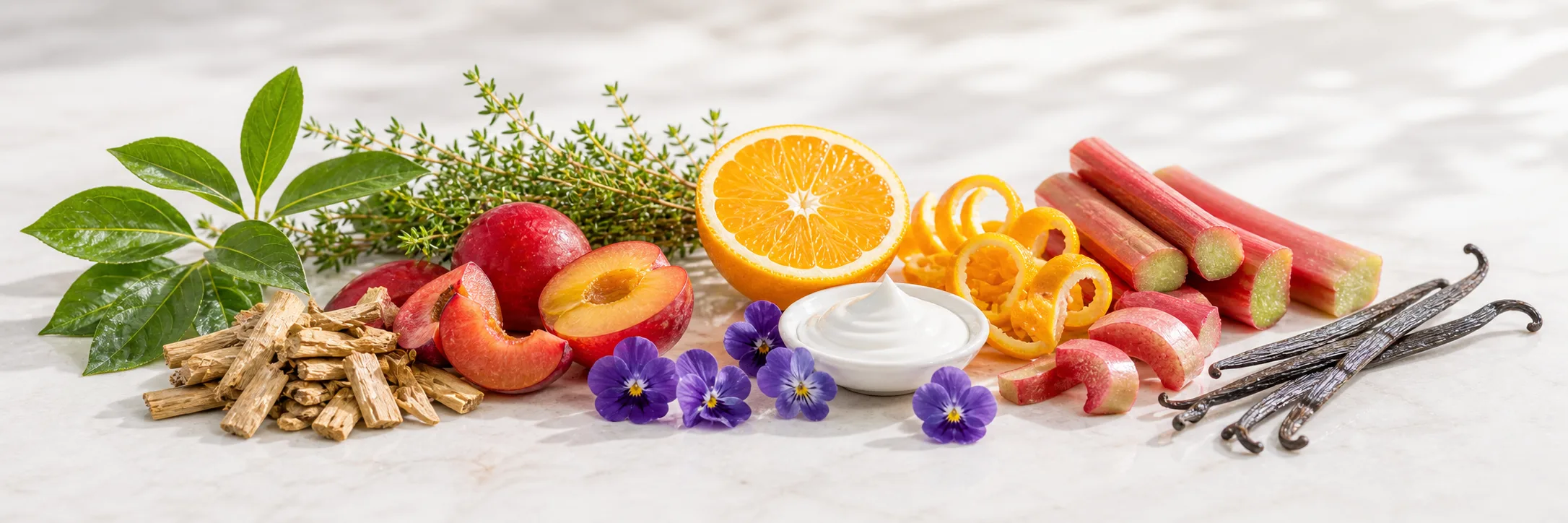
The composition is built almost entirely around rhubarb. Litchi and bergamot sit up top, camelia and orchid in the heart, and vanilla plus an oak-wood base anchors the drydown. The defining moment is the opening: a pitch-perfect tart, sweet, juicy rhubarb, crisp and vegetal, frequently compared to fresh-cut rhubarb stalks or rhubarb syrup in seltzer. Litchi adds a small rose-like sparkle that supports rather than competes, and bergamot lifts the whole top.
As it develops, the tart green intensity recedes and a creamier, woodier, faintly vanillic phase takes over — still pink rather than murky green, closer to rhubarb pie or gelato than to a raw stalk. The base is generally judged pleasant but somewhat generic creamy vanilla-wood; the real magic is front-loaded into the first act.
A faint synthetic undercurrent typical of the house runs throughout, and a minority of wearers pick up a stranger facet — a sour rice-milk or wax note that one reviewer likened to kheer, cardamom rice pudding. The structure is fairly linear in concept but reads as two clear acts: tart green, then creamy wood. Several wearers also find it leans more masculine and cologne-like than its “sherbet” name suggests.
Performance
Longevity is the near-universal criticism. Reports range from roughly twenty minutes on difficult skin to a more typical three to four hours, with the vivid rhubarb specifically fading inside the first hour and the creamy drydown lingering longer — longer still on clothing. Sillage is modest: this is a close, refreshing scent rather than a projector. The sensible approach is to apply generously and expect to reapply, treating it as a summer pick-me-up rather than an all-day anchor. It performs best in heat, where its cooling tartness comes alive.
Wearing Context
This is a spring and summer, daytime, casual fragrance above all — fresh, juicy, and realistic, an upbeat warm-weather refresher. Its tart green character is invigorating in heat and would feel out of place as a cold-weather or formal evening scent. It is fully unisex, leaning slightly green and masculine on some skins. It suits anyone wanting something unusual, cheerful, and non-sweet for hot days, and is the wrong pick for anyone who needs projection, longevity, or a conventional perfume.
Comparisons & DNA
The most telling reference comes from Duchaufour himself: he later made rhubarb the star of Aedes de Venustas EDP (2012), pairing it with tomato leaf, and named this CdG as the precursor where he first tested whether rhubarb could anchor a fragrance — so the clearest DNA line runs from here to a greener, more vegetal, longer-lasting successor. Among other rhubarb scents, Hermes Eau de Rhubarbe Ecarlate turns to a fruity white musk faster, where this one stays juicier for longer. Le Prince Jardinier Ciel Mon Jardin is repeatedly named as a stronger, more natural, longer-lasting garden-rhubarb alternative. Within its own line it is the tart-green counterpoint to Sherbet: Cinnamon, a musky “Big Red gum” cinnamon. No cheap designer clones are documented.
Reception
Reception is strongly positive among those who like the rhubarb note, with a clear majority leaning favorable. The praise centers on realism (often called a precise replica of rhubarb), originality, refreshing summery character, and Duchaufour’s craft in making a single-note idea genuinely wearable. The criticism is near-unanimous on one point — poor longevity — joined by a smaller group who find it too tart, too masculine, or soap-like, and by the divisive sour-milk facet a few wearers detect. The polarization runs along two axes: love-the-realism versus dislike-the-tartness, and the love-or-hate sour-milk note. One memorable verdict calls it a kaleidoscopic butterfly that lives only for a single day, which captures both the highest praise and the central complaint. As a low-cost, small-format bottle it was historically an easy, low-risk try for the curious.
Versions & Reformulation
The fragrance was sold as an EDT in a 30 ml spray and, formerly, as a perfume solid of about 0.4 oz; the solid is now especially rare. There is no documented reformulation of the juice — the only real “version” distinction is format, spray versus the now-scarce solid. The fragrance is discontinued. A packaging quirk worth noting: the pale bottle and the Sherbet/Sorbet naming led some to dismiss it as juvenile despite the composition’s sophistication.
Acquisition Notes
This is a discontinued, originally inexpensive release — early pricing was around $36 for the 30 ml EDT and $30 for the solid. It still surfaces at some European stockists and on the secondary market, generally at modest prices given the small bottle. Because it is short-lived, sampling via a decant before committing is the sensible route. The common size is 30 ml; its small format and low price make it a low counterfeit target.
Notable Facts & Lore
- The Sherbet line was a deliberate CdG concept exercise in minimalism, each fragrance built around a single note.
- Duchaufour described it as “a really unusual product… an avant-garde perfume accord” for someone who “wants to wear something very original.”
- It became personally significant to Duchaufour as the seed of his later acclaimed Aedes de Venustas EDP.
- It is widely cited as a rhubarb benchmark — the scent rhubarb fans tend to name first.
- The trio comprised Rhubarb, Cinnamon, and Peppermint, with Rhubarb generally judged the standout.