Comme des Garçons — Comme des Garcons Series 2 Red: Sequoia
Essence
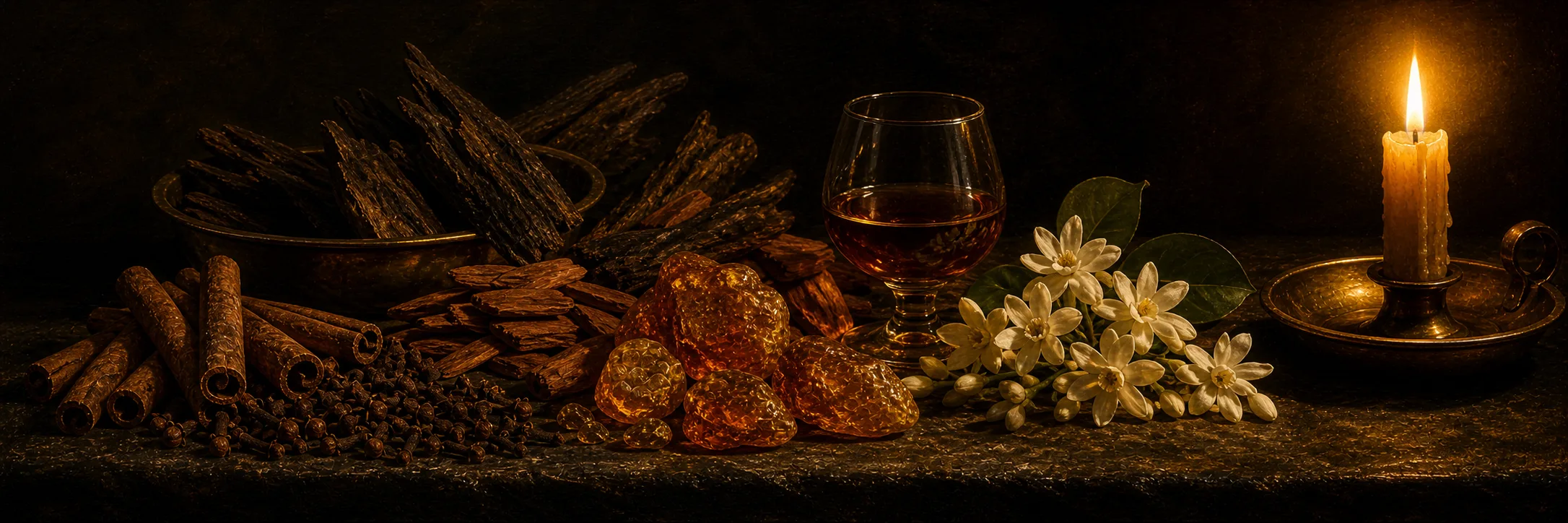
Sequoia is the woody anchor of Comme des Garcons’ 2001 Series 2: Red, and over two decades it has earned a reputation that outruns the house’s modest, abstract intentions. The brief was literal, the exact scent of the largest trees on earth rather than the mood of an ancient forest, but what Bertrand Duchaufour built is stranger than a tree note: a boozy, rum-soaked sweetness wrapped around dry, polished hardwood, with a resinous opoponax base and an early, exotic oud impression that gives the fragrance its claim to historical importance.
Scent Profile
The opening is the most divisive stretch. Many wearers describe an alcoholic-sweet top that reads as forest-berry liqueur or spiced rum, Captain Morgan poured over a woodpile. It is thick, slightly liquored, and sits close to the skin rather than radiating outward. Underneath, the wood arrives quickly, not sawdust or sap-and-wax but, as one writer put it, cleverly worked, beautifully burnished timber. A karo-karounde note, a jasmine-like Congolese floral material Duchaufour also used in L’Artisan’s Timbuktu, adds a faint exotic-floral, almost leathery facet that keeps the woods from going flat. Opoponax oozes beneath it, bittersweet and faintly reminiscent of aged scotch, while the oud hovers in the background as a dry, resinous shadow rather than the medicinal barnyard of true agarwood. The arc is slow. The rum cloud dominates roughly the first two-thirds before the composition finally settles into its warmest, most balsamic phase, leading one reviewer to remark that it reveals its true beauty a little too late. Detractors find a high-pitched, almost metallic or vinegary edge to the wood, and a minority liken that quality to Diptyque’s Eau Lente.
Performance
Reports cluster around moderate. Sequoia is not a skin scent, but neither is it a powerhouse; several wearers note it stays relatively close and is not especially loud, which some attribute to the eau de toilette concentration. One careful account had it hanging on for five to six hours, never huge but keeping its bark close to the skin, with the woody-resinous drydown carrying the staying power once the boozy top burns off. Expect a few hours of legible development and then a long, soft woody-amber sit-down. People sensitive to woody-amber materials may find the base a touch synthetic.
Wearing Context
This is cool-weather, contemplative wear, best in autumn and winter, in the evening, and for the wearer’s own pleasure rather than a crowd. The rum-and-wood profile reads as after-dinner and fireside, a cocktail taken out to the woodpile. It is fully unisex on paper, though the heft of the woods and the boozy-spicy character tilt it slightly masculine in practice. It is emphatically not an office freshie or a summer scent, since the sweetness and resin feel heavy in heat; think of it as a connoisseur’s woody for when you want something rich and a little unusual.
Comparisons & DNA
The most important comparison is internal to Duchaufour’s own work: Now Smell This’s Robin called Sequoia something like an early sketch done in preparation for Timbuktu, L’Artisan’s 2004 woody scent that shares the karo-karounde signature, and many prefer those later, more fully realized versions such as Timbuktu, Dzongkha, and Al Oudh. Within the Red series it is the wood entry, sitting beside the clove-carnation soliflore of Carnation, the rosewood of Palisander, and the cult Harissa. On the booze-and-oud axis its most cited modern descendant is Initio Oud for Greatness, frequently called its spiritual heir. For the boozy-wood idea specifically, YSL’s M7 is the recurring historical reference point, with Sequoia positioned as the more wearable, less polarizing option.
Reception
Sequoia is one of the more warmly regarded Red entries. Persolaise, in his 2020 review of CdG Rouge, noted that the 2001 Red series is still considered one of the house’s finest achievements, with many lamenting the discontinuation of some of its scents. Robin at Now Smell This judged it beautifully done but cautioned that it is hardly worth trying unless you are a huge fan of wood, since the basic impression is of a huge, newly cut hunk of wood still oozing sap, glorious for those who love that. Sentiment is broadly positive but genuinely split: admirers call it a timeless Duchaufour piece and the best tree scent in the Red series, warm and organic, while skeptics find the rum cloud overbearing, the woods slightly metallic, or, among those who waited years to try a white whale, anticlimactic now that boozy-woody niche ideas are everywhere.
Versions & Reformulation
Sequoia launched in 2001, was discontinued when the Red series wound down, and became a hard-to-find grail with inflated secondary prices. In May 2017 CdG reissued it in the permanently available Olfactory Library collection, alongside Palisander, now in plain white 50 ml bottles. The crucial point for buyers is that owners who used up old Red-series bottles and reunited with the Olfactory Library version report they smell the same, with no noticeable difference in sillage, a rare case of a reissue that appears faithful to the original. The main reported catch is value, with the reissue arriving in a smaller bottle at a price some feel belongs to a larger one.
Acquisition Notes
Because the reissue is widely considered identical to the vintage, there is little reason to chase expensive sealed Red-series bottles unless you specifically want the original red packaging as a collector’s piece. The current 50 ml is the sensible buy and is far cheaper than the discontinued M7 it is often compared to. This is a fragrance that rewards sampling first, since the boozy-rum opening is a love-it-or-leave-it proposition and people expecting an airy coniferous tree scent are sometimes thrown by how sweet and balsamic it actually is. Decants are easy to come by.
Notable Facts & Lore
- The Series 2: Red concept celebrated, in CdG’s own words, the red of the sun, fire, and blood and the serenity of the red temple gate of the Far East, expressed through spices, woods, flowers, and fruits.
- The karo-karounde note is described as a jasmine-like material used in the Congo in fertility rituals.
- Its biggest piece of lore is the oud-pioneer claim, that Duchaufour deployed an agarwood impression in 2001, before M7 and well before oud saturated Western niche perfumery.
- Knowledgeable reviewers caution the oud is likely an illusion built from cypriol oil and woody aromachemicals rather than real agarwood.
- The same sweet-alcoholic rum peak some detect here is claimed to reappear in Duchaufour’s 2009 L’Artisan Vanille Absolument.