Comme des Garçons — Comme des Garcons Series Luxe: Champaca
Essence
Champaca is the floral half of Comme des Garcons’ 2007 two-piece Luxe series (the other being Patchouli), launched under the deliberately provocative tagline “the true sign of luxury is rarity and quality.” Composed by Nathalie Feisthauer, it is a high-grade soliflore built around champaca - the creamy, fruity, tropical magnolia relative known in Southeast Asia as the “perfume tree” - amplified by green tuberose and a spicy-aromatic angelica top. It is, by CdG standards, almost shockingly conventional: where the house built its reputation on tar, ink, and burning rubber, Luxe Champaca is a lush, expensive-smelling, near-girly white floral. That very prettiness, paired with an eye-watering price, made it one of the more debated CdG releases of its era - and one of the more lamented now that it is discontinued and hard to find.
Scent Profile
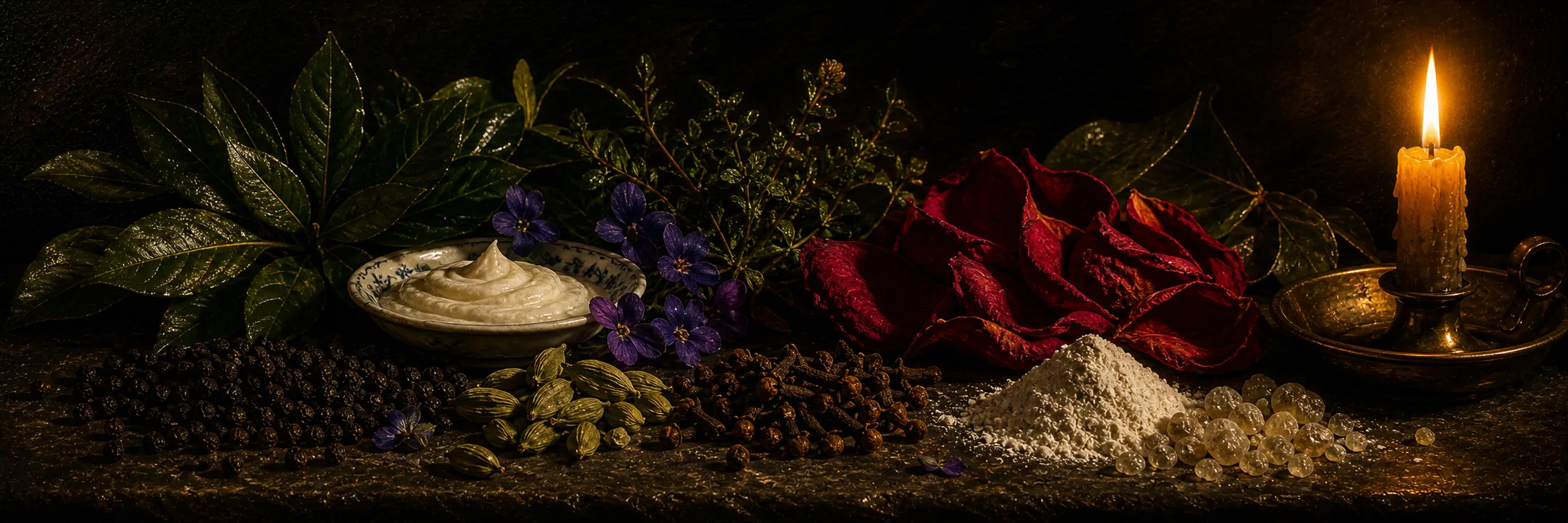
The opening is genuinely distinctive thanks to angelica - herbaceous, spicy, slightly musky and aromatic - laced with white pepper and cardamom, giving the first ten minutes an unexpected sharpness that keeps the composition from going straight to floral-perfume cliche. Many reviewers note the angelica is the most interesting and most fleeting part: its “delicate aura” evaporates too soon. As it warms, champaca and tuberose take over. The champaca itself is rendered as a creamy, fruity, limpid white floral - reviewers reach for comparisons to gardenia, narcissus, and jasmine - while the green, slightly chemical tuberose lends body and a faintly indolic edge that never tips into the “blue cheese” carnality of a Fracas or Carnal Flower. The indoles are present but tamed; this is a “cleaner,” more obviously floral take than the dirtier white florals it’s often measured against. The drydown is an understated orris and white musk foundation, smooth and skin-like, with a slight powdery creaminess. The recurring descriptor is “expensive spa” or luxury-hotel lobby - polished, sophisticated, slightly soapy in the best sense.
Performance
Strong. Despite being most commonly encountered as an EDP (with an EDT version following), longevity and sillage are consistently praised as excellent - reviewers report roughly eight hours and up, with several claiming ten to twelve. One wearers reviewer reported “The longevity and sillage are excellent, lasting approximately 8 hours on the skin”; a wearer discussion user reported “more than 12 hours” from the EDT, calling the lasting power “astonishing for an EDT.” Sillage is good without being a screaming projector - a few sprays go a long way, and it announces itself at conversational distance as something rare and costly. For a soliflore, this is well above average performance and part of what justified the price for fans.
Wearing Context
A statement white floral best suited to those who actively want to be noticed as wearing something unusual. Reviewers describe it as exotic, regal, and “not for the faint of heart” - wearable by both men and women, with several male reviewers calling it a daring, exotic choice, though by contemporary trends it leans feminine. It reads as a cooler-weather or evening scent for many because of its richness and tuberose heft, though some find the champaca’s freshness summer-appropriate. The repeated image is luxury and ceremony: the lobby of an expensive Eastern hotel, an impeccably stylish mature woman, a spa. Not an office wallflower; a perfume for occasions where you want presence.
Comparisons & DNA
The essential CdG comparison is to Guerrilla 1, which also features champaca but to deliberately odd, “butcher shop” effect - Luxe Champaca is the beautiful, polished sibling without the weird plastic note. Against the great tuberoses, reviewers consistently position it as more delicate than Robert Piguet Fracas and less indolic than Editions de Parfums Frederic Malle Carnal Flower, with some calling it an “also-ran” to Fracas and others a potential tuberose holy grail. It has been compared favorably to Serge Lutens A La Nuit and Creed White Flowers in the white-floral space, and contrasted with the dirtier, more animalic Mona di Orio Nuit Noire and Etat Libre d’Orange Charogne (Champaca being the “cleaner” of the three). Versus Tom Ford’s various champaca-adjacent and tropical florals, reviewers find the CdG more linear but more naturalistic. Ayala Moriel’s discontinued Moonbreath is cited as a soft match with worse longevity.
Reception
Critically, the headline verdict is Luca Turin’s: “Boring soliflore that smells nice,” from the 2007 - 08 era guide - a backhanded dismissal that defenders have spent years pushing back against, arguing that bringing out a perfect flower’s voluptuousness without distraction is itself the art. Blog reception in 2007 (critical coverage, Perfume-Smellin’ Things) was split: near-universal admiration for the juice paired with near-universal revolt at the price. Perfume-Smellin’ Things found Champaca “just okay” relative to the Luxe Patchouli, while commenters balked at paying the steep markup for an EDP. wearers reception on wearer discussion and wearers is markedly warmer in retrospect - recurring words are “achingly beautiful,” “masterpiece,” “smells expensive,” and the salesperson line, endlessly quoted, that it “makes you smell like an expensive spa.” The most evocative latter-day wearers review compares it to the scent of Jaipur’s Rambagh Palace. The consensus dissent: it can read bitter or overly chemical-green to some, and a minority find it a “big bunch of powder-room flowers.”
Versions & Reformulation
There are two principal expressions: the original 2007 Luxe Champaca, presented in distinctive black-crystal bottles (a cuboid and the notorious “Atari joystick”/pyramid shape, packaged in CdG’s inscrutable double-box), and a later Eau de Toilette version (wearers lists a separate Luxe Champaca EDT entry). Reviewers who have compared note the EDT is a somewhat lighter, occasionally “cardboard”-tinged reading versus the richer Luxe EDP. The line was marketed at one point under Puig (according to wearer reports). The EDP/Luxe is the one to seek for the full, celebrated effect. Reports of strength vary by version, so buyers should confirm which concentration and bottle they’re acquiring.
Acquisition Notes
This is the central caveat: Luxe Champaca is discontinued and rare. It commanded extreme prices even new - critical coverage reported the launch price at “170… available in 45 ml Eau de Parfum,” a wearer discussion reviewer cited “45 mls for $256,” and a critical coverage commenter who tried it at Liberty London in 2007 noted the UK price outright as “145 sterling.” Today it surfaces on the secondary market (eBay, decant sellers) at collector prices, with sealed 100 ml EDT bottles appearing periodically. Decant houses still carry it as “rare and discontinued.” Beware “type”/dupe recreations marketed under the Champaca name - these are not the original. For most people, a decant is the rational entry point before committing to a costly full bottle.
Notable Facts & Lore
- The Luxe series’ tagline - “the true sign of luxury is rarity and quality” - drew open mockery from critics for its tautological emptiness (critical coverage noted it “makes just as much (meaning as little) sense when rearranged”), and was read as CdG, the great trend-setter, cynically following Tom Ford-style aspirational pricing into the deep-pockets-few-customers model.
- The champaca raw material itself carries heavy cultural weight: the flower is sacred in Hindu worship, associated with Krishna and grown on temple grounds, and is counted among the five blooms tipping the arrows of Kamadeva, the god of love.
- There was period speculation (raised on critical coverage) that the perfume might use the low-temperature-extracted champaca made by Luca Turin’s acquaintance Peter Wilde - speculation, not confirmed fact.
- The bottles’ aggressively anti-commercial black-crystal design, hiding a light floral inside a forbidding cube, is itself classic CdG provocation.