D'Orsay — Chevalier d'Orsay
Essence
Chevalier d’Orsay is a classic French aromatic-fougère, launched in 1911 by Parfums d’Orsay as one of two “dandy fashion” masculines and named for the house’s tutelary figure, Count Alfred d’Orsay. It reads as a precursor specimen — a bright, sharp, citrus-aromatic-spicy composition treated as a historical bridge toward later landmark masculines. Now discontinued again, it exists in two practically distinct identities: deep-vintage pre-1995 bottles, and the circa-1995/2008 “Intemporelle” reissue that, unusually, was kept close to the century-old original rather than modernized.
Scent Profile
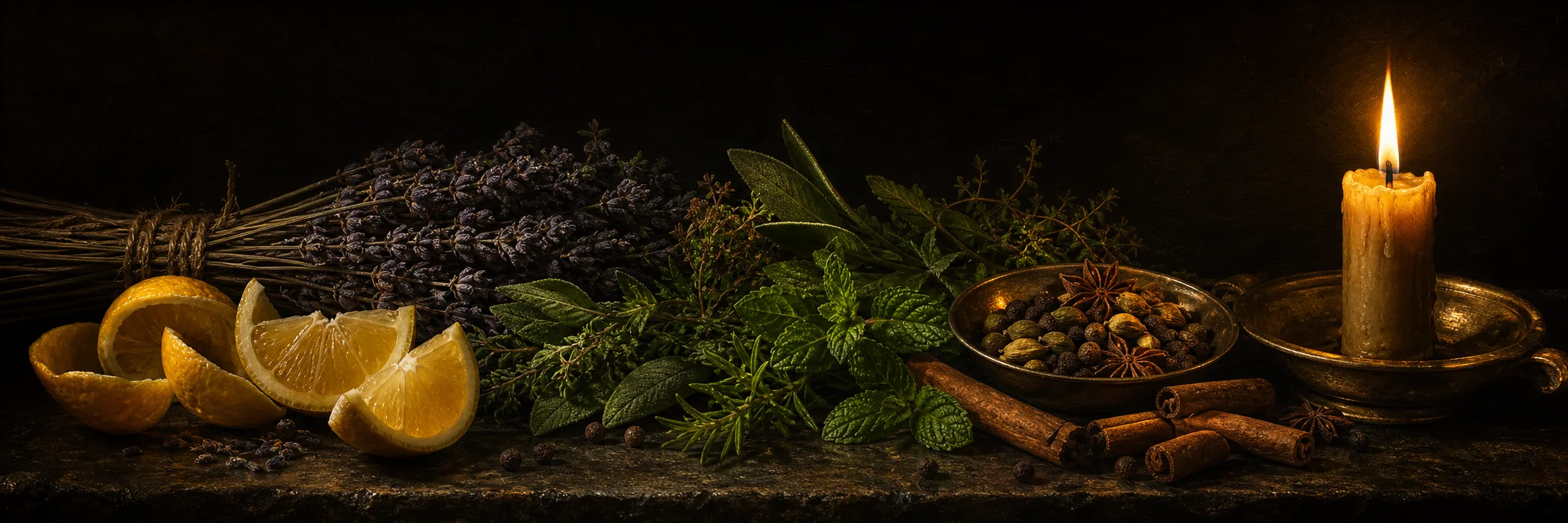
The signature is a sharp, soapy-citric aromatic opening that polarizes — a near-effervescent lemon-neroli blast once described as “a soaped up lemon, astringent champagne thing,” which some noses read as a cleaning agent. Underneath, lavender, basil, and herbs supply the classic fougère spine.
It moves into a warm, smooth spiced heart of nutmeg, cinnamon, black pepper, and a cooling mint. Here the two versions diverge most: a deep-vintage bottle can fire a “smokey/sweet” opening of “liquid cinnamon, honey, hot toddy” with real projection, far warmer and richer than the bright reissue.
The base is a classic fougère coda — oakmoss, musk, a touch of patchouli and vanilla — with the musk keeping it from tipping fully into old-school cologne. Linearity is moderate: the citrus-aromatic top is the dominant impression, and the spiced-mossy drydown is gentler and skin-close.
Performance
Performance diverges sharply by version, and this is the crux. The reissue is widely called weak and close-wearing — “felt for a few hours but remains close to the skin,” with one reviewer warning you must carry a decant to reapply. Vintage owners report the opposite: 12-hour-plus longevity and assertive projection. The reconciling read is that deep-vintage extrait and cologne concentrations performed strongly while the later reformulated EDT is a quiet, refined skin scent. It is best worn after a shower in warm weather, where the bright aromatic-mossy profile lingers transparently.
Wearing Context
Wearers place it as a spring and summer daytime scent — suited to casual, dressy, or office settings on sunny days — precisely because of the bright, soapy citrus, though its inoffensive softness makes it year-round-capable. It reads socially as a restrained, elegant “gentleman’s scent,” explicitly the opposite of a loud crowd-pleaser. It is comfortably unisex by modern standards, and the warm spice and vanilla can make a vintage bottle work as a cool-evening scent.
Comparisons & DNA
- Yves Saint Laurent Pour Homme (1971) and Gianfranco Ferré for Man (1986): the scents Chevalier is positioned as a precursor to — its historical interest is largely as their ancestor.
- Caron Pour Homme (1934): a reference for its heavy-lavender turns.
- D’Orsay Le Dandy and Étiquette Bleue: the in-house masculines wearers rank it alongside, with Chevalier often the daily-driver favorite.
- Jacomo de Jacomo and Azzaro pour Homme: named alongside the reformulated Chevalier in the “dark fougères of the 1980s” lineage for its heavy clove-cinnamon and resinous-woody emphasis.
Reception
Sentiment splits between reverence and disappointment, again along the vintage-versus-reissue fault line. Vintage devotees call it “the crown jewel of the house of d’Orsay,” a noble, harmonious aromatic that is “criminally overlooked.” Reissue-era critics can be harsh, one likening a current bottle to “three different cleaning sanitizers mixed together.” The balanced majority view is a high-quality, genuinely classic but weak-performing aromatic that rewards those who love the style and do not demand projection. It samples cheaply, but buyers must know which version they are getting — vintage tops may be faded or turned, and the reissue is a quiet skin scent.
Versions & Reformulation
The version history is consequential. The 1911 original ran in pre-WWII and mid-century cologne and extrait forms — deep vintage, warmer and stronger. At the niche relaunch, Chevalier was unusually reissued circa 1995 and again in 2008 in the “Intemporelle” range “remade just as they were” rather than modernized, making it one of the few d’Orsay scents kept faithful rather than rebuilt. Wearers describe the vintage and reissue as “two rooms in the same house”: same citrus-aromatic-woody shape, but the old one is dark wood-paneling and the reissue brighter, with fizzy powdery highlights over a paler creamy-coumarin musk. The house has since ceased operations, so all versions are discontinued.
Acquisition Notes
As a discontinued vintage-classic with low collector hype, Chevalier is comparatively affordable on the secondhand market, with vintage decants available through specialist splitters. The key risk is not counterfeiting but condition: deep-vintage citrus tops are prone to fading or turning, so a vintage bottle is a gamble on storage. Dating d’Orsay bottles is difficult, with batch numbers that are hard to decode. Decide deliberately between a riskier, stronger, warmer vintage and a safer, weaker, brighter reissue.
Notable Facts & Lore
- Parfums d’Orsay was founded in 1908 to preserve the perfume legacy of Count Alfred d’Orsay, the celebrated dandy.
- The name became both the brand’s tutelary figure and, in 1911, the name of this perfume, launched as the first Paris boutique opened on the Boulevard des Italiens.
- Multiple wearers connect it to Mad Men, recalling the show’s repeated “Chevalier, Chevalier” refrain (a fictional account) that drew curiosity-buyers to the d’Orsay name.
- Marie Huet acquired and revived the house in 2007, updating classics before it again wound down.