D'Orsay — Intoxication d'Amour (Vintage)
Essence
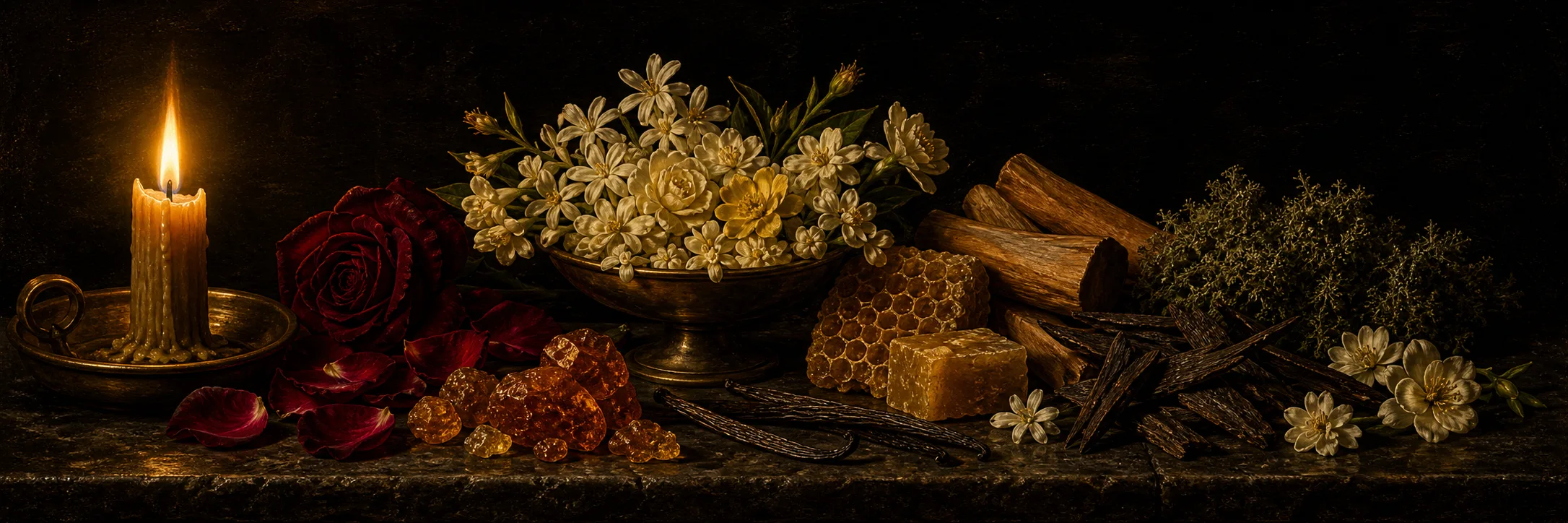
The 1942 Intoxication d’Amour is a classical floral-oriental that reads more polished than resinous. Its surviving profile suggests a fruit-tinted white-floral opening, a softened floral heart, and a sandalwood-oakmoss base that gives the perfume a dressed vintage finish rather than a heavy amber wall.
Scent Profile
The structure starts with tangerine, gardenia, rosewood, and blackcurrant: bright fruit and creamy white florals rather than a smoky or balsamic opening. The most detailed wear account reads the first impression as rich muguet and gardenia lit by orangey undertones, with enough green freshness to keep the perfume from feeling static. The heart is where the vintage floral character opens up. Honeysuckle, jasmine, lily of the valley, violet, rose, and peach make the center soft, sweet, and slightly powdery. A perceived lavender facet appears in the account even though it is not part of the published pyramid; that detail helps explain why the perfume can feel fresher and greener than its floral-oriental label implies. The drydown is the anchor: sandalwood rises steadily until it becomes the main tone, with vanilla, vetiver, and oakmoss giving sweetness, polish, and a moss-softened base. The sandalwood is described as pure and central, not a modern creamy abstraction. Overall, the perfume sits closer to old floral tailoring than to syrupy amber or contemporary fruity-floral sweetness.
Performance
The concrete performance evidence is narrow but useful: moderate sillage, very good projection, and roughly seven hours of wear in one detailed account. Because this is a discontinued vintage perfume, bottle condition can change the result dramatically. Treat any longevity expectation as approximate and dependent on storage, evaporation, and age.
Wearing Context
Intoxication d’Amour Vintage points toward dressed, classical wear. The floral opening is rich enough for formal daytime or evening use, while the sandalwood and moss base make it most natural in cooler weather, mild evenings, or indoor settings. It is not an overspray casual scent; it asks for the kind of context where a vintage floral can unfold slowly.
Comparisons & DNA
Reliable direct smellalike comparisons are scarce, which is itself useful: this should not be forced into a dupe map. Its DNA is best understood as a lightly fruited, moss-backed vintage feminine floral with a strong sandalwood finish. Within the D’Orsay catalog, its closest reference point is the later Intoxication d’Amour name, but the 1997 re-orchestration is a distinct composition rather than a simple continuation. The safer comparison is conceptual: the 1942 perfume belongs beside classical floral woods and moss-softened feminine perfumes, not modern syrupy ambers.
Reception
Reception is thin but clearly split. The positive side praises the rich white-floral opening, sweetened floral heart, sandalwood-led base, and classical sophistication. The sharpest negative reaction is simply that the vintage floral texture is a scrubber. With so few detailed accounts, neither side should be over-weighted. The practical consensus is sample or test only if possible, especially outside a collector context. People who already enjoy older floral woods, sandalwood-heavy drydowns, and moss-softened vintage femininity have the best chance of finding it elegant. People unsure about vintage textures should treat the warning seriously.
Versions & Reformulation
The version story is essential. The 1942 scent was re-orchestrated in 1997, and the later Intoxication d’Amour is treated as a separate composition. Commentary on the later release says it was sold as both eau de parfum and eau de toilette and that its composition bore no relation to the original. In practice, “Intoxication d’Amour” is not enough identification by itself; the vintage 1942 composition must be distinguished from the later reworked release and from the adjacent D’Orsay Intoxication line.
Acquisition Notes
This is a discontinued vintage hunt, not a normal retail purchase. The key acquisition task is identity control: confirm that a listing is for Intoxication d’Amour Vintage from 1942, not the 1997 re-orchestration and not the separate Intoxication line. No reliable current price, common size, decant, counterfeit, or batch-code pattern is established from the available evidence. Condition matters enormously.
Notable Facts & Lore
- The important lore is practical rather than romantic: 1942 original, 1997 re-orchestration, and a separate Intoxication line can all blur together in searches.
- The 1997 Intoxication d’Amour was sold as both eau de parfum and eau de toilette.
- The later composition is described as bearing no relation to the original.
- The vintage profile is unusually dependent on bottle condition, because surviving examples may vary by storage and age.
- The published pyramid omits the lavender facet perceived in the most detailed wear account.