D'Orsay — Intoxication
Essence
Intoxication, as catalogued here, is the 2006 eau de parfum reissue of D’Orsay’s classic 1938 chypre-floral - a department-store relaunch sold in a replica of the original bottle. The 1938 original was a powdery, oakmoss-based white-floral chypre of the inter-war “proper lady” school, famously advertised with the line “Someone beautiful just passed by, someone wearing Intoxication.” The 2006 version is best understood as a thinned, IFRA-era reformulation of that classic: per the documented account of a longtime reviewer, it is the original “minus the neroli, amber, oak moss and styrax” - which is to say, the reissue keeps the floral chypre silhouette but loses much of the mossy, resinous depth that defined the vintage. It is a comfortable, slightly old-fashioned floral chypre rather than a cutting-edge composition.
Scent Profile
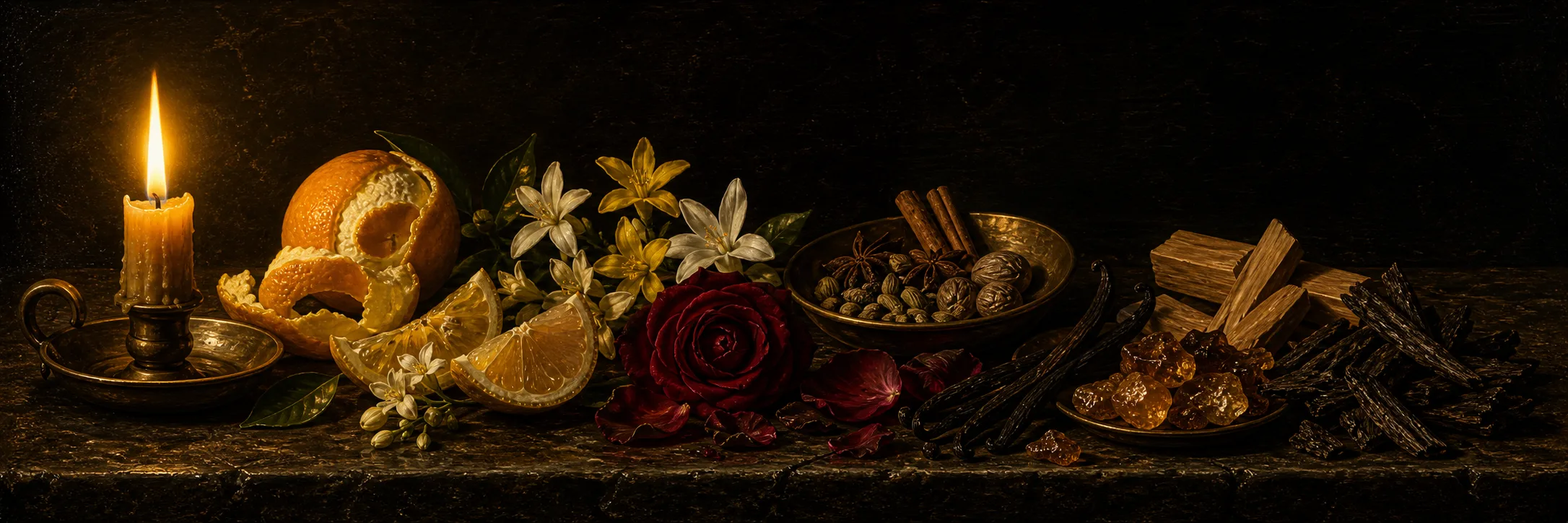
Reading from the catalog notes and vintage/reissue descriptions, Intoxication opens bright and a little sharp: bergamot, lemon and mandarin, sometimes read with a sparkling, faintly aldehydic lift. The heart is a classic indolic white-floral bouquet - lily of the valley, jasmine, rose, orange blossom and ylang-ylang, with nutmeg adding a warm-spicy facet - that several vintage wearers describe as powdery and “soapy,” dialed to “Victorian levels of proper.” The base in the catalog (benzoin, tonka, patchouli, sandalwood, vetiver, musk) gives a sweet-balsamic, lightly woody-mossy finish; one vintage owner called the effect “floral champagne poured into a real amber glass,” another “spicy oriental overtones on a smoky, boozy, oakmoss base.” The crucial caveat: the 2006 reformulation reportedly lacks the neroli, amber, oakmoss and styrax of the original, so the reissue reads cleaner, sweeter and less mossy/animalic than the vintage descriptions that dominate online. It is largely linear in the reissue - a powdery floral chypre that holds its shape.
Performance
Hard data is thin and complicated by the vintage-vs-2006 confusion. aggregated wearer reports for the 2006 entry suggest good longevity and strong sillage, but the evidence is thin and may be colored by vintage bottles. Vintage parfum/EDT owners consistently report robust, long-lasting wear typical of the era’s oakmoss bases - one noting it “smells a lot better in the air surrounding me than it does pressing my nose to my skin.” For the 2006 EDP specifically, evidence is too sparse to commit to firm hours; the reformulation, stripped of oakmoss and styrax, most likely performs more modestly than the vintage. Treat performance claims with caution and assume the reissue is the lighter of the two.
Wearing Context
This is cool-weather, classic-perfumery territory. a detailed review detailed reviewer pegs it as a conservative, “Suzie Homemaker” floral chypre - something “everyone’s grandmother would have worn to church or family picnics,” and imagines it as “the perfect office fragrance for a secretary or receptionist in a film noir.” As a practical reading: best for autumn/winter or cool days, daytime, and settings where a polished, slightly retro floral reads as appropriate. It explicitly warns there is “no suggested context for use in a modern setting unless you’re around people who appreciate vintage style” - so the social skew is toward classic, mature, understated taste rather than contemporary trend.
Comparisons & DNA
Intoxication sits in the powdery floral-chypre lineage. a detailed review reviewer positions it as “a precursor to the later Evyan White Shoulders (1945) and Nina Ricci L’Air du Temps (1948)” for its clean white-floral heart over a bitter base, while explicitly contrasting it against the louder icons of its day - it is “not the golden floral glow of Patou Joy (1930) or the soap-meets-civet dance of Coty L’Aimant (1927),” but a chypre “made safe” by dialing up powder and white florals. A vintage owner compared it to Bal à Versailles “but without the civet bang.” So the DNA is genteel, conservative floral chypre - adjacent to White Shoulders/L’Air du Temps but more restrained than the era’s animalic blockbusters. No modern designer clone exists; this is a heritage scent.
Reception
Among the small circle of vintage chypre enthusiasts who have tried it, reception is warmly respectful but measured. a detailed review in-depth review gives it “thumbs up, but with admonition that this one is only for die-hard oakmoss chypre lovers,” judging it “unremarkable outside of quality, like all but a few landmark D’Orsay perfumes” - well-made but never an icon. Vintage owners are more affectionate, praising its “mossy vintage feel” and balsamic-floral warmth. The polarization axis is era-taste: lovers of classic powdery chypres appreciate it; modern noses “thoroughly unaccustomed to a stern perfume without sugar and fruit” may find it soapy or dated. There is also genuine confusion in wearer reports between the vintage and the 2006 reformulation, which muddies consensus. Blind-buy verdict: only for committed vintage-chypre collectors who know which version they’re chasing.
Versions & Reformulation
This fragrance has a tangled multi-version history. The original Intoxication launched in 1938 (powdery floral chypre, oakmoss base). A flanker, Intoxication d’Amour, appeared in 1997 (and a separate vintage Intoxication d’Amour dates to 1942) - the 1997 composition reportedly “bore no relation to the original.” The entry catalogued here is the 2006 eau de parfum reissue, sold in upscale department stores in a replica of the original bottle, and documented as a reformulation of the 1938 scent “minus the neroli, amber, oak moss and styrax.” Vintage parfum, parfum de toilette and eau de toilette concentrations (in the pleated Lalique-style bottle) also circulate. Buyers should be precise about which Intoxication and which year/concentration they are acquiring, as the compositions differ materially.
Acquisition Notes
All versions are discontinued. The 2006 reissue and the various vintages turn up on the secondary market (eBay, Etsy, specialist vintage decanters and “fragrance vault” - type sellers offering 1950s - 60s EDT samples). Pricing is collector-driven and variable rather than tiered retail. The chief acquisition risk is not counterfeiting but version confusion - vintage parfum in crystal flacons versus the 2006 department-store EDP versus the 1990s/2000s reissues all share the name and similar bottles. Note also that the modern D’Orsay house (relaunched and restyled multiple times, including under Marie Huet from 2007 and again from 2020) is a completely different creative entity and does not sell this classic Intoxication. No batch-code authentication guidance is documented; buy from reputable vintage sellers and verify the era.
Notable Facts & Lore
- The lore is wrapped up in D’Orsay’s own curious origin: the house was founded in 1908 by investors trading on the romantic name of Count Alfred d’Orsay, the long-dead 19th-century Bonapartist dandy, though he never actually owned it.
- Over the decades it outsourced to noted perfumers including Henri Robert (who went on to Coty and then Chanel).
- Intoxication launched on the eve of WWII in 1938 and was one of the house’s more commercially durable early creations, surviving long after discontinuation - a wearers suggests it was likely more popular with 1960s American “baby boomers” than with 1930s shoppers.
- Its period advertising tagline - “Someone beautiful just passed by, someone wearing Intoxication” - and references in vintage-perfume literature (Barbara Herman’s Scent and Subversion) keep it alive in collector memory.
- One vintage reviewer romantically imagined it as what Holly Golightly might have worn stepping out of the cab in front of Tiffany’s.