D'Orsay — Oud et Bois
Essence
Oud et Bois is a 2014 D’Orsay oud composition that behaves less like a fashionable oud statement and more like a dry, resinous, controlled study in woods, smoke, earth, and amber. Some catalogs index the same release as Al-Kimiya - Oud et Bois with a richer note set, but the character is consistent: oud turned polished, dark, and contemplative rather than sweetly commercial or aggressively animalic. Its appeal is restraint, not shock value.
Scent Profile
The opening leans on a sweet amber, the most approachable moment in an otherwise austere composition. Beneath it the woods arrive quickly: dry sandalwood, smoky resins, and an oud that reads more resinous than barnyard.
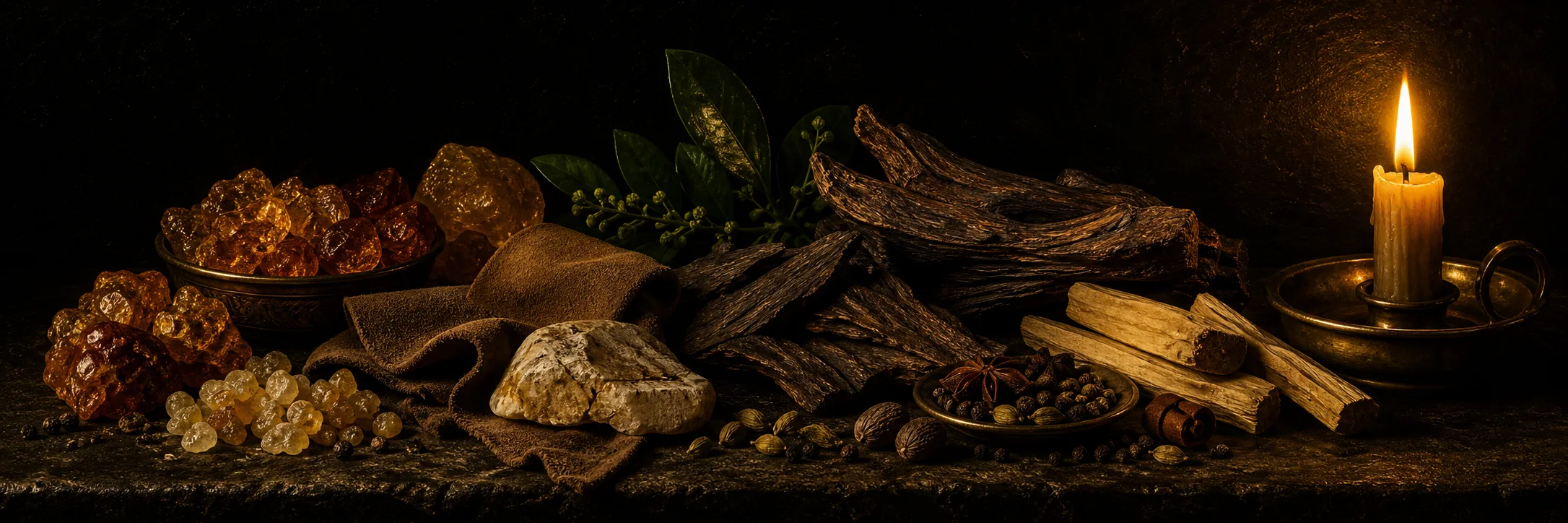
Fuller accounts expand the structure well past the minimal three-note listing — Laotian oud, Australian sandalwood, labdanum, amberwood, cypriol, elemi, frankincense, and patchouli — and the wear bears that out, with patchouli-soft earth, a cypriol harshness, and even a chocolate-dust effect over dark soil. The texture is dry and multifaceted rather than glossy.
Notably, the fragrance is built almost entirely from base-note material and does not develop in the usual top-heart-base sense. Instead it holds a slow, dry, smoky-amber-woody continuum, sharpening and softening by degree rather than changing character. The result is a steady, contemplative aura rather than a staged performance.
Performance
Performance is strong but never a sledgehammer. Longevity is long — one detailed account reports around 9.5 hours on skin and suspects it could go further — while projection is moderate and described as noticeable but perfectly controlled. The overall profile is long-wearing and steady, more a persistent resinous aura than an oud bomb. A light hand suffices.
Wearing Context
The mood is almost self-selecting. The fragrance evokes late autumn fog, bare trees, gray skies, and inward-looking calm, which makes cool weather, evening wear, and contemplative use its natural habitat. It suits settings where a darker scent should read refined rather than loud — a gallery, a dinner, solitary reading, quiet tailoring. It is a poor match for high heat or for anyone wanting rose-oud opulence, sweetness, or crowd-pleasing lift. It wears comfortably across genders.
Comparisons & DNA
The clearest reference is Gucci Intense Oud: Oud et Bois opens in that neighborhood but reads as better-quality and more niche, drier, more resinous, and more patchouli- and cypriol-textured, more concerned with earth and wood than with easy amber gloss. Broadly it belongs to the restrained woody-resinous oud family rather than the rose-oud, candy-amber, or leather-oud subtypes — a useful distinction for anyone expecting a sweeter or more floral oud.
Reception
Reception is strong but measured, solid support for a relatively quiet niche release. Praise centers on material quality, dry multifaceted woods, controlled smoke, and the way it can win over people who normally dislike oud. Criticism centers on austerity, a sense of barrenness or incompleteness, skepticism toward the layering concept, and straightforward price resistance. The recurring verdict is that it is admirable but taste-specific and expensive, so it is not an obvious blind buy — not because it is poorly regarded, but because it asks for the right wearer.
Versions & Reformulation
The main version question is naming, not formula. One catalog lists it simply as Oud et Bois with a minimal oud/sandalwood/amber structure; another lists it as Al-Kimiya - Oud et Bois, credits Amelie Bourgeois, supplies an expanded note set, and frames it as a base-note composition conceived for layering. These appear to be two framings of the same 2014 release rather than separate perfumes. No reformulation is documented, though the fragrance now appears to be discontinued.
Acquisition Notes
Pricing points to a small-format niche release — one reference cites EUR 185 for 40 ml, and 40 ml appears to be the standard size. It is now apparently discontinued, so availability is limited and likely through specialist channels. Because it is expensive and taste-specific, sampling before committing is sensible. Reliable information on counterfeits or batch codes was not found.
Notable Facts & Lore
- The fragrance is composed only of base notes, an unusual structural choice that explains its lack of conventional top-to-base development.
- It was conceived to work two ways: as a standalone perfume and as a layering tool that adds depth to another fragrance.
- Wearers split on that intent — some write at length about pairing it with other D’Orsay perfumes; others insist it is already complete and should be worn alone.
- Some catalogs index it as Al-Kimiya - Oud et Bois and credit perfumer Amelie Bourgeois, with a much fuller note set than the minimal listing.
- It now appears to be discontinued, having been a small-format, relatively expensive niche release.