D'Orsay — Intoxication (Vintage)
Essence
A 1938 chypre-floral from a house built on the borrowed glamour of the long-dead dandy Count d’Orsay, Intoxication is - somewhat against its name - a conservative, soapy, powdery white-floral chypre over a chewy oakmoss base. It is the “safe,” proper end of the late-1930s chypre spectrum: a perfume that dialed up muguet, neroli, and powder to “Victorian levels of proper” while keeping a faintly animalic, smoky-resinous undertow. Significant less as an innovator than as a beautifully made, long-lived example of a style that has vanished from modern shelves.
Scent Profile
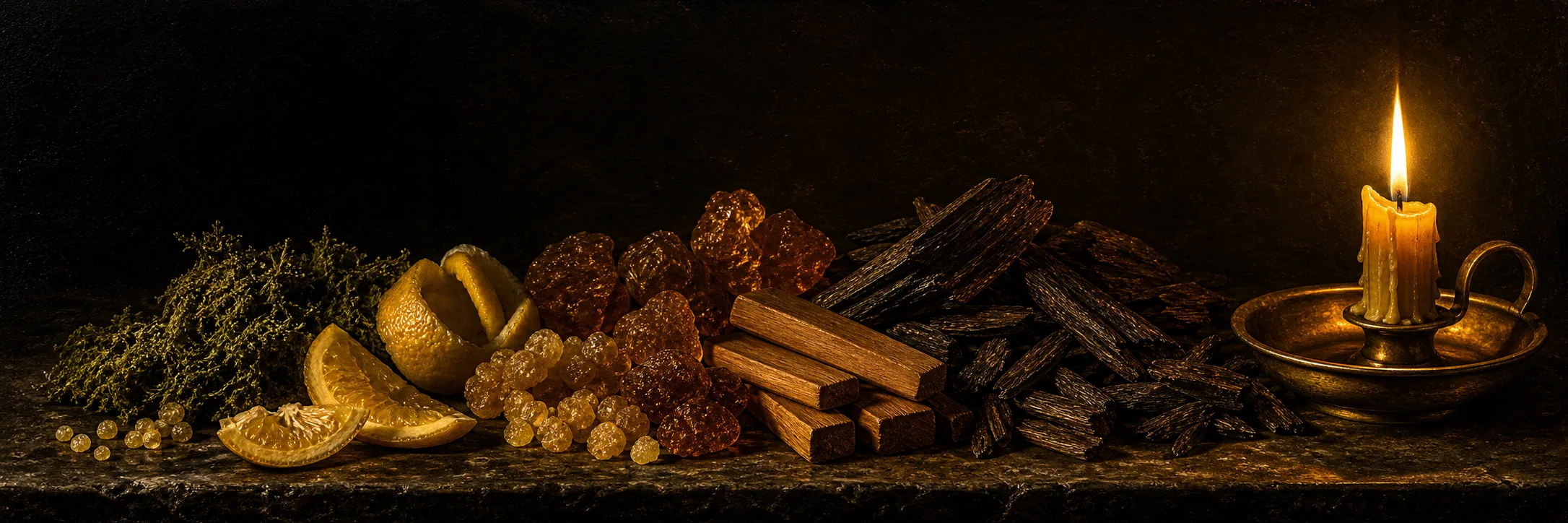
The catalog’s compressed pyramid (styrax/citrus top, floral heart, amber/oakmoss base) maps onto a much fuller historical note list reconstructed by collectors: a citrus-aldehyde opening (bergamot, lemon, mandarin) over indolic rose and jasmine, soapy neroli, muguet and ylang, a piquant nutmeg/clove edge, drying to sandalwood, amber, nitro-musks, vetiver, buttery oakmoss and a skin-growl of styrax. The Scented Devil (Varanis Ridari) gives the most precise read: the opening is “straightforward sour bergamot and mandarin with lemon, and a few zingy aldehydes,” leading “right into indolic rose and jasmine paired up with the contradiction of soapy neroli,” before drying to “a powdery French savon accord” with “a hint of skin growl with styrax.” Yesterday’s Perfume describes “sharp, sparkling, and sweetly floral” florals with “an animalic undertow” that “smelled like civet,” resolving into a drydown that is “warm (ambery/vanillic), woody, spicy and animalic.” Crucially, on aged bottles the citrus top has often “not survived the years,” plunging wearers straight into the velvety rose-jasmine heart. Signature accord: powdery soap-and-moss with a faint animalic warmth.
Performance
Performance reports come from aged stock and vary with bottle condition, so treat them cautiously. Varanis Ridari, testing a vintage EDT, reports it “really wears like an eau de parfum in terms of longevity, with sharp but not overbearing sillage for 3 hours then reducing to a powdery skin feel after 7 or so hours.” A wearers of (assumed) vintage was more effusive: “strong sillage, great projection and a stunning thirteen hours of longevity.” The honest synthesis: robust, long-lived classic-era performance, generally lasting most of a day, with projection that is present but not aggressive. Parfum concentration and well-sealed bottles will outperform decanted/aged EDT.
Wearing Context
By the documented profile this is autumn/winter and cooler-weather wear - wearer reports calls it “beautiful in autumn and winter.” It carries an unmistakably mid-century, dressed-up register; Varanis Ridari suggests “no suggested context for use in a modern setting unless you’re around people who appreciate vintage style,” imagining it as “the perfect office fragrance for a secretary or receptionist in a film noir.” Multiple reviewers attach a domestic, “everyone’s grandmother would have worn it to church or family picnics” association - proper rather than seductive despite the name. Best for vintage enthusiasts and formal/daytime settings rather than club or warm-weather use.
Comparisons & DNA
This is well-contextualized by sources. Varanis Ridari situates it as “a precursor to the later Evyan White Shoulders (1945) and Nina Ricci L’Air du Temps (1948)” for its clean white-floral heart over a bitter base, while explicitly contrasting it against the era’s icons: “not the golden floral glow of Patou Joy (1930) or the soap-meets-civet dance of Coty L’Aimant (1927),” nor as severe as Avon Unspoken (1975). It is “comparatively casual” and conservative versus the dangerous florals of its day - Yesterday’s Perfume frames it as “sexy and bright rather than dark and dangerous like Narcisse Noir, or verging on poisonous like Fracas.” A wearer likened the mossy vintage feel to Jean Desprez Bal à Versailles “but without the civet bang,” and a commenter relayed a MakeupAlley comparison of the drydown to Serge Lutens Daim Blond. Yesterday’s Perfume also draws a personality parallel to Revlon’s Intimate - “something playful and fun about its sexiness - something American, maybe, rather than French.”
Reception
Reception splits along enthusiast lines. Among the small circle of vintage collectors who’ve tried it, affection runs high: Yesterday’s Perfume’s author declares “I’m intoxicated by Intoxication,” and the post is anchored by a moving memory story (a woman named Tommie Jean for whom it was the first perfume her husband bought her, in Ft. Worth in the courting days). wearer reports carries warm reviews calling it “one of D’Orsay’s masterpiece chypres.” The structural criticism is about significance, not quality: Varanis Ridari’s verdict is “thumbs up, but with admonition that this one is only for die-hard oakmoss chypre lovers,” judging it “unremarkable outside of quality” and a perfume that “falls by the wayside in regards to hobbyist interest.” Aged-bottle funkiness is a real caveat - one wearer reports owner found a “goopy brown resin in the bottle” that nonetheless “smelled fine.”
Versions & Reformulation
There are multiple distinct “Intoxication” entries to disambiguate. The 1938 original is the subject here. D’Orsay later issued Intoxication d’Amour (1997, by Yves Tanguy) and a 2006 chypre-floral simply titled Intoxication - wearer reports full pyramid for the 2006 version (bergamot/lemon/mandarin; muguet, jasmine, rose, orange blossom, ylang, nutmeg; benzoin, tonka, patchouli, sandalwood, vetiver, musk) is widely (and confusingly) quoted on vintage listings. Yesterday’s Perfume explicitly flags that “Intoxication has been reissued, so the following notes might be for the reformulation.” For practical purposes the vintage parfum/EDT (1938 through circa 1960s - 70s production in the fluted Verreries Brosse flacon) is what collectors mean by “vintage Intoxication”; later reissues are different juices.
Acquisition Notes
Discontinued; available only on the secondary market (eBay, Etsy, vintage dealers, decant houses). Found in parfum, parfum de toilette and EDT, in several flacon styles - collectors note the Verreries Brosse fluted bottle and a Chanel-cube-like sealed crystal flask from the mid-1960s/early-70s. Decants and 1ml samples of 1950s/60s juice circulate through vintage-fragrance dealers, which is the sensible way to test before committing to a full bottle. No counterfeit problem of note; the real risks are evaporation, turned top notes, and mislabeling across the various Intoxication editions. Condition (sealed, boxed, minimal evaporation) drives price far more than concentration.
Notable Facts & Lore
- Intoxication’s cultural footprint is largely visual and nostalgic.
- Its bottle was manufactured by Verreries Brosse, and period-photo lore places a bottle on the vanities of Hollywood figures - Jayne Mansfield’s vanity is documented as displaying it.
- Yesterday’s Perfume names 1930s comedic actress Carole Lombard as the scent’s imagined “patron saint.” The house lore itself is part of the story: per the brand’s own history, d’Orsay was assembled in 1908 by investors - named as Siegfried and Sally Berg, Leo Fink, and M.
- Van Dyck - trading on the name and coat of arms of Count Alfred d’Orsay (1801 - 1852), the “most fashionable man” of his London circle, who had dabbled in perfumery; they “went to great lengths, including acquiring a grand castle to serve as the company’s headquarters” to manufacture an aristocratic image (a wearer reports contributor notes packaging still claims “since 1830”).
- The perfumer for Intoxication is unknown.
- The ad line “the champagne fragrance that whispers ‘Someone lovely has just passed by wearing Intoxication’” is house marketing and should be read as such.