D'Orsay — Etiquette Bleue
Essence
Etiquette Bleue is the foundational fragrance of the house of D’Orsay and one of the most romanticized objects in mainstream perfume lore - a citrus-oriental cologne wrapped in a love story. The legend, repeated on the catalog and the house’s own materials, is that Count Alfred d’Orsay composed it in 1830 as a secret gift for his beloved Marguerite Gardiner, Lady Blessington (a married Irish novelist), and that because the love was forbidden the perfume carried no name - only a blue label (étiquette bleue). It is genuinely important as a historical artifact: a fresh hesperidic cologne grafted onto a soft, powdery, balsamic-woody base, which a detailed review editorial framing argues “looks forward nearly a century to modern niche perfumery trends” of the long-lasting luxury cologne. The catalog dates it 1830 and lists a fully fleshed-out citrus/orange-blossom/woody-amber pyramid; that dating is part of the lore, and the truth is more complicated (see Versions & Reformulation).
Scent Profile
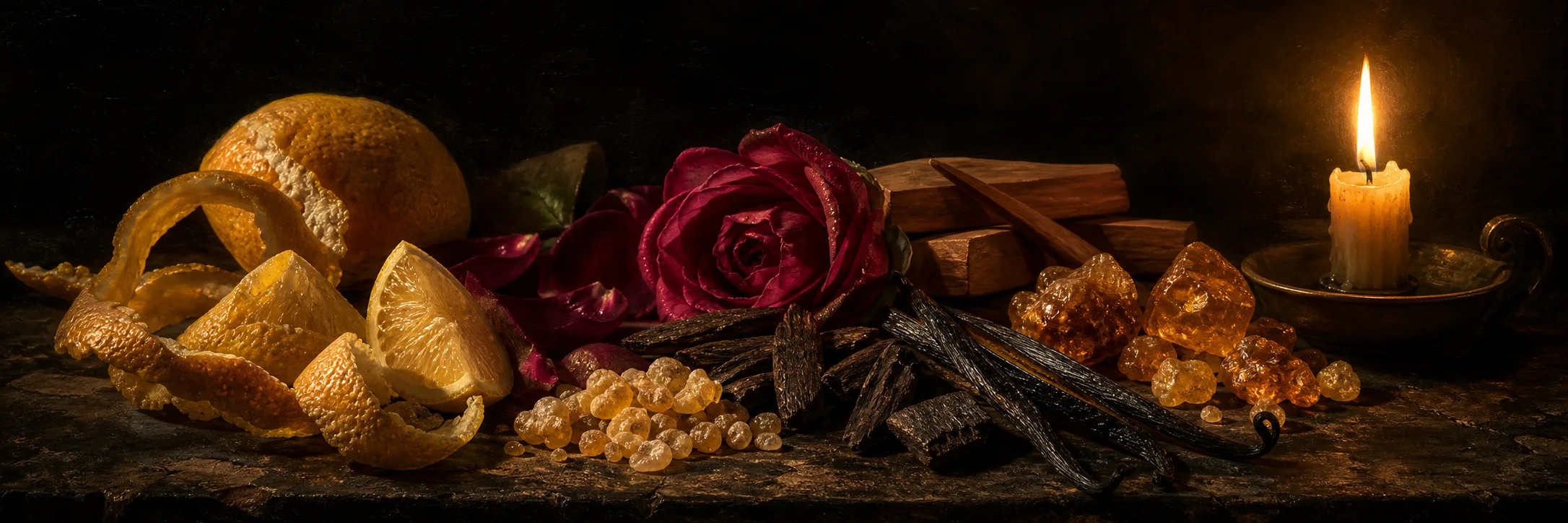
For all the marketing romance, the structure is a refined eau de cologne with ambitions. It opens bright and bracing - Amalfi lemon, bergamot, orange and an aromatic rosemary that several reviewers read as more lavender-like and “stringent,” a genuine wake-up call. But unlike a standard cologne it doesn’t evaporate into nothing: the heart turns on a soft, non-soapy orange blossom/neroli that mellows the citrus into sweeter territory, and the base - sandalwood, vanilla, amber, with the myrrh/opoponax and oakmoss often cited from the older formulas - pulls the whole thing into warm, powdery, slightly balsamic territory. The most repeated comparison among knowledgeable wearers is to Guerlain L’Heure Bleue and Habit Rouge: imagine, as one wearers put it, “if L’Heure Bleue experienced a bright, sunny, cool autumn day following its previous brooding night.” It’s a cologne with a powdery oriental soul.
Performance
Performance is the perennial knock and depends heavily on which formulation you have. The modern (2008) reconstruction is widely described as quiet and short-lived - wearer reports notes a lifespan “of about two hours” with limited sillage and projection, best as a hot-weather office scent. Other reviewers find the base lingers surprisingly long in a soft, close, powdery way even after the citrus burns off, and one describes an “eau de toilette double extrait” version wearing more like an EDP that lasts 12 hours with close sillage. The consensus: bright and beautiful but fleeting up top, with a quiet powdery-woody drydown of variable tenacity. Frequent reapplication is the standard advice, which makes a small decant unsatisfying.
Wearing Context
This is a genuinely unisex, all-occasion cologne that skews toward warm-weather and daytime use - spring, summer, hot office days - while its powdery sweetness lets it stretch into autumn. Multiple reviewers note that, despite wearer reports historically filing it as a women’s scent, it reads as easily masculine or even more so; one recounts that at her grandparents’ German drugstore it was bought more by men than women, while women reached for D’Orsay’s Tilleul. It’s a “re-calibrating” scent - Olfactoria’s Travels’ Birgit called it exactly that, a baseline that “lets me breathe free again and reminds me of what is ‘normal.’” Think of it as a sophisticated, slightly nostalgic 4711 upgrade rather than a statement perfume.
Comparisons & DNA
The dominant comparisons are to classic Guerlains - L’Heure Bleue (for the powdery sweet base married to citrus) and Habit Rouge (for the citrus-over-warmth structure, though Etiquette Bleue is cooler-spicy and less intense). Reviewers also place it a clear step above 4711 Echt Kölnisch Wasser in both complexity and longevity, and in the same conversation as Mugler Cologne (in the top) and the classic Guerlain colognes. a detailed review editorial framing positions it as a historical forerunner to the entire modern “long-lasting luxury cologne” category later mined by Thierry Mugler and Bond No. 9. Within the house, its natural companion is Tilleul, D’Orsay’s beloved linden soliflore.
Reception
Among classic-cologne devotees Etiquette Bleue is quietly cherished, sometimes rapturously so - one long-time wearer reports collector ranked an old sealed bottle among the very few perfumes that “actually surpass” excellence, citing the “perfect fusion of highest quality petitgrain and orange blossom/neroli.” Olfactoria’s Travels’ Birgit (review dated September 8, 2011) loved its bracing citrus-rosemary opening and “the delightful evolution… by in a matter of minutes.” Detractors find it too old-fashioned, too soft/short, or, in the modern version, a touch synthetic in the citrus and “powdery balsam” - one wearers dismissed the deep drydown as smelling “like a Glade candle.” It is, by general agreement, more historically significant than thrilling in a contemporary context.
Versions & Reformulation
This is where the romance meets the archive. The catalog and house lore date the perfume to 1830; a detailed review editorial and several historians instead date the commercial fragrance to 1908, the year the Compagnie Française des Parfums d’Orsay was founded - and the Count, who died in 1852, never owned a perfume house. The reconciling facts: Alfred d’Orsay reportedly composed a personal “Eau de Bouquet” for Lady Blessington; the formula was rediscovered in 1865 (thirteen years after his death); and the house - founded in 1908 by a consortium (not the d’Orsay family) as the Compagnie Française des Parfums d’Orsay - commercialized it as the perfume now known as Etiquette Bleue. As one wearer reports contributor noted, the house “came up with a huge ad campaign on its ‘romantic’ origins, and in the 1940s even published an illustrated book shoring up the myth.” The modern juice is a 2008 reconstruction by Florent Leblanc; Olfactoria’s Travels (September 8, 2011) states it directly: “Allegedly created in 1830 for the Count d’Orsay and reconstructed in 2008 by Florent Leblanc, Etiquette Bleue contains notes of lemon, bergamot, orange, petit grain, rosemary, rosewood, orange blossom, sandalwood, balsam of peru and oakmoss.” Vintage splash bottles from the 1960s - 80s exist and are described as richer than the reissue. Crucially, the house itself has changed hands repeatedly: relaunched by Marie Huet (who bought it in 2007), then acquired by the Æra Nova group in 2015 and relaunched again in 2018 - 2020 under Amélie Huynh, with the historic line largely retired in favor of new “Portraits Équivoques” compositions. a detailed review editorial bluntly noted the older incarnation was “discontinued as house D’Orsay is dead again.”
Acquisition Notes
Etiquette Bleue in its 2008 D’Orsay form is discontinued and increasingly a secondary-market item. The good news, per wearer reports, is that it “isn’t particularly vaunted by vintage nuts so it shouldn’t be excruciatingly expensive to buy” - it’s collectible for house fans rather than a grail flipped at grail prices. Buyers should be clear about what they’re getting: vintage splash bottles (often Eau de Cologne, decades old) will smell richer and more characterful than the lighter 2008 reissue; the current Maison D’Orsay range under Amélie Huynh does not include the historic Etiquette Bleue. Given the well-documented longevity issues, buy a size you’ll actually reapply from, and sample the specific vintage/formulation before paying up.
Notable Facts & Lore
- The name means “Blue Label” - literally the blue ribbon/label on the original nameless bottle, chosen so the forbidden perfume need not be named.