D'Orsay — Flower Lust
Essence
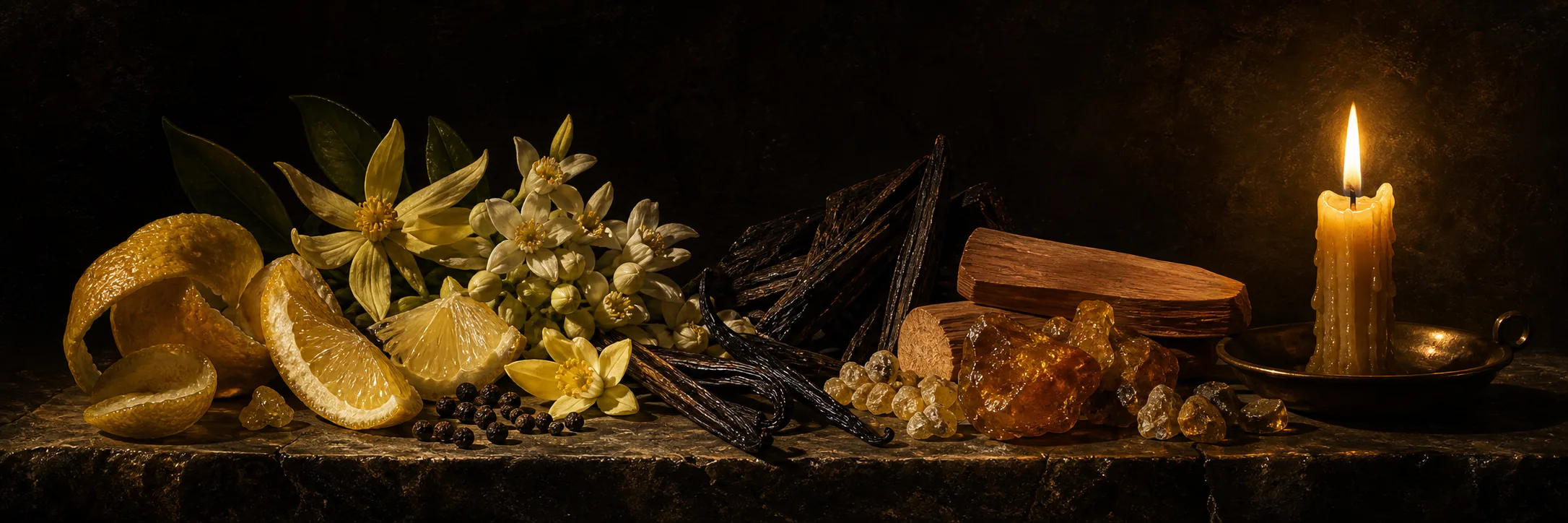
Flower Lust is a 2024 extrait de parfum by Dominique Ropion for the revived D’Orsay, the headline release of the house’s three-piece “Les Extraits” collection. It is a deliberately maximalist white-floral oriental — a peppered ylang-ylang and orange-blossom bouquet planted on a sweet, ambery tonka-sandalwood base. What makes it distinctive and divisive is that it reads as a knowing throwback to the loud florientals of the late 1980s and early 1990s, executed with modern materials at over 30% concentration.
Scent Profile
The opening is a peppery flash of pink and black pepper that most wearers report vanishes quickly, ceding to the heart almost at once.
The heart is the fragrance’s center of gravity: a dense duo of ylang-ylang and orange blossom. Ropion chose his ylang for a leathery, almost animalic dimension and the orange blossom for an addictive honeyed quality, and that carnal-honeyed white-floral mass dominates the wear.
The base is where the warmth lands — tonka, benzoin, and sandalwood deliver a sweet, ambery, faintly powdery drydown, with patchouli and vetiver adding a resinous shimmer rather than earth. The woods stay submerged as structural support. After the pepper burns off it is close to linear: a sustained candied-floral hum rather than a sequence of chapters. A minority of wearers report a polarizing medicinal or cough-syrup facet in the first minutes, which fades.
Performance
Marketed as an extrait concentrated over 30%, it reads as above-average in projection and longevity, though experience splits. Many report heavy, room-filling projection; a dissenting subset finds it surprisingly intimate, with strong longevity but quiet sillage. The reconciliation is that longevity is reliably strong, most of a day, while projection is potent but skin-dependent. Given the density and sweetness, one or two sprays is the sensible dose, and it leans cold-weather — at least one wearer found it too dense for warm weather.
Wearing Context
This is an evening and cold-weather fragrance by temperament: a dense, sweet floriental several wearers flag as too much for heat. It suits dinners, nights out, and occasions where presence is the point, and would feel wrong in a hot office or a gym. Socially it skews feminine-glamorous in the vintage-powerhouse sense, though it is sold unisex and some men report wearing and enjoying it. Its strongest association is nostalgia for the huge-white-floriental mood, so it reads as confident and maximalist to those who love that era and old-fashioned to those who do not.
Comparisons & DNA
- Givenchy Amarige (also Ropion): the dominant comparison — wearers call Flower Lust “a re-worked Amarige,” a bit tamer and more expensive-smelling but still a touch kitschy.
- Lancôme La Vie Est Belle (also Ropion): the gourmand-sweet cousin, summarized as “the niche La Vie est Belle.”
- Giorgio Armani Code Femme and Jil Sander Jil: cited for the sweet-flowers-plus-pepper combination.
- Giorgio Beverly Hills: the late-80s powerhouse-floriental mood it deliberately evokes.
It is not a dupe of any of these — it is a contemporary, extrait-concentration restatement of the peppered-white-floriental family Ropion helped define.
Reception
Reception is genuinely polarized, a textbook love-it-or-hate-it release. Admirers describe it as “a floral dose of excess” and intensely sexy, praising Ropion. Detractors find it very strong and very sweet, with a drydown likened to candy, “too cloying and almost headache-inducing.” A recurring middle position is disappointment despite loving Ropion: wearers who expected an Alien or Carnal Flower caliber masterpiece found it underwhelming and familiar. The two recurring axes are the candied sweetness level and a minority medicinal opening. Given how exactly the sweetness and vintage-floriental register divide opinion, it is a sample-first proposition.
Versions & Reformulation
Single composition, no known reformulations. It launched in September 2024 as one of three D’Orsay extraits; its siblings Tonka Hysteria (a powdery tonka-iris) and Incense Crush (a smoky incense-woods) are separate fragrances, not flankers of Flower Lust.
Acquisition Notes
Flower Lust is niche-priced and sold as an extrait de parfum in 50 ml and 90 ml, with small travel formats and sample sets. A US authorized retailer lists it at $240 for 50 ml, and the range across sizes lands roughly in the $200–260 band depending on retailer. Authentic channels include the D’Orsay site and established niche retailers. As a young, lower-volume release, counterfeiting is not a documented problem and no batch-code guidance is established; use the brand’s sample-with-purchase option given how divisive the scent is.
Notable Facts & Lore
- Flower Lust is built around D’Orsay’s revival narrative, which traces the house to an 1830 unisex perfume Alfred d’Orsay made for himself and Marguerite Blessington.
- Creative director Amélie Huynh frames the modern line around “states of love.”
- Ropion described the brief as “an olfactory encounter between 2 worlds evoking excess, passion and excessiveness… a kind of love potion.”
- He chose the ylang-ylang for radiance and a leathery, almost animalic quality, and the orange blossom for honeyed warmth.
- As of mid-2026 no major critic has formally reviewed it, itself notable for a Ropion composition.