D'Orsay — Tilleul
Essence
Tilleul is widely held as the reference-standard linden-blossom green floral — the one wearers repeatedly call “the queen of linden” (tilleul is French for the linden tree). It smells like standing under a linden in full bloom on a hot June afternoon: green, nectar-sweet, pollen-dusty, with a waxy honeyed undertow. The trick Olivia Giacobetti pulls is naturalism — it reads as the actual tree, flowers, leaves, bark, and the air around it, rather than a perfumey floral, which is exactly why it stands apart from cheaper linden-adjacent blends.
Scent Profile
The opening is a green-citrus splash: bitter lemon-tree leaf and a crisp watermelon-rind note that reads cool and watery rather than sweet-fruity, with several wearers also getting cucumber. That melon-cucumber freshness is brief — one wearer clocks the watermelon at roughly seven minutes — before the heart opens.
The linden-blossom heart is the centerpiece: green, tart, and honeyed in Technicolor, accented by an airy cyclamen that adds a watercolor transparency. This is the phase that earns the “queen of linden” reputation, rendering the flower with unusual realism.
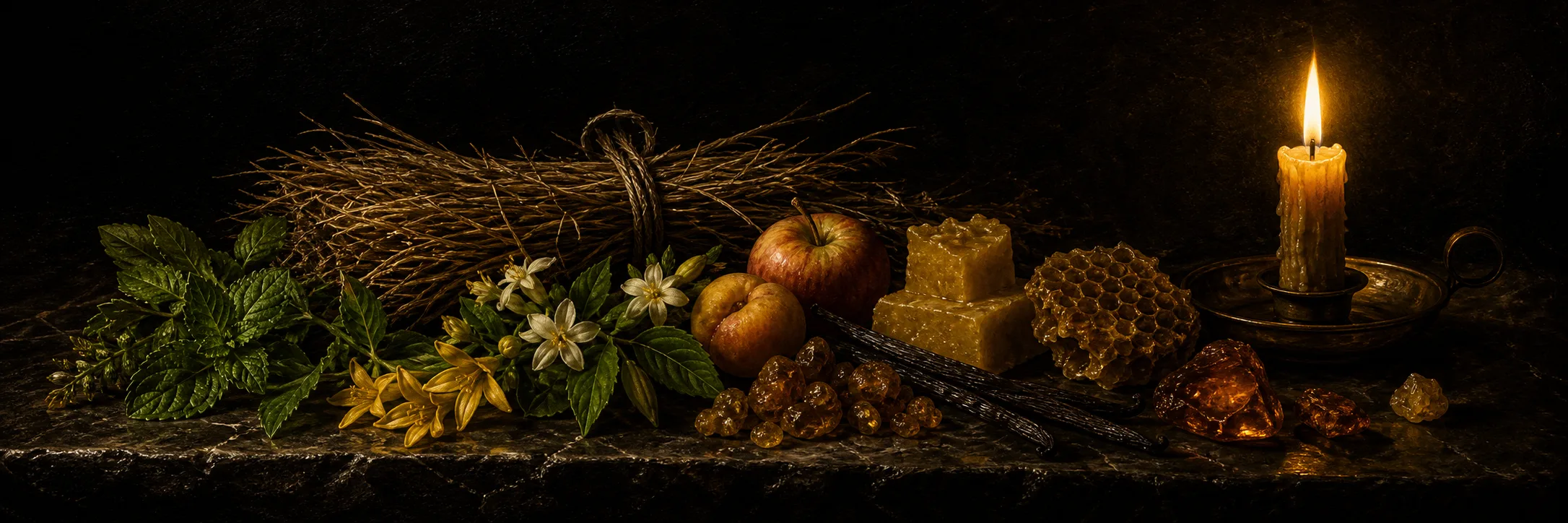
The drydown is the signature: cut hay plus golden beeswax, producing a faintly musty, honeyed, tea-in-the-pot warmth, with black locust adding a soft blond-wood depth. Opinions split on sweetness — some find it sheer and ethereal with no cloying honey, others find the beeswax oppressive after a while — and skin chemistry clearly swings the result.
Performance
Sillage is light and close to the skin, but longevity is better than expected for an EDT built on fugitive green-citrus material, because the hay-beeswax base is what lingers. Wearers report it lasting for hours, especially in heat, with one citing roughly ten hours on clothing, while others call the lasting power only so-so. The pattern is clear: heat amplifies and extends it, cool skin lets it evaporate. Projection is intimate, the kind that draws compliments at close range rather than across a room.
Wearing Context
Spring and summer, full stop — an olfactive postcard of nature. Wearers describe it as a hot-day, hammock-nap, walking-through-blooming-linden-trees scent that embodies June like no other, and it works beautifully in heat and humidity, though some wear it year-round as a winter promise of spring. It feels unisex despite the feminine classification, and was in fact marketed to men in the early 1970s.
Comparisons & DNA
The essential reference is Giacobetti’s own linden work. L’Artisan Parfumeur L’Ete en Douce, originally Extrait de Songe, is the close cousin, once described as essentially Tilleul with the honey replaced by musk over sun-dried cotton — making Tilleul the warmer, waxier, more honeyed of the two. Frederic Malle En Passant shares the same creamy transparent base and is frequently named alongside it. Acca Kappa Tilia Cordata is a budget realistic-linden option. Within the house, Tilleul Pour La Nuit swaps in chamomile and thyme, while Tilleul Friction de Nuit is a darker, denser, more concentrated night version.
Reception
Tilleul is strongly beloved among enthusiasts and widely called a masterpiece and one of Giacobetti’s finest. The dissent is narrow and predictable: people who simply dislike linden, or who read the beeswax as soapy or musty. A well-known paired review split cleanly — one writer named it a favorite summer fragrance, crisp with linden and citrus and settling into airy linden and hay with a pronounced beeswax honey, while the other found the powdery lime blossom almost musty. Critic Victoria Frolova of Bois de Jasmin treated it as the linden benchmark even while noting its waxy drydown. Notably, the major print critics in Turin and Sanchez’s Perfumes: The Guide appear to have passed it over without a star rating, surprising for a Giacobetti composition.
Versions & Reformulation
The catalog’s 1915-plus-Giacobetti entry conflates two things, and it resolves cleanly. The original Tilleul was created in 1915 and became the house’s most popular fragrance; Olivia Giacobetti, born in 1966, did not compose that original but reinterpreted it after the house was revived. The house’s own account dates her renewal to 1995, while some sources cite a 2008 reformulation. The likely reading is a 1995 revival-era reinterpretation, possibly tweaked again in 2008. Tilleul is now discontinued under that name, effectively relaunched as Vouloir Etre Ailleurs C.G. in 2020, again by Giacobetti, though opinion splits on whether the successor fully matches the original’s freshness.
Acquisition Notes
Tilleul is discontinued under its own name, so it means hunting vintage bottles or buying the spiritual successor Vouloir Etre Ailleurs C.G. new from D’Orsay. Decant houses historically carried it, with one listing a 50 ml around $75 in the 2010s. Anyone wanting the genuine Tilleul experience without the hunt should sample C.G. first, keeping in mind that opinion is divided on how closely it matches. For vintage, note the formula drift: 1990s bottles run a touch fleeter and faster-drying.
Notable Facts & Lore
- The Proustian resonance is intentional: tilleul (linden tea) and madeleines are the literal trigger of involuntary memory in Proust’s In Search of Lost Time.
- The house Parfums d’Orsay is named for the Comte Alfred d’Orsay, a famous 19th-century French dandy, though one account holds the company actually started in Berne around 1911 and used the name commercially.
- The 1915 original predates a long dormancy; the brand was revived in the mid-1990s and later passed to Amelie Huynh’s ownership.
- It feels unisex and was marketed to men in the early 1970s, despite its feminine classification.
- Tilleul has been relaunched as Vouloir Etre Ailleurs C.G., treated by the house as the same fragrance under a new name.