D'Orsay — Intoxication d'Amour
Essence
This is one of the trickiest entries in D’Orsay’s catalog to pin down, and any chat agent using this dossier should lead with that caveat. “Intoxication d’Amour” (1997) is a late-20th-century reworking tied to D’Orsay’s storied early-century perfume “Intoxication” - but it sits in a confusing thicket of three closely named releases: the original “Intoxication” (1938, a chypre floral), “Intoxication d’Amour” dated to 1942 (an oriental floral), and this 1997 version, which wearer reports catalogs separately with perfumer Yves Tanguy and a stripped-down “floral notes / sandalwood” pyramid. According to a knowledgeable wearer reports vintage collector, the 1997 release was “a failed attempt to create a flanker, Intoxication d’Amour, in 1997… sold in both eau de parfum and eau de toilette concentrations,” and crucially, “the composition bore no relation to the original.” wearer reports more gently calls the 1942 scent one that “was re-orchestrated in 1997.” Either way, the 1997 is a modern, simplified floral-sandalwood - not the smoky, animalic, oakmoss-laden vintage chypre that perfumistas prize.
Scent Profile
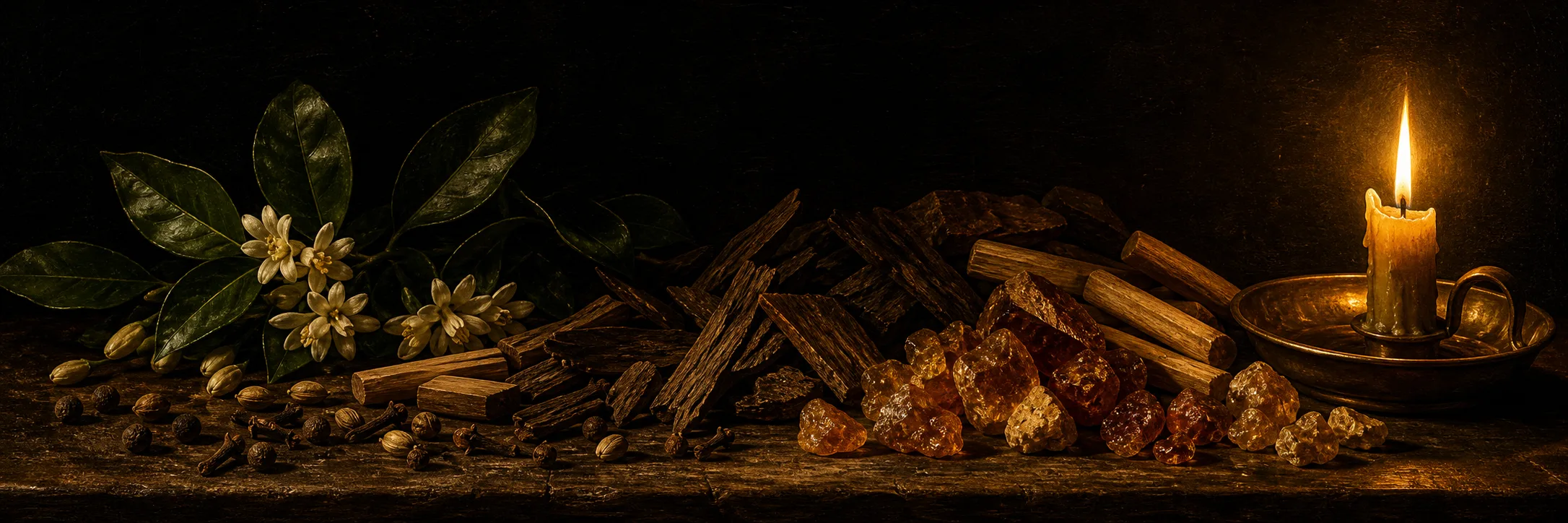
The best available scent description matching the 1997’s floral-sandalwood profile (from a wearer reports review on the d’Amour page) reads: “A rich white floral opening developed into a floral side and eventually opens up to develop a delightful sandalwood note, which gradually takes over. The opening florals a mainly muguet and gardenia, and they are freshened up by an orangey undertones… a very classical lavender arises, and the development heads into a sweeter territory, where peach and honeysuckle add depth and softness… It is a pure, cedar-free and without any spicy sidelines - simple and straightforward in a positive way. The sweetness is re-enforced by tonka and blends well with the wood and florals.” In short: muguet-and-gardenia white floral, an orange-tinged freshness up top, lavender bridging to a peach/honeysuckle sweetness, settling onto a clean, prominent, spice-free sandalwood base. This is markedly simpler and “cleaner” than the vintage Intoxication, which collectors describe as a “spicy Oriental… on a smoky, boozy, oakmoss base” with civet-like animalics.
Performance
wearer data is thin but consistent. wearer reports voters rate longevity qualitative praise and sillage 2.67/4 - moderate. The detailed wearer reports “moderate sillage, very good projection and seven hours of longevity on my skin,” which is solid for a clean floral. Treat these as small-sample figures.
Wearing Context
Marketed for women and recommended by retailers for evening wear, though the clean sandalwood-floral character reads as versatile and could work daytime. As a sophisticated, “classical” white-floral-on-sandalwood, it suits someone who wants a polished, slightly retro floral without the heavy animalic drama of true vintage perfumery.
Comparisons & DNA
The most important DNA point is the contrast with its own ancestors. The 1938 “Intoxication” is a landmark-style chypre (bergamot/citrus top; rose-neroli-jasmine-ylang heart; vetiver-patchouli-oakmoss-amber-styrax-civet base) compared by collectors to Bal à Versailles “without the civet bang.” The 1997 d’Amour deliberately abandons that structure for a transparent floral-sandalwood - which is precisely why the vintage wearer regards it as a lesser, unrelated creation. Within the modern simple-sandalwood-floral space it has cousins but no famous direct comparator in the documented sources.
Reception
Reception is essentially a vacuum at the critic level - no - 2 source reviewed the 1997 version, and it carries only a handful of user reviews across wearer reports. What enthusiast commentary exists is mildly positive (the wearers scored it qualitative praise, “Rich, classical and sophisticated - maybe a touch lacking structure at times, but overall delightful”). The dominant theme in the broader conversation, however, is disappointment that the d’Amour and later reformulations are not the beloved vintage. A chat agent should not present wearer love for “Intoxication” as applying to this 1997 release.
Versions & Reformulation
This is the heart of the confusion and must be communicated carefully:
Acquisition Notes
Discontinued. Found only on the secondary market - eBay, Etsy, and discount/closeout fragrance sites carry sealed 50ml EDT and 100ml EDP bottles. Because of the version confusion and replica bottles, buyers should scrutinize listings: a “replica of the original bottle” may be the 1997 flanker or the 2006 reformulation, not true vintage. Anyone hunting the prized smoky-chypre experience should specifically seek the 1938/1940s-era vintage parfum, not anything labeled “d’Amour.”
Notable Facts & Lore
- The house of D’Orsay was founded in 1908 (some sources say as early as 1865) by investors trading on the legend of Count Alfred d’Orsay (1801 - 1852), the celebrated dandy, painter, and sculptor who moved among Byron, Dumas, Dickens, Victor Hugo, and the future Napoleon III, and was reputed to be an amateur perfumer.
- The brand peaked in the early 20th century - by 1932 selling, per Wallpaper* magazine, “more than five million bottles a year,” with flacons by Baccarat, Daum, and Lalique and campaigns by Cocteau and Lepape.
- The name carries no actual aristocratic lineage; investors “selected the d’Orsay name and coat of arms to create the image” of a venerable French house.
- D’Orsay was relaunched as a contemporary niche house in 2015 under Amélie Huynh, which is why the brand today (Tonka Hysteria, Flower Lust, etc.) bears little relation to the late-1990s commercial era that produced this Intoxication d’Amour.