D'Orsay — Incense Crush
Essence
Incense Crush is a smoky, church-incense-forward extrait de parfum from the revived French house D’Orsay, composed by Julien Rasquinet and launched in September 2024 as part of a trio of high-concentration Extraits de Parfum. It is the literal embodiment of its name: a dense, charred frankincense-and-wood composition built on certified LMR Naturals by IFF materials, concentrated at over 30%. Its distinction is less the concept than the execution — a genuinely loud, ashen olibanum draped over creamy leather and dry cedar and oak.
Scent Profile
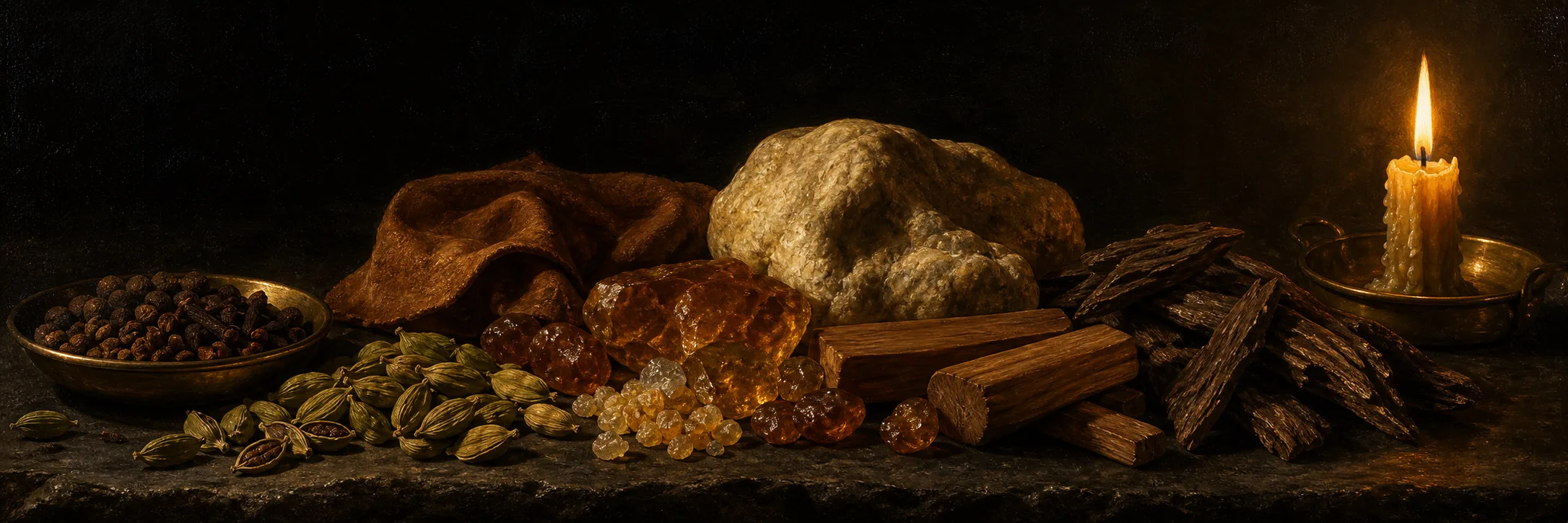
The opening is the signature event. It hits with charred, chalky, smoky olibanum and very little sweetness — wearers describe it as a fistful of incense ash blown into the face — brightened only slightly by cardamom and clove. This is church incense, the Boswellia kind, rather than a sweet or resinous “crystal shop” interpretation.
As it settles, a creamy leather accord emerges; many wearers identify leather as the most prominent facet of the heart. The critic Daniel of Leave No Cologne Unturned reads it as more about wood and smoke, picking up campfire smoke and a creamy sandalwood-and-varnish accord before a smooth leather rounds the edges.
The base is a dry, sawdust-like woodiness from cedar, oak, and vetiver — several wearers reach for “lumberyard” to describe it. The composition is largely linear: a smoky-woody-leather monolith rather than a shifting arc, best described as antique incense smoke over dry charred wood. The opening is loudest, after which it calms into the wood and leather.
Performance
Performance is a consistent strong point. The extrait projects heavily and lasts well over a workday — wearers report upward of ten hours, with one noting a single spray lasting nine hours on the wrist. The clear application advice is restraint: one spray is widely called sufficient, and overspraying risks a “house on fire” effect. It performs best in cool air, where the smoke and wood thrive.
Wearing Context
This is a fall and winter fragrance by near-unanimous read, evoking a wood pew in a medieval church in winter. It is best for evenings and cooler-weather daytime, and the brand itself frames it as evening wear. It shines in contemplative, indoor-leaning, or dramatic settings and can feel oppressive in heat or tight quarters such as a hot office or transit. Socially it reads serious, bold, and slightly austere — a statement and connoisseur incense rather than a crowd-pleasing compliment-getter. It is fully unisex. Newcomers to heavy incense may find the ashy opening polarizing, while incense fans treat it as a wearable daily smoke.
Comparisons & DNA
- Bois d’Ascese (Naomi Goodsir), also by Rasquinet — the closest campfire-smoke relative, though that one is often found more suffocating.
- Indian Study (Miller et Bertaux) — shares the creamy sandalwood-and-varnish accord, at a notably lower price.
- Comme des Garçons Avignon — a purer church incense with less of the leather and wood.
- Armani Privé Bois d’Encens — a colder, more mineral take on frankincense.
The broad DNA is the dry, smoky, unsweetened church-incense-plus-leather family. Recommendation engines sometimes surface sweeter scents like Xerjoff Naxos or MFK Oud Satin Mood, but those are less ashy and less faithful comparisons.
Reception
Reception is positive but openly polarizing. Praise centers on a hyper-realistic incense effect, excellent performance, and what many call a strong price-to-quality ratio. Criticism targets the harsh, ashy, chalky opening that some find bizarre or compare to furniture polish, plus an artificial-wood note a minority detect. The axis of polarization is incense tolerance: those who love church incense rate it among the best they have smelled, while those who do not find it suffocating. The critic Daniel went against the polarizing consensus, calling it the balanced pick of the trio and saying he wanted to wear it again. For committed incense fans it is a reasonable blind buy; everyone else should sample first.
Versions & Reformulation
There are no reformulations — this is a 2024 release. It exists as a single extrait de parfum concentration, stated by the brand at over 30%, and is part of D’Orsay’s three-piece Extraits de Parfum line launched alongside Flower Lust (Dominique Ropion) and Tonka Hysteria (Jordi Fernandez). There is no EDT or EDP sibling under the same name.
Acquisition Notes
Sold as extrait de parfum in 50 ml and 90 ml, at launch around €180 and €240 respectively — a mid niche price tier. It retails through major luxury department stores and D’Orsay’s own boutiques, and is widely available as samples and decants. One buyer noted that an aluminum bottle plus international shipping and tariffs made an overseas purchase unexpectedly expensive, a logistics caveat rather than a counterfeiting concern. As a recent niche release from authorized stockists, authenticity risk is low when bought from established retailers.
Notable Facts & Lore
- D’Orsay frames the entire Extraits line as “love potions,” marketing Incense Crush as a scent that opens the chakras and reveals one’s power of seduction — ad copy several reviewers met with eye-rolls.
- The house’s modern identity traces to Amélie Huynh, who revived D’Orsay in 2015 around the 19th-century love story of Alfred d’Orsay and Marguerite Blessington.
- The ingredients are certified LMR Naturals by IFF, a sustainability angle the house highlights.
- It launched as one of a trio of Extraits, alongside compositions by Dominique Ropion and Jordi Fernandez.
- A running thread of skepticism surrounds the industry-wide “extrait bandwagon” of houses launching high-concentration lines at premium prices.