D'Orsay — Le Dandy
Essence
Le Dandy is a 1923 floral-aldehyde parfum by the historic French house D’Orsay, composed by Henri (Henry) Robert - the perfumer who would later move to Coty and then to Chanel, where he created Chanel No. 19. Despite a defiantly masculine name (a nod to Comte Alfred d’Orsay, “the first dandy”), the original was a deeply feminine perfume: a plush, softly spiced, musky aldehydic floral built in the competitive wake of Chanel No. 5 (1921) and Guerlain Mitsouko (1919). It is essentially a “lost fragrance” - its original formula was completely abandoned, the house collapsed in 1983, and the name was later resurrected as an entirely unrelated boozy masculine (“Le Dandy Pour Homme,” 1999). What survives today exists almost exclusively as collector’s bottles, and it is best understood as a piece of perfume archaeology rather than a functional purchase. Crucially, this dossier concerns the 1923 original, NOT the 1999 reissue, which shares only a name.
Scent Profile
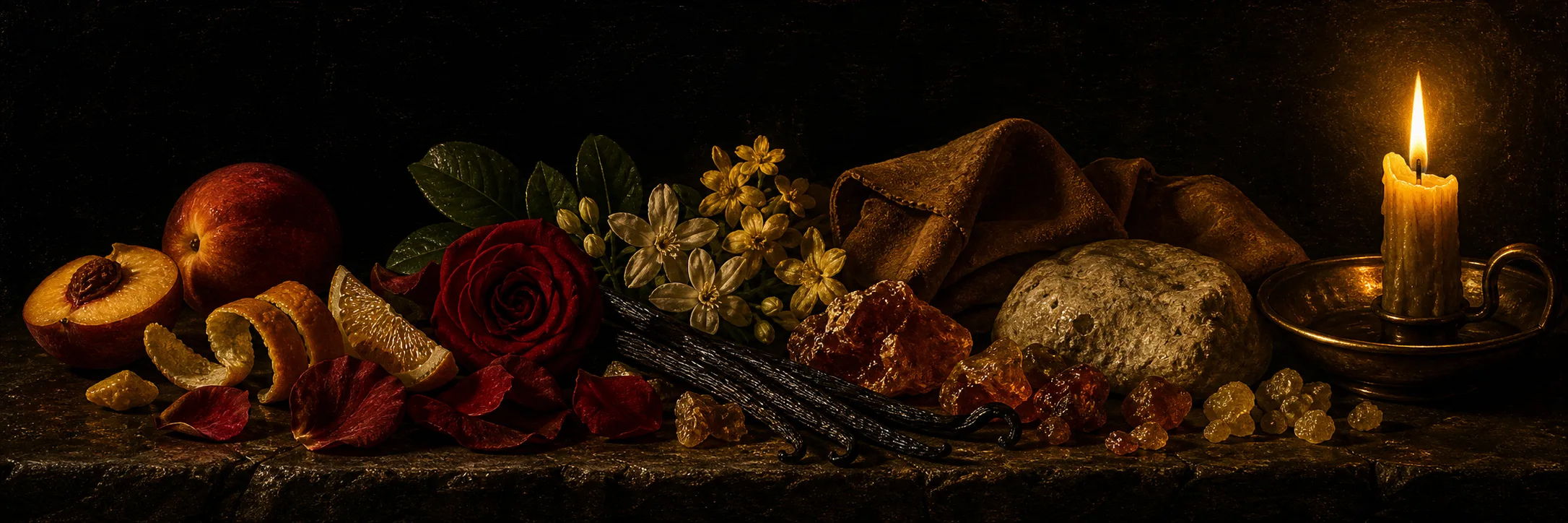
The vintage opens with the era’s signature gestures: aldehydes (duller and softer than No. 5’s sparkling “grande dame” treatment), a cold spice facet, carnation (eugenol), and fruity lactones. The heart is a soapy, powdery floral core - rose, jasmine, neroli/orange blossom, and powdery orris moving “as one” - with a touch of indole in the jasmine but less than later florals like Lanvin Arpège. The base is where the period character lives: sandalwood, oakmoss, coumarin standing in for tobacco, a balsamic-resinous warmth, and “something a bit sharp and leathery” that critic-collectors liken to a Mousse de Saxe effect. Barbara Herman, smelling a near-century-old sealed bottle, described it as “a beautifully plush, softly spiced, musky floral, a bit like Caron Nuit de Noel (1922) crossed with No. 5… gorgeous jasmine, rose, carnation (eugenol), an amaretto cookie note, and buttery nitromusks.” Several vintage-bottle owners report it has aged into a more straightforwardly No. 5 - adjacent warm woody-floral with old-school animalic/indolic facets; the listed leather, vanilla, tobacco, and tonka register as a soft, powdery sweetness rather than discrete notes. Linearity: it moves slowly and seamlessly from aldehydic-floral to powdery-woody-mossy. Signature accord: soapy aldehydic rose-jasmine over a mossy, sandalwood-and-musk “Mousse de Saxe” base.
Performance
Reliable performance data is limited because nearly all wearers are sampling decades-old juice, where age has altered the composition. The one substantive period-formula assessment from a critic (The Scented Devil), based on a vintage bottle, reports wear time “over 12 hours” with the scent staying “very present for most of it, trailing off into sandalwood savon and moss only at the end” - consistent with the heavy oakmoss-and-sandalwood naturals of the era. one source classifies the vintage parfum’s longevity as “above-average.” This reflects the parfum/extrait concentration (one collector noted the juice stains paper, suggesting extrait strength) and 1920s materials no longer permitted. Real-world projection on aged samples is naturally diminished and variable; some collectors report a glorious surviving scent, others a degraded “tart floral drying down to talcum powder.” Treat any performance claim as concentration- and age-dependent.
Wearing Context
As a functional matter this is barely a wearable proposition in 2026 - it’s a collector’s and educational piece. To the extent it’s worn, the critic consensus (The Scented Devil) places it in spring or fall: “too powdery for summer and not warm enough for winter.” Its character is formal, mannered, and mature - described as “properly dandy and most likely to be worn by a mature woman with a sense of propriety.” Wearing vintage Le Dandy today is framed less as fitting an occasion than as a statement of connoisseurship: as one critic put it, you become “the walking version of The Osmothèque,” trailing century-old oakmoss and real sandalwood, likely the only person in the room who knows the value of what you’re wearing. It is the opposite of a crowd-pleasing modern signature.
Comparisons & DNA
The dominant comparison is Chanel No. 5 (1921): multiple vintage-bottle owners say aged Le Dandy smells “incredibly similar to Chanel No 5 Eau de Cologne,” and Herman positioned it as “Caron Nuit de Noel (1922) crossed with No. 5.” The Scented Devil also flags that Le Dandy’s “soapy rose core almost feels like a presage to Yves Saint Laurent Rive Gauche (1971)” - a striking historical rhyme, since Rive Gauche’s perfumer Jacques Polge would later succeed Henri Robert at Chanel. As an exercise in conventional 1920s floral craft, it sits in the broad family of period aldehydic florals (Arpège, etc.), distinguished by its softer aldehydes and mossy, faintly leathery base. The critical consensus is blunt that it was always more derivative than groundbreaking - “in comparison to those, Le Dandy must have felt more like ‘le dowdy.’” Note: it has NO meaningful relationship to the 1999 “Le Dandy Pour Homme” (a boozy whiskey/rum/plum gourmand by Dominique Preyssas) or the later “La Dandy/Femme de Dandy” feminine - these are separate compositions sharing only the name, and a frequent source of database confusion.
Reception
Among the small wearer of vintage collectors and historians who’ve actually smelled it, reception is respectful rather than ecstatic. Praise: a beautiful, elegant, plush period floral; gorgeous real-jasmine and carnation; an object of genuine historical interest in a coveted Art Deco bottle. Criticism: derivative of better-known contemporaries (especially No. 5); some samplers, working from degraded juice, got only “tart floral drying down to talcum powder” and gave up. The strongest polarization axis is simply vintage-condition and expectation: collectors smelling well-preserved extrait are enchanted; those with oxidized samples are baffled. There is no “blind buy” verdict in the normal sense - it cannot be bought new - but the collector verdict is that a sound bottle is a rewarding piece of perfume history, while a degraded one is not worth the chase.
Versions & Reformulation
The original 1923 composition by Henri Robert was produced largely unchanged until the house’s collapse in 1983, then completely abandoned - the formula was not carried forward (a lost formula or discontinued supplier base is the suspected cause). The name was revived for two entirely unrelated modern fragrances: “Le Dandy Pour Homme” (1999, Dominique Preyssas - a woody-spicy boozy gourmand of whiskey, rum, plum, peach, spices, tobacco) and the feminine “Femme de Dandy”/“La Dandy” (c. 2001/2010 - a fruity-spicy peach-cinnamon floral). In 2022, D’Orsay also released “Dandy or Not. G.A.” by Sidonie Lancesseur, a modern black-tea-and-leather reinterpretation tied to the original’s legacy. These share branding and inspiration, not juice. So: the 1923 original is a single, now-lost composition; the “Le Dandy” name has multiple distinct successors.
Acquisition Notes
Not available new. The 1923 original survives only on the vintage/collector market (eBay, Etsy, specialist dealers, the International Perfume Bottle Association circuit). Bottles appear as the black-glass Art Deco flacon designed by Louis Süe (often credited Süe et Mare, i.e., Louis Süe and André Mare) and manufactured by Baccarat, in octagonal and square forms ~3½” tall, with later versions reportedly by Cristalleries de Nancy. Prices are condition-driven: empty or partial flacons trade roughly in the low tens to low hundreds of dollars, while factory-sealed full bottles with original cording/box command significant “very rare” premiums (precise sale prices are hard to verify - most listings are asking prices, not confirmed hammer results). Counterfeiting is less a risk than misattribution and dating: reputable vintage sellers stress careful dating and warn against listings that conflate launch year with bottle age. There are no modern batch codes. Buyers should expect age-degraded juice and prioritize sealed examples from knowledgeable dealers.
Notable Facts & Lore
- The launch year is genuinely disputed across authoritative sources - 1922, 1923, and 1925 all appear (one source says 1923; D’Orsay’s own materials and several bottle catalogs say 1925; Herman writes “1922, some say 1923 or 1925”).
- The name honors Comte Alfred Guillaume Gabriel d’Orsay (1801 - 1852), the celebrated 19th-century dandy and successor to Beau Brummell as London society’s arbiter of elegance - though the house itself was only founded in 1908 and never actually belonged to the Count.
- The most persistent myth, debunked by Barbara Herman, is that Le Dandy was “originally marketed to men”: she “found no evidence of this in the vintage ads,” noting D’Orsay sold Le Dandy - scented face powder and lipstick, confirming a feminine product line; wearer reports concurs the original was “dedicated to women.” The bottle’s designer Louis Süe also designed Patou’s flacons including the iconic Joy bottle.
- Perfumer Henri Robert served at D’Orsay through the late 1920s - early 1930s before his moves to Coty (1934) and Chanel (1952).
- The fragrance’s disappearance is tied to the collapse of Parfums d’Orsay in 1983 (president Jacques Guérin stepped down in 1982); the house was revived in 1993 by Groupe Marignan, which chose to create new “Dandy” scents rather than reconstruct the lost original.
- A macabre bit of wearer lore (unverified) jokes about Wall Street men “wearing this fragrance” during the 1929 crash - apocryphal color, not fact.