D'Orsay — Nous Sommes Amants. M.D.
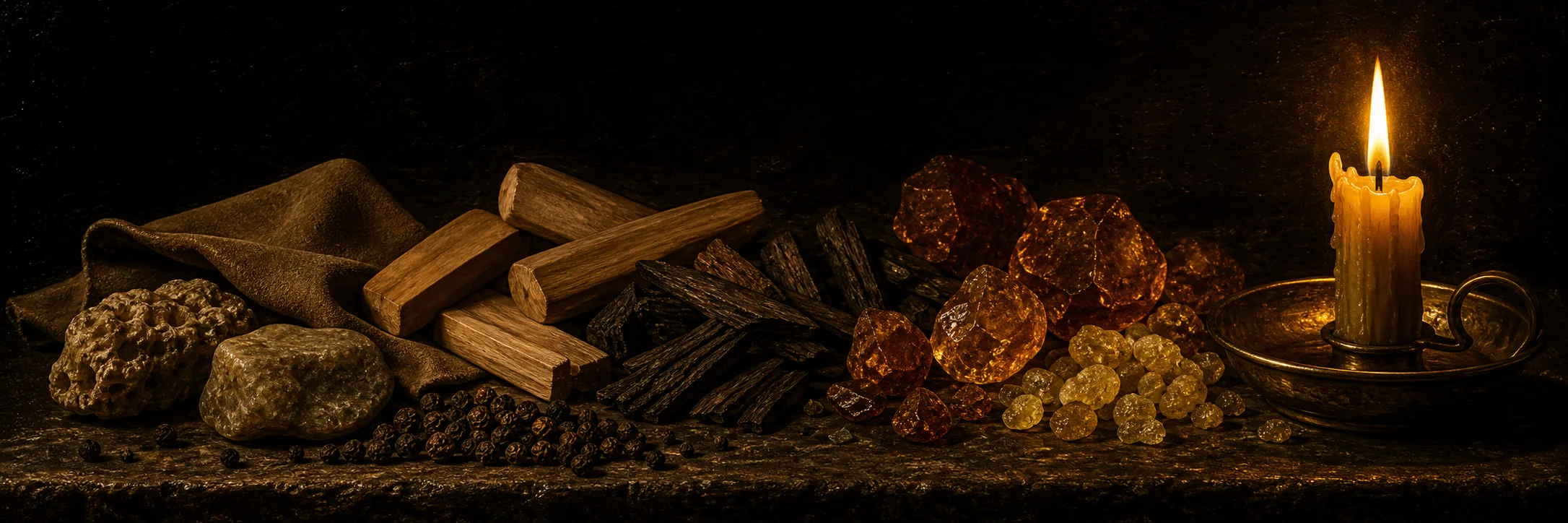
Essence
Nous Sommes Amants. M.D. is Bertrand Duchaufour’s 2022 (some databases list 2021) reworking of D’Orsay’s vintage masculine Le Nomade for the relaunched, Amélie Huynh - led house. Per D’Orsay’s own copy it is “a unisex interpretation of Nomade, a fragrance originally created for men in 1976,” whose “aromatic warmth of Caraway and Sage, hallmarks of the original fragrance, is reworked around Palo Santo.” The “M.D.” initials follow the house conceit of signing each scent with a secret personality’s initials - and as Çafleurebon guest writer J Wearescentient notes, the title “Nous Sommes Amants” (We Are Lovers) “definitely refers to one of [Marguerite Duras’s] most famous books ‘The Lover’ from 1984,” though the house never confirms M.D. is Duras. In practice the perfume is a palo-santo - forward woody-spicy skin scent - a cool, peppery, dry-wood meditation built to read as bare skin rather than statement perfume.
Scent Profile
The defining architecture, per the brand, is “monolithic head-heart-base,” anchored on palo santo and crossed by “a note of hot milk, interpreted by a very particular molecule: sulfurol.” That lactonic-creamy thread is the conceptual hinge, though wearers rarely call it out by name. What wearers consistently report is a cool, “molecular” opening - juniper berries, bamboo, and the black/pink pepper duo giving what one wearer called a “juicy” green edge and a “fresh-spicy and slightly floral hue.” The palo santo arrives smoky and dry-aromatic; several note its resemblance to actually burning the wood at home (“smells the way the wood you burn in your house smells”). The drydown is a soft, dry sandalwood-cedar base - warm but not smoky, with cypriol (nagarmotha) and a leather accord adding faint earthy darkness and ambergris lending diffusion. The recurring descriptor across catalog listings is “pencil shavings” / sharpened-pencil cedar. A reviewer captured the intended duality nicely: “a scent of polar opposites: cool gin and tonic + hot milk, damp bamboo + dry palo santo.”
Performance
This is deliberately quiet. Multiple wearers describe it as “sort of hard to smell nose to skin” while it “wafts all around,” and as a skin scent lasting “the whole day” in faint form. One representative wear-test: “Doesn’t last insanely long, but I got a good hour or two out of it.” The honest read is moderate-to-low projection, a fast collapse to skin-scent within the first hour, and respectable but close longevity - typical of Duchaufour’s transparent woody style and of the EDP concentration here (listed at ~79.7 - 80% alc.). Expect an intimate radius, not a room-filler. If you want palo santo that announces itself, this will frustrate; if you want it as a second skin, it succeeds.
Wearing Context
A genuinely seasonless, gender-agnostic woody skin scent that skews to cooler months for the dry-wood coziness but works year-round given its lightness. It’s office-safe to the point of near-invisibility, ideal for close-contact/“skin-to-skin” intimacy (the entire marketing concept), and for people who, per the brand, “often find fragrances overbearing.” Reviewers repeatedly land on “cozy,” “comforting,” and even “a lovely gift for a teacher.” Not a club/projection scent and not a formal statement fragrance.
Comparisons & DNA
The overwhelming reference point in wearer discussion is Le Labo Santal 33 - but stripped down. wearers describe it as “similar to Santal 33 but with all of the green and creaminess removed. The wood here is warm and dry but not smoky,” and elsewhere as Santal 33’s “flaccid sandalwood.” Detractors group it with “Papyrus Molecule or Santal 33, but greener and even more feminine.” Its true lineage, though, is internal: it is explicitly a modern reinterpretation of D’Orsay’s own Le Nomade (the vintage 1970s masculine), itself frequently likened to a modern Cartier Déclaration. Within Duchaufour’s catalog it sits in his transparent-incense/dry-wood family alongside his palo-santo and woody-smoky work.
Reception
Polarized but tilting positive among niche buyers, with a clear split. Enthusiasts call it “Gorgeous, gorgeous, juniper and palo santo woody fragrance from BD” and praise its natural, true-to-life palo santo. Skeptics find it thin and derivative: “Not the most interesting or memorable by Bertrand Duchaufour,” “I could buy this for cheap at Urban Outfitters,” and the memorable dissent that “it smells like a pencil.” A notable minority report a barnyard reaction to the opening (“reminds me strongly of horse droppings”). There is no published critic review of the scent itself - Çafleurebon’s only D’Orsay coverage touching it is J Wearescentient’s vintage-Fantastique piece, which uses M.D. only as a jumping-off point and states “I have yet to smell” it. So reception here rests on wearer reports rather than critic consensus.
Versions & Reformulation
Sold as EDP in 10ml, 50ml, and 90ml. Note that the house and some catalogs date it 2021 while one source lists 2022 - likely a soft-launch vs. wide-release gap rather than a reformulation. No reformulation is documented; it remains in production and the brand calls it “one of the best sellers of the Maison D’ORSAY.” The composition descends from the discontinued vintage Le Nomade, so think of M.D. as the living reinterpretation of that older idea rather than a scent with its own version history. Listed allergen/ingredient panels (limonene, hydroxycitronellal, citral, linalool, eugenol, etc.) are consistent across current retail.
Acquisition Notes
Widely available from the official D’Orsay site and authorized niche stockists (Aedes, ZGO, Nose Paris, Clare V., etc.); US retail runs about $140 for 50ml / EUR in Europe. Because performance is intimate and the style is divisive, this is a strong sample-first candidate - decants are easy to find. The 10ml is a sensible entry given the close-wearing nature. No authentication minefield here; it’s a current-production niche release, not a hunted discontinuation.
Notable Facts & Lore
- The “M.D.” almost certainly nods to Marguerite Duras: “Nous Sommes Amants” evokes her 1984 novel The Lover (L’Amant), and the house’s signature gimmick is naming each scent like a love letter signed with a hidden personality’s initials - a system devised under creative lead Amélie Huynh, who revived D’Orsay in 2015.