D'Orsay — J'approchais Un Mystère A.C.
Essence
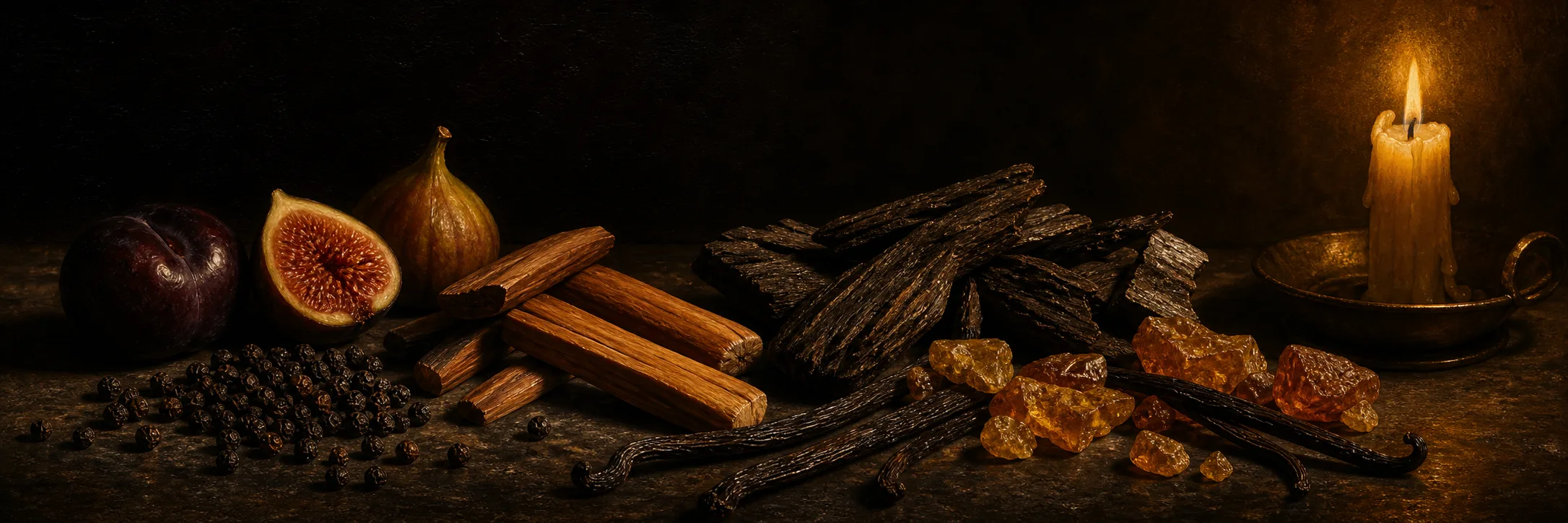
J’approchais Un Mystère A.C. is a woody-green unisex EDP from the relaunched Maison D’Orsay, composed by Anne-Sophie Behaghel around a deceptively simple idea: cedar and “crumpled leaves.” Built on a pink-pepper and fig-leaf top, a double-cedar heart of Atlas and Virginia cedar, and a creamy sandalwood base, it evokes a magnetic, nature-rooted personality — the house describes the unnamed wearer “A.C.” as a filmmaker as beautiful and majestic as a tree. In practice it is an elegant, intimate fresh-woody that opens green and leafy and dries down to a much-admired creamy sandalwood. D’Orsay has since re-positioned it as a modern reading of the house’s 1911 fragrance Chevalier.
Scent Profile
The opening is fresh, crisp, and leafy — a green fig-leaf brightness lifted by a piquant, slightly aniseed pink pepper. It reads more like crumpled green leaves than like fruit or spice.
Within an hour the cedar takes over. A generous, dry, woody dose of Atlas and Virginia cedar dominates the heart — several wearers reach for “pencil shavings,” and mean it as a compliment. Fig leaf threads a green-milky creaminess through this stage, keeping the wood from turning harsh.
The development is fairly linear through the woody middle, but the consistently celebrated phase is the late drydown: a soft, creamy, slightly nutty and caramelized sandalwood that wears close to the skin and earns near-rapturous praise. Note records differ slightly — the brand and some sources also list pepper leaf, oakmoss, white musk, and a touch of Madagascar vanilla — and a minority of wearers read the scent as far smokier and more incense-like, with a sacral, church quality, against the green-creamy-woody majority.
Performance
Performance is the central caveat. Reports vary widely with skin chemistry: some wearers get a respectable five to six hours, while others find it fades to almost nothing quickly. Sillage is consistently intimate — it rarely projects beyond arm’s length, by design. The recurring frustration is that the best part, the creamy sandalwood drydown, arrives late and then fades, so some wearers carry a small decant to reapply. It is best treated as an intimate, personal-enjoyment fragrance rather than a projector.
Wearing Context
Its fresh-green-to-creamy-woody character makes it a versatile, refined daily option, comfortable both casually and for going out. The fig-leaf and cedar freshness lean it slightly toward warmer and transitional weather, though the sandalwood base also suits cooler evenings. It reads cleanly unisex, with a faint creamy lean some perceive as feminine. Its quiet, sophisticated profile suits close-quarters professional and intimate settings; its soft projection makes it a poor choice when you want to be noticed across a room or need all-day wear without reapplication. Several wearers frame it as a scent worn to complement rather than to collect compliments.
Comparisons & DNA
- Diptyque Tam Dao — the standout reference; J’approchais reads as a longer-lasting, slightly creamier and more feminine-leaning take on the same dry-cedar idea.
- Van Cleef & Arpels Santal Blanc — cited for a similarly linear early woody character.
- Parle Moi de Parfum Comète Paradis — a comparison for the nutty, caramelized late drydown.
- D’Orsay Chevalier (1911) — the most important DNA link within the house: the brand frames A.C. as a contemporary reinterpretation, trading the original’s lavender facet for cool spices while keeping its pepper-leaf accord and oakmoss-musk backbone.
Broadly, its DNA sits in the green-fig and creamy-cedar-sandalwood family rather than anything sweet or oriental.
Reception
Coverage is modest but skews positive among niche enthusiasts. Praise centers on its elegance, naturalness, and refinement, with the green opening and especially the creamy sandalwood drydown winning strong admiration; fans of Tam Dao often find it a worthy, longer-lasting alternative. Criticism is overwhelmingly about longevity and value — several feel the weak performance makes the niche price hard to justify, and one was shocked by how quickly it vanished. There is also a genuine perceptual split on character, with most reading it green-creamy-woody and a minority finding it smoky and incense-forward. The main polarization axis is those who prize a beautiful-but-quiet drydown against those who demand projection and longevity. It is easy to love and unlikely to offend, but performance-focused buyers should sample first, ideally for the drydown.
Versions & Reformulation
Released as a unisex EDP, mainly in 90 ml, in D’Orsay’s signature transparent bottle with a magnetic engraved cap. Per the brand’s own product page, it is a contemporary version of Chevalier from 1911, in which the lavender facet prominent in the classic structures of the era gives way to an opening of cool spices, while oakmoss and musk preserve the depth and nobility shared with the original. It is best understood as a contemporary reimagining of a historic formula rather than a wholly new idea. No flankers or alternative concentrations of A.C. itself are documented.
Acquisition Notes
This is a niche-tier release, sold mainly as a 90 ml EDP through D’Orsay’s own boutique and site and through specialist stockists, with samples offered. Some buyers feel the price runs ahead of the soft performance. As a relatively low-volume modern niche release sold largely through official and specialist channels, counterfeiting is not a documented concern. Given the wide variance in longevity, trying before buying is strongly advised.
Notable Facts & Lore
- It is part of D’Orsay’s concept, under the brand’s 2015 relaunch by Amélie Huynh, of scents named with a poetic phrase and signed with the initials of an unnamed personality — here “A.C.”
- Perfumer Anne-Sophie Behaghel described it as a very simple fragrance of cedar and crumpled leaves only, inspired by a filmmaker born in the countryside, a man of nature.
- The house later reframed it publicly as a modern reading of its 1911 fragrance Chevalier.
- The maison’s broader lore holds that Count Alfred d’Orsay created an early “unisex” perfume in 1830 to conceal his love affair with Marguerite, Lady Blessington, underpinning the brand’s couples positioning.
- No celebrity associations or viral moments are documented for this specific scent.