Molinard — Ambre Eau de Parfum
Essence
A refined, restrained labdanum-resin amber from the historic Grasse house Molinard, sold in the instantly recognizable purple rectangular flacon of the 2015 “Les Elements” collection. It’s widely regarded as one of the best value-for-money ambers on the market - a warm, smoky-sweet, slightly powdery resin scent that lands squarely in Ambre Sultan territory but lighter, smoother and far cheaper.
Scent Profile
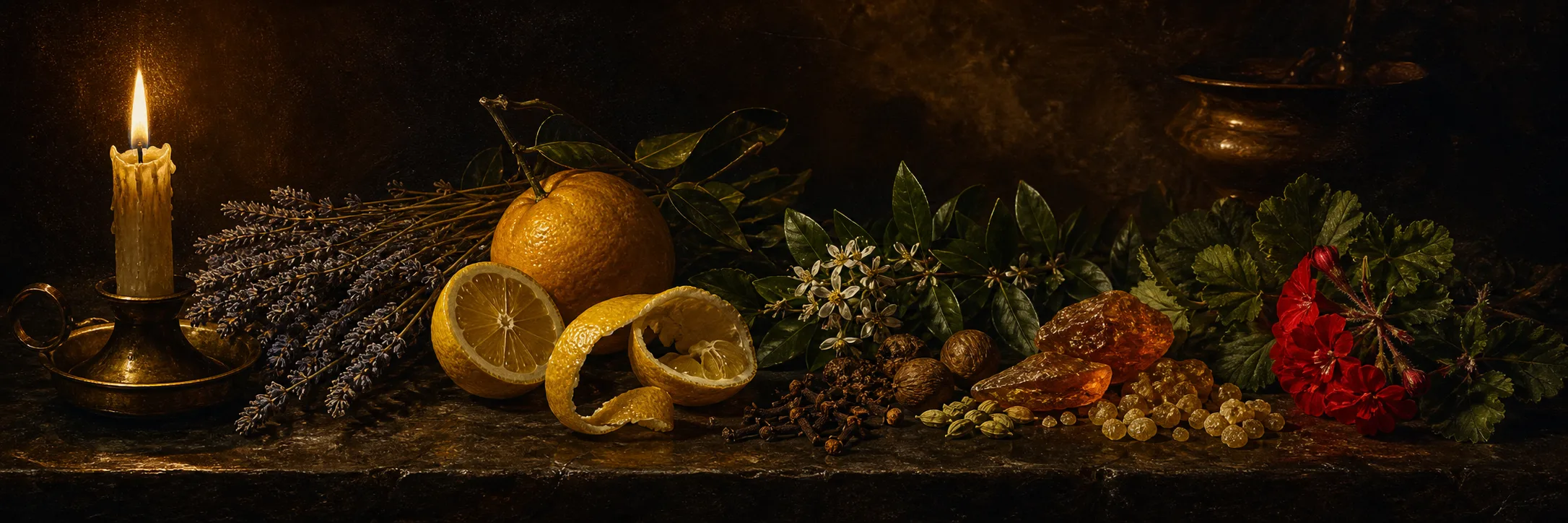
The opening is the most divisive moment: a herbal-citrus-lavender blast that several reviewers find genuinely harsh - “nail polish remover in the dry cleaner,” “quite harsh, I blame the lavender and the strong citrus.” Push past the first couple of minutes and it transforms into its real self: a warm, balsamic amber built on benzoin and what reads as labdanum (not officially listed, but reviewers repeatedly invoke it), threaded with a delicate, smoky incense, a touch of clove-spice and geranium. The patchouli grows more marked as it develops, adding a “humid soil”/vegetal earthiness reminiscent of (but milder than) Molinard’s own Patchouli. The drydown is the most-praised stretch: a creamy, balsamic, sweet-but-not-cloying vanilla-sandalwood close, “one of the best creamy balsamic sweet sandalwood drydowns” one reviewer had smelled that year. Texture is “refined, verging on delicate” - reviewers note “a beautiful blend of resins that smell like the real thing - dried nuggets of frankincense, myrrh, benzoin,” though in heat it can turn “lactonic, orange creamsicle.” Quasi-linear after the rough opening settles: warm resinous amber → spicy-smoky heart → creamy balsamic base. Reads slightly masculine/unisex in the smoky opening, softening to a cozy, faintly powdery vanilla-amber.
Performance
wearers consensus lands on moderate-and-pleasant rather than beast-mode, which is consistent across public listings. Projection is “average”/“moderate” - it becomes a soft skin scent after a couple of hours per one detailed account. Several reviewers specifically praise the restraint as a feature: “not beast mode, yet don’t disappear after a few hours either,” making it easy to over-apply safely.
Wearing Context
Fall and winter, evening-leaning, cozy and intimate - the recurring imagery is a warm sweater, a wool blanket, a comfortable sofa. It’s versatile enough for both casual and dressed settings because it’s “decadent but not overpowering,” and the moderate sillage makes it office-tolerable in cold months (unlike a loud oriental). As a practical reading: ideal as a comforting cold-weather daily amber or a low-stakes date-night warmth; less suited to hot, humid days where the opening citrus-lavender can read sour and the resins can go lactonic/creamsicle.
Comparisons & DNA
The reference point, cited in virtually every discussion, is Serge Lutens Ambre Sultan - reviewers call Molinard Ambre “a slightly less spicy version of Ambre Sultan, a bit flatter, but very similar. A bargain at this price.” The nuance from one comparison: Ambre Sultan “really digs in and sort of grasps your skin,” while Molinard’s “more lays alongside your arm, chilled out, making no conversational demands” - ie, same family, less intensity and herbal bite. Critics of the comparison caution it can be “misleading” because Molinard’s “is just missing all the brilliance and complexity.” Other wearer reports: it’s been likened to Guerlain Spiritueuse Double Vanille (“a boozy, incensey vanilla”), positioned as more wearable than L’Artisan Ambre and Histoires de Parfums Ambre 114, and grouped vibe-wise with Serge Lutens Chergui, Mugler Alien and even (briefly) Xerjoff 17/17 Symphonium. For shoppers, retailers’ “similar to” lists pair it with Ambre Sultan, Ambre 114 and Montale Blue Amber.
Reception
Broadly positive with a clear value-champion narrative, plus a vocal minority who find it either harsh-opening or simply unremarkable. The praise: excellent quality-to-price (“stands shoulder to shoulder with fragrances 4x its price point”), a beautiful creamy-balsamic drydown, and a refined, non-cloying amber that even amber-skeptics can wear; fans also adore the purple Les Elements bottle and the broader collection (“they occupy a space between designer and niche, with great quality and value”). Polarization axes: (1) the opening (refreshingly herbal vs. harsh/sour); (2) ambition (elegantly restrained vs. flat/unremarkable next to Ambre Sultan). Blind-buy verdict: a confident yes for amber lovers given the low price and high quality - just know going in that the first two minutes can be rough and the overall effect is “refined amber,” not a dense bomb.
Versions & Reformulation
Important catalog nuance: there are two Molinard “Ambre” entries. The original Ambre launched in 1993 as an oriental (now widely reported discontinued in its older bottle), and the Ambre Eau de Parfum (2015) is the version in the purple rectangular flacon, part of the Collection Matieres: Les Elements (the 2015 single-note/material-focused relaunch). They share essentially the same note structure (lavender/orange/bergamot/lemon top; benzoin/incense/clove/geranium heart; vanilla/patchouli/musk base), and wearer reports treats the 2015 purple-bottle version as the reformulated/refined international format - “the new ones, in the purple rectangular bottles, are, more refined, with better performance overall.” Molinard further restructured its range in 2021 around three tiers (La Fraicheur, Les Elements, Les Prestiges), under which Ambre continues.
Acquisition Notes
Affordable “value niche” tier - one of the genre’s best price-performers. Sampling Molinard from outside France has historically been harder (limited counter presence), so several wearer reports blind-buy on the strength of the reviews. No Documented counterfeit-prevalence or batch-decoding guidance specific to this fragrance was found; given the modest price and the distinctive purple Les Elements bottle, counterfeit risk is low - just confirm you’re buying the 2015 purple-flacon EDP rather than the older 1993 version if formula matters to you. The house also runs boutiques/tours in Grasse, Nice and Lille.
Notable Facts & Lore
- The lore here is house-level rather than scent-specific: Molinard is one of the oldest continuously family-run perfume houses, founded in Grasse in 1849 by Hyacinthe Molinard (run historically as “Molinard Jeune”); per Cote d’Azur France tourism, its State “Entreprise du Patrimoine Vivant” (Living Heritage Company) label “salutes the excellence craftsmanship of Molinard alongside only two other houses: Guerlain and Caron.” The Ambre belongs to its modern single-material “Les Elements” concept (the 2015 collection was framed as distilling the house’s most authentic raw-material-driven scents into the purple flacons).
- The brand’s own copy frames Ambre as “an unforgettable journey to the lands of the Orient,” but there’s no documented individual launch story, perfumer interview, or celebrity/viral moment tied specifically to this amber.
- Its real cultural footprint is grassroots: it’s a long-standing wearers “hidden gem” and recurring recommendation in “affordable Ambre Sultan alternative” discussions.