Molinard — Violette Eau de Parfum
Essence
Violette Eau de Parfum is Molinard’s 2016 reading of the violet soliflore - a flower the Grasse house has worked since the mid-19th century - recast for a modern, lightly fruity, unisex-leaning palate rather than the dusty “violet pastille” register most associated with the note. It belongs to the brand’s restructured “Les Elements” range, part of the broader Collection Matieres that Molinard redesigned in 2021 into three interpretations of raw material - La Fraicheur, Les Elements and Les Prestiges.
Scent Profile
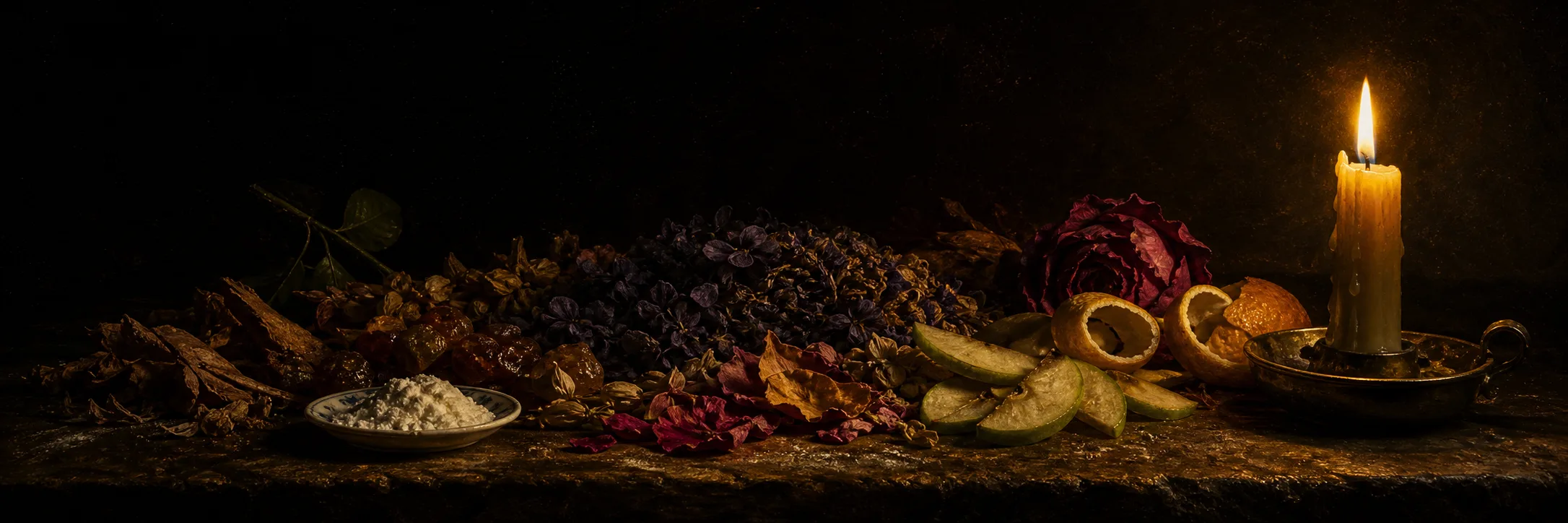
On most skins the fragrance opens bright and slightly tart, with a fleshy green-apple facet and citrus lift that several wearers single out as a “small blast of fleshy green apple.” This green-fruity overture is the most divisive moment: a number of reviewers find the black-currant facet “overripe,” even “rotting” or like a “burnt fruit compote” in the first minutes, an opening one wearer said her young son called “something dead.” Within roughly twenty minutes that volatility resolves into the core: a dense, jammy, candied violet rather than a fresh, petally one. This is the heart that violet lovers buy the scent for - sweet, slightly green, with the Parma-violet-candy sweetness softened by tart apple. The drydown turns powdery and soft, with iris lending a cosmetic, makeup-bag quality and white musk smoothing everything into a clean, close skin scent. Some wearers read the green violet-leaf facet as nearly soapy or “detergent”-like; others find a “rum-like” warmth emerges below 60°F. It reads green-sweet rather than dewy-floral, and is best understood as a candied-violet-with-fruit construction, not a naturalistic bunch of fresh violets.
Performance
Real-world reports split sharply: several wearers report all-day wear and “amazing” longevity with whiffs “into the next day,” especially on fabric, while others find it a quiet skin scent within an hour or two. The consensus that reconciles these is that Violette performs far better on clothing than on skin and is intimate in projection by design - a close-wearing, personal violet rather than a room-filling one. Treat it as a low-sillage daytime scent.
Wearing Context
This is a spring-and-autumn daytime fragrance: light, powdery, and office-safe in its drydown, though the fruity-green opening gives it some seasonal flexibility into warmer months. Multiple wearers describe it as a “wear-to-bed,” pillow-mist comfort scent - soft enough to drift off in. Despite Molinard marketing it as unisex and several reviewers noting it could skew masculine in its earthier, violet-leaf-forward moments, the dominant perception is feminine and “ladylike.” It suits someone seeking a nostalgic-but-modern violet for casual, intimate, or comfort-wear rather than a statement or evening perfume.
Comparisons & DNA
The reference point reviewers reach for most often is Guerlain Insolence: Violette is repeatedly described as a fresher, greener, crisper, less plasticky and lower-projecting cousin of that violet powerhouse, with the green apple as its distinguishing signature. Others compare it to Guerlain Meteorites (though they note Meteorites is more powdery and “sophisticated” while Molinard is “juicier and green-ish”) and to a “less vintage Guerlain violette.” Within the broader violet-soliflore field, it sits between the sugary end (Caron Aimez-Moi, Laurence Dumont Vanille Violette) and the green end (L’Artisan Verte Violette, Berdoues Violettes de Toulouse); Molinard’s 2016 EDP leans candied-but-green, distinct from the more straightforwardly powdery vintage Molinard violets. Fans of violet-leaf scents (Burberry Weekend, Balenciaga Paris) and those hunting a Penhaligon’s Violetta alternative also gravitate here, though one such seeker found it “too sweet and cloying” as a Violetta replacement.
Reception
The recurring praise: a beautiful, well-blended, realistic-yet-candied violet that punches above its modest price. The recurring criticisms: weak performance, a polarizing/overripe opening, and - for some - a green soapiness that reads as “detergent.” There is no significant major critic review of this specific 2016 release; coverage is concentrated in wearers platforms, which is typical for a value-priced Grasse soliflore that flew under the critical radar.
Versions & Reformulation
The principal source of confusion around this perfume is nomenclature, not reformulation. Molinard has sold violet scents under overlapping names for over a century - including a 19th-century “Violette,” a 1994 “Les Fleurs Violette,” and this 2016 “Violette Eau de Parfum.” The 2016 EDP is the one now sold within Les Elements (also branded “Les Elements Exclusifs” at some retailers) and is offered as a 75ml EDP plus a matching roll-on and soap. Molinard restructured its entire Collection Matieres in 2021 into three tiers, with Violette placed in Les Elements; the juice itself appears continuous through that repackaging.
Acquisition Notes
Violette is widely available and inexpensive for a Grasse house - Molinard’s own site prices the 75ml EDP at 57.50 (around €57.50 / $57.50 depending on region, against an RRP near $67), with the roll-on around €11.67 and frequent third-party discounting well below retail. The chief acquisition caution is identity confirmation: with multiple Molinard violets in circulation, confirm the 2016 EDP note set (violet/black-currant/bergamot/lemon up top; iris/white musk base) and the current Les Elements packaging. Given the soft performance, the roll-on and the 75ml are both sensible entry points; sampling first is wise because the opening is genuinely polarizing.
Notable Facts & Lore
- Violet is one of Molinard’s foundational materials, traceable to the house’s first Eaux de Fleurs of 1849 and to 19th-century soliflores, some of which were bottled in Baccarat crystal.
- The note carries built-in nostalgia: violet absolute is prohibitively expensive, so virtually all modern “violet” accords (including this one) are reconstructed from ionones and violet-leaf materials - which is why reviewers oscillate between reading the scent as “candy” and as “green leaf.” Molinard’s broader heritage looms behind the release: the house’s Grasse headquarters occupies a factory whose structure is associated with Gustave Eiffel, and its history includes Lalique- and Baccarat-designed bottles and the landmark Habanita (1924).
- Against that backdrop, Violette EDP is a humble, modern, affordable expression of a flower the house has interpreted for more than 170 years.