Molinard — Le Rêve Nirmala
Essence
Le Reve Nirmala is Molinard’s 2017 gourmand-floral reworking of its own house classic Nirmala (the original dates to 1955), recast for the modern “fruitchouli” era: a sweet, fruity, chocolate-praline-patchouli confection that draws constant, near-unanimous comparison to Thierry Mugler Angel. It is a candy-shop fragrance in the most literal sense - wearer reports reach for imagery of overloaded dessert tables and powdered-sugar-dusted wooden candy chests.
Scent Profile
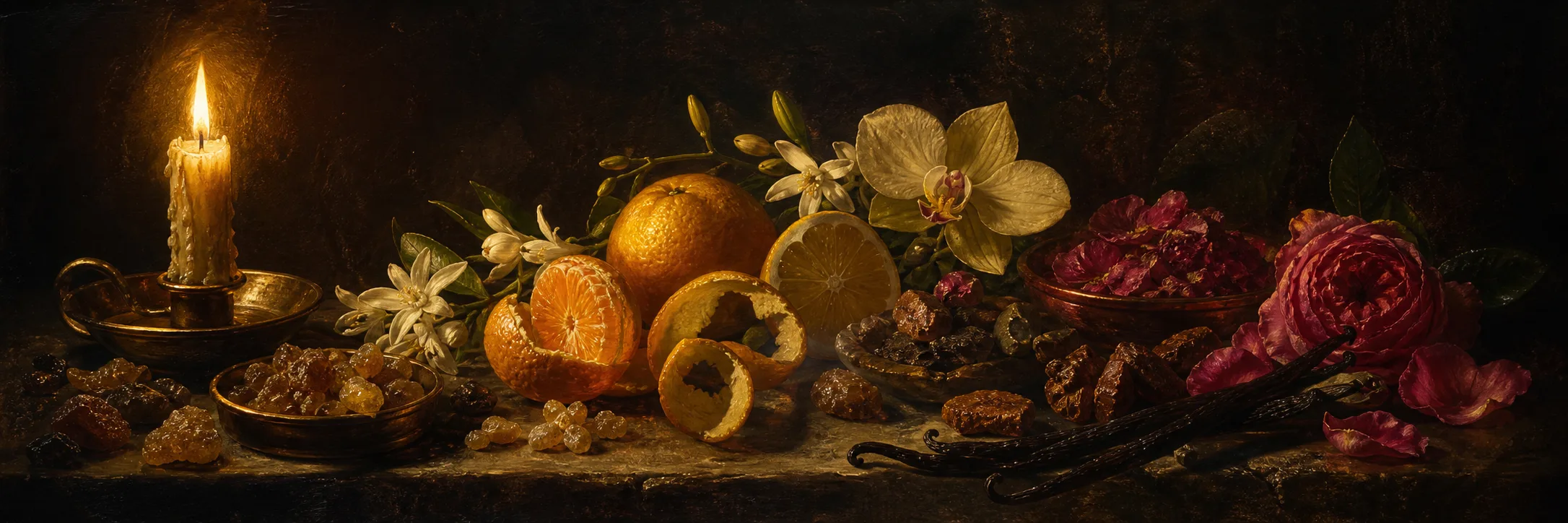
The opening is an immediate, almost overwhelming sweet-fruity blast - candied almond, peach and mandarin with bergamot, landing somewhere between praline dust and tropical fruit. Reviewers note it “hits you all at once in a single blast and doesn’t really quite pace itself.” The heart brings powdery floral support (violet is repeatedly singled out as the source of a powdery quality, with orchid and rose in the mix) but the florals are largely submerged under the gourmand machinery. The base is the genre’s signature accord: chocolate, praline and patchouli, with vanilla and sandalwood, rounding into what one reviewers called “an exquisite small wooden candy shop, full of open cedar chests, Icing powder lifts in the air every time the candy is moved around.” Development is limited; several wearers call it linear and “all over the place” at once rather than evolving. A recurring complaint is a “nasty white musk” in the drydown that grows more dominant over time - the key difference, per one reviewer, between Le Reve Nirmala and the original Nirmala.
Performance
Multiple reviewers describe it as long-lasting with “great sillage and projection” - “pungent and makes its presence known,” to the point that one wearer uses it primarily as a room fragrance. A dissenting minority report it fading or “wearing off” quickly on their skin, so there is some skin-chemistry variance. The consensus practical read: it projects strongly early and lasts well, occasionally to the point of being cloying in close quarters.
Wearing Context
This is a cold-weather, evening-leaning comfort scent - the sort of sweet, cozy gourmand reviewers describe wearing to bed or in winter. It reads feminine and, per the wearers, “modern, youthful (not young).” Best for casual and intimate settings rather than the office, given its sweetness and sillage. Practical reading: if you already love Angel-style fruitchoulis, this slots in as a slightly lighter, airier daily option; if you find dense praline-patchouli gourmands juvenile or headache-inducing (several reviewers report queasiness and headaches, with one comparing the effect to Gucci Rush), it is an easy skip.
Comparisons & DNA
The comparison that dominates every thread is Thierry Mugler Angel - Le Reve Nirmala is repeatedly called “Angel without the patchouli,” “lighter and more airy, without that super dense gourmand note,” or simply a well-done Angel variant. It is also likened to Mugler Angel Muse (a “very gourmand patchouli, sweeter and powdery”) and to Mugler Innocent, with one reviewer preferring Innocent’s spicier profile. Mugler Angel Eau Croisiere comes up as a near-relative, though one careful reviewer argued the two diverge (Angel Eau Croisiere being “juicy tropical cocktails,” Nirmala being the “wooden candy shop”). The clearest delta the wearers draws: versus Angel, Nirmala is warmer, less bitter, fruitier and easier to wear, but its detractors say it smells noticeably cheaper and more synthetic, where “Angel smells expensive.”
Reception
Reception is divided but skews toward “pleasant if unoriginal.” Admirers call it “scrumptious,” “quirky delicious,” a “wonderful fruity rich scent.” A substantial critical contingent is harsher: “smells unfortunately extremely cheap and oversweetened,” “a mess of everything,” and disappointment that a historic house like Molinard delivered a “generic so very popular sweetshop gourmand” rather than something distinctive. The polarization axes are (1) sweetness tolerance and (2) the white-musk drydown, which is a specific dealbreaker for several. Blind-buy verdict: reasonable for committed gourmand/fruitchouli fans given the low price, risky for anyone sensitive to synthetic sweetness or to musk - sample first if possible.
Versions & Reformulation
The naming is a genuine source of confusion. Molinard’s 1955 Nirmala is the historic original; in 2015 Molinard restyled the Nirmala bottle, and in 2017 it released both a relaunched/renamed presentation of Nirmala and this distinct flanker, Le Reve Nirmala, a separate gourmand composition with its own pyramid (candied almond, chocolate, praline). The original Nirmala is the fruitier, fresher, more tropical scent (mandarin, passionfruit, mango, tonka); Le Reve Nirmala is the chocolate-praline-patchouli reinterpretation.
Acquisition Notes
Sold as an EDP (with EDT versions of the Nirmala name also circulating). Given the deep discounting and the naming overlap, the main acquisition risk is buying the wrong Nirmala rather than counterfeiting. No batch-code or fake-product discourse of note in the wearers.
Notable Facts & Lore
- Molinard is one of the oldest French perfume houses (founded in Grasse in 1849), and the Nirmala name carries decades of house history, which is partly why the 2017 gourmand reissue drew scrutiny from longtime fans.
- The brand press framed Le Reve Nirmala as “a dream of tasty candies” and “an ode to love, a delectable journey through exotic flowers and tropical fruits,” housed in a faceted pink “diamond” flacon.
- Beyond the persistent Angel-comparison lore, there is no notable celebrity tie, viral moment or controversy attached to this specific release.