Molinard — Figue
Essence
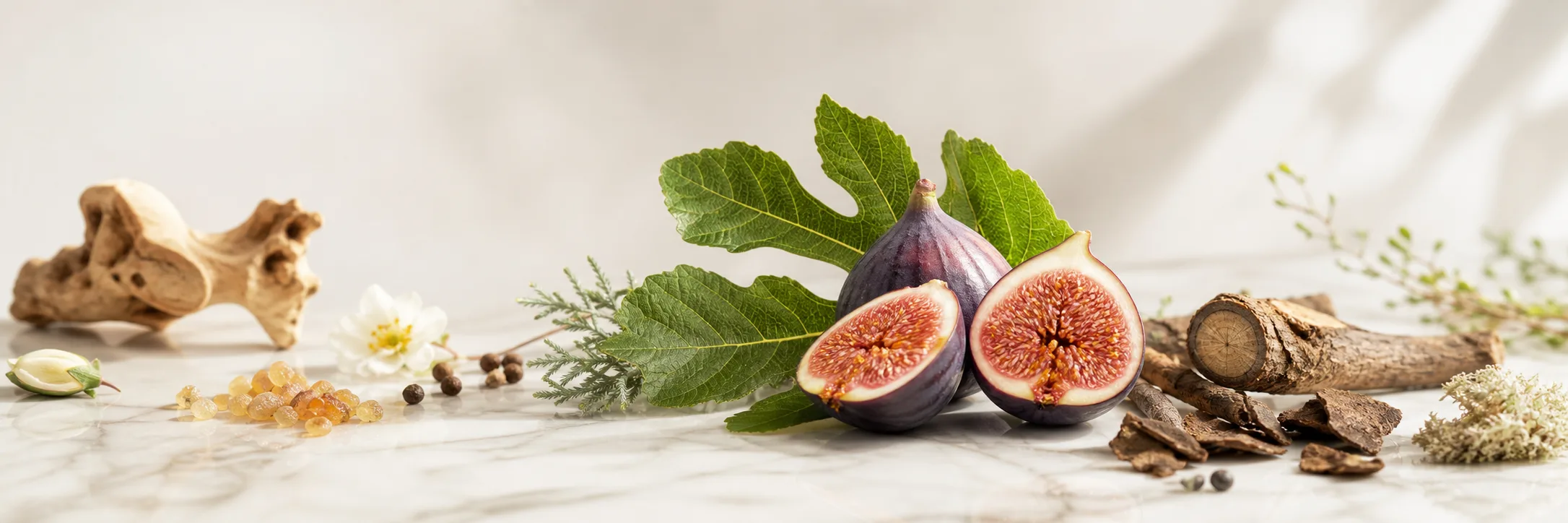
Figue is a fig soliflore from the historic Grasse house Molinard (established in Grasse since 1849), built around a fig accord and marketed as part of the brand’s ingredient-focused “Collection Matieres: Les Elements” line. The catalog lists it as a 2015 EDT centered on fig, fig leaf and fig tree, in the floral-fruity family.
Scent Profile
The catalog’s minimalist fig/fig-leaf/fig-tree structure understates what reviewers actually smell. wearers testers describe a bright, citrus-tinged green-fig opening that settles into a “calm and contemplative” milky-green fig with an underlying sweetness, over a soft cedar-and-musk base. The dominant read is a FRUITY-leaning fig rather than a purely green fig-leaf scent - “quintessential fig scent, on the sweeter side, but with some greenness as well,” and “beautiful, dry but juicy natural fig with a hint of sweetness.” A persistent lemon note “brightens things up and keeps it from becoming too introspective.” A vocal minority experiences it differently - either greener (“a clean green, leaf with less wood”) or, in the common criticism, dominated by lemon and a “particularly synthetic-smelling cedar” with little detectable fig (“Where’s the fig? All I feel is lemon and cedar”). Perceptible: green-citrus fig, milky sweetness, soft cedar. It does not develop dramatically - reviewers call it “calm” and note it “does not develop massively.” Skin chemistry is unusually decisive here.
Performance
Performance reports are highly variable and skin-dependent, which is the key signal. Many find longevity modest for the price (“longevity is around 6 hours,” “moderate”), and several cite this as the fragrance’s main weakness, recommending a neutral body lotion underneath to anchor it. Yet a substantial minority report excellent tenacity: “still projecting after 10 hours,” “stays very long in warm weather, I got 8 hours,” and “amazing lasting power.” Projection is generally rated average.
Wearing Context
A warm-weather, daytime fig - reviewers overwhelmingly tag it for “spring/summer/autumn day or evening” and “hot summer days,” calling it “refreshing and uplifting” and an everyday warm-weather scent. The green-fruity profile reads casual, fresh and unisex (it is marketed unisex and worn by both men and women). As a practical reading from the documented profile: ideal for hot daytime and casual summer settings, transitional spring/fall wear, and relaxed evenings; less suited to cold weather or formal occasions where a richer scent is wanted.
Comparisons & DNA
Fig lovers anchor it to the canonical figs with specific deltas. Diptyque Philosykos is the most-cited reference - reviewers call Molinard “a beginner’s version of Philosykos” and note it is “calm and contemplative like Philosykos” but leans “more overtly fruity and sweet,” whereas Philosykos is greener and more fig-leaf-driven. Against Acqua di Parma Fico di Amalfi, reviewers find Molinard less extroverted and summery but “bright and refreshing” in the same vein. The strongest value comparison comes from a reviewer who bought Figue in Molinard’s Rue Saint-Honore boutique because it smelled “very similar” to Jardin de Kerylos by Pierre Guillaume “but the Molinard has much better longevity, and at a fraction of the price.” Reviewers also list it alongside Hermes Un Jardin en Mediterranee and Ferrari Noble Fig in their fig rotations.
Reception
wearers-only coverage (no major critic review), and it is genuinely polarizing on a skin-chemistry axis. Praise is enthusiastic among fig fans: “if you love fig fragrances, do not sleep on this,” “a real hidden gem,” “absolutely beautiful,” and repeated value endorsements. Cafleurebon’s Sebastian Jara featured it in a “Three You Should Be Wearing” Molinard piece, recommending Figue as the summer pick (“with its juicy pulpy fruit”). The recurring criticism is twofold: weak/variable longevity, and a subset of wearers who get mostly lemon and synthetic cedar instead of fig (“Not my cup of Fig!!
Versions & Reformulation
There is real identity ambiguity worth flagging. public listings carry two overlapping entries - “Figue” (the catalog’s 2015 entry, listing only fig/fig leaf/fig tree) and a fuller “Figue Eau de Parfum” (2016) crediting perfumer Mathieu Nardin with a complete pyramid (fig/lemon/black currant top; green leaves/floral/jasmine heart; cedar/musk/amberwood base) - while public listings merges them into a single 2015 entry in the “Collection Matieres: Les Elements” line. The most defensible reading is that these describe the same Eau de Parfum, with the catalog’s sparse 2015 listing being a duplicate of the canonical EDP; Molinard officially sells Figue only as an Eau de Parfum, and no separate Figue EDT could be confirmed in the current catalog - a discrepancy with the catalog’s “EDT” label that buyers should note. Molinard restructured its range in 2020 into three tiers (La Fraicheur, Les Elements, Les Prestiges), with Figue in Les Elements. (Do not confuse with Molinard’s older Fleur de Figuier, 1999, a distinct greener fig-leaf scent.)
Acquisition Notes
The 75ml is the dominant size.
Notable Facts & Lore
- Molinard frames Figue as a “summer’s evening” Mediterranean garden image - “a sparkling Mediterranean citrus, wrapped in the broad leaves of the fig tree.” The house itself is a major piece of Grasse perfume heritage (established since 1849, home to the iconic Habanita of 1921, and one of only three perfume houses - with Guerlain and Caron - holding France’s State “Entreprise du Patrimoine Vivant” label).
- Since 2010 it has been led by Celia Lerouge-Benard, the fifth generation and the first female director in the house’s history.
- Beyond the house lore and the Les Elements concept, there is no notable viral moment or controversy specific to Figue; its standing is that of a quietly well-regarded budget fig among enthusiasts.