Molinard — Habanita Anniversary Edition
Essence
The Habanita Anniversary Edition (2021) is the centennial release of Molinard’s landmark 1921 Habanita - and the crucial fact, stated plainly across the wearers, is that it is not a new fragrance. It is the standard modern Habanita Eau de Parfum juice in a special “Habanita red” bottle commemorating 100 years; per multiple reviewers, “it IS the same powdery, spicy Habanita just redressed in a red bottle,” with notes “exactly the same as Habanita the black bottle.” So the dossier is really about the modern Habanita EDP in centennial dress: a powdery floral-oriental built on heliotrope, rose and ylang over a vanilla-amber-moss-vetiver base, the contemporary descendant of one of perfumery’s most historically important “tobacco” scents (a fragrance that, famously, contains no tobacco).
Scent Profile
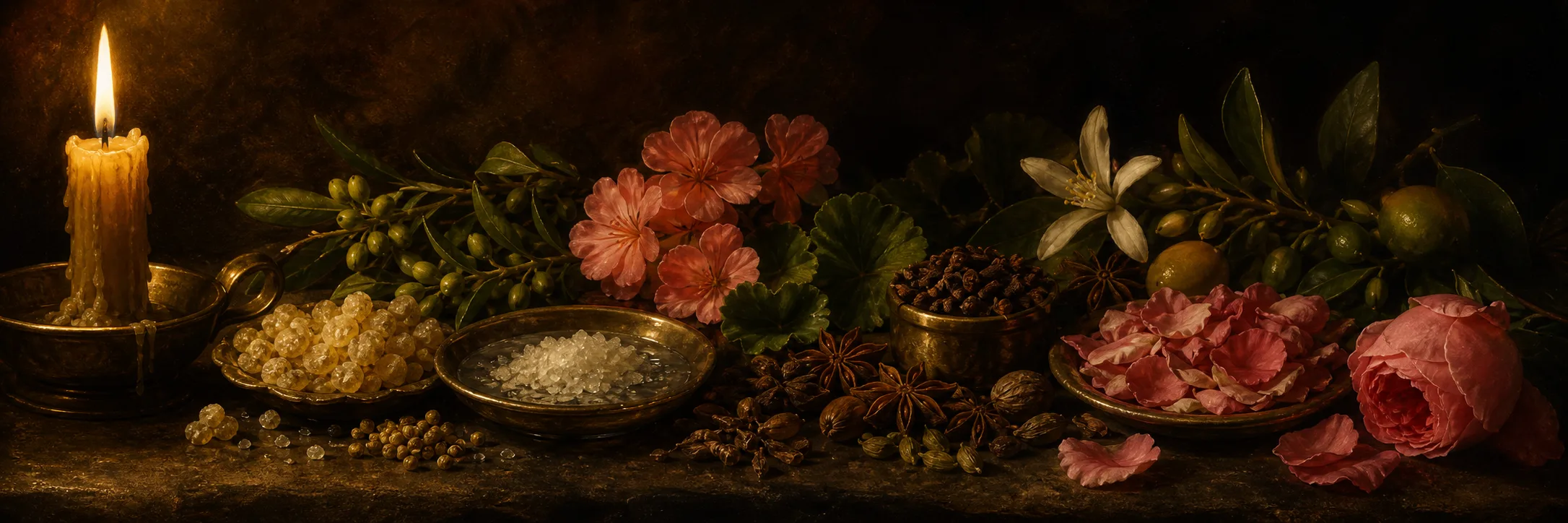
The modern Habanita reads as a powdery, spicy floral-oriental that shifts constantly on skin. The opening is bracing and slightly bitter-green - mastic/lentisque gives a resinous, almost turpentine-ish jolt, with geranium, black pepper, petitgrain and a touch of sea salt sharpening it before the powder arrives. The heart is the signature: heliotrope and orris-style powder wrapped around Taif rose, ylang-ylang, jasmine and mimosa, dusted with nutmeg, with vetiver and cedar adding a dry, smoky-grassy spine. The base is where Habanita’s identity lives - vanilla, sandalwood, amber, musk, oakmoss and patchouli forming a warm, resinous, faintly animalic drydown that many read as “tobacco” or “incense” even though neither is present. The “tobacco” effect is an illusion created chiefly by the smoky vetiver and leathery facets; as Kafkaesque’s review explains, it smells like “talcum-powder tobacco paper” rather than cigarettes, and Luca Turin reportedly categorizes Habanita simply as a “vetiver vanilla.” Compared to vintage, the modern EDP is “a miniscule amount softer” per one reviewers but still “a HEAVY nod to the vintage juice,” retaining the powdery-vanilla-and-spice core; a reviewers found the 2012 EDP leans more “occult shop” - sandalwood-cedar incense and patchouli - than the boozy bourbon-vanilla-amber of the 1988 EDT. It is relatively linear in its powdery character but genuinely changeable in which facet (fruit, flower, vetiver, vanilla) surfaces at any moment.
Performance
Habanita is famously tenacious - Molinard’s own original slogan, acquired around 1924, billed it as “le parfum le plus tenace du monde” (“the most tenacious perfume in the world”). wearer reports for the modern EDP describe strong projection and very long wear: “pretty much permanent on whatever you spray it on,” with repeated warnings to apply sparingly - “beware spraying either with abandon! You’ll fumigate yourself and others.” It is a cool-weather and evening scent by temperament given the heavy powdery-resinous base, though some wear it year-round. The most-repeated practical advice is restraint on application; it is a powerhouse in the older mold, and the centennial bottle’s juice behaves identically to the regular black-bottle EDP.
Wearing Context
This is a fall/winter, evening-leaning fragrance for someone comfortable with old-school, powdery, statement perfumery - “not for little girls,” as one reviewer put it. It carries strong vintage-glamour associations: flappers, femme fatales, smoky cabarets, the 1920s. It is nominally feminine but widely worn unisex; the dry vetiver-leather-spice core gives it enough backbone that reviewers repeatedly note “it could fit perfectly for men, too,” and many describe it as genuinely unisex.
Comparisons & DNA
The essential comparisons are within the Habanita family. Against the vintage Habanita (parfum/EDT, pre- and post-1988): the modern EDP is softer, less leathery and less boozy, but recognizably the same DNA - vintage fans split between “the modern EDP is the Habanita experience” loyalists and “puritans” who insist the vintage smoky-leather depth is irreplaceable. Against Habanita L’Esprit (2013): L’Esprit is the deliberate modern-light flanker - a “snow-white,” clean musky-floral with mimosa, lemon and labdanum that strips out the leather, tobacco-smoke and dark mystery; Cafleurebon’s Mark Behnke praised it as “true to its heritage without slavishly imitating it,” while many reviewers (and Behnke himself initially) note its strong resemblance to Narciso Rodriguez for Her and Juliette Has a Gun Citizen Queen. The house also makes Habanita Edition Exclusive (less rose, more amber), Habanita La Cologne (crisp, oakmoss-and-vetiver focused), and the discontinued Miss Habanita / Un Air d’Habanita flankers.
Reception
Habanita is treated as a genuine classic and a connoisseur’s badge - “understanding Habanita, is almost like understanding Picasso, not for everyone,” as one public listings defender put it. The modern EDP is broadly respected as a faithful, affordable way into the legend, with the powdery-spicy-vanilla character winning strong loyalty. The anniversary edition specifically drew warm but clear-eyed reception: collectors loved the red bottle and the centennial gesture, while reviewers were careful to flag that the juice is unchanged - “not a new fragrance but a superb red bottle.” Several long-time wearers used the occasion to praise Molinard as a family-owned, non-greedy house (“you can’t compare them to parts of LVMH or Kering”) that kept the price modest for the edition. The polarizing axis is the same as for any vintage-style oriental: powder-and-spice lovers adore it; others find it “baby powder and rotten flowers” or overpoweringly old-fashioned.
Versions & Reformulation
Habanita’s version history is long and genuinely confusing, and matters for buyers. The 1921 original (cigarette-scenting product, then 1924 perfume) was reformulated notably in 1988 and again for the modern era. Raiders of the Lost Scent documents at least four post-1980 bottle/formula generations (transparent “syllables” bottle 1980-88; Lalique-style “squared” 1988-2005; Lalique-style “tall/Anniversary” 2005-12; modern EDP-only from 2012).
Acquisition Notes
Habanita is one of the great value propositions in classic perfumery - Molinard prices it modestly and sells directly, often more cheaply than third-party marketplaces. public listing’s Elena Vosnaki noted the centennial red bottle “retails for 94 euros on Molinard right now, for 75ml of Eau de Parfum” - ie the anniversary edition was priced in line with the regular EDP, not at a collector premium. Large formats (up to 500 ml) exist for heavy users. Vintage EDT and parfum are the targets for those chasing the darker, leathery older character, available through vintage specialists. Sample the modern EDP before committing given its divisive, powerful profile.
Notable Facts & Lore
- Habanita is one of perfumery’s foundational stories.
- Created at Molinard in Grasse around 1921, it was first sold not as a perfume but as a product to scent cigarettes - perfumed sachets to slip into a cigarette pack, or a liquid applied with a glass rod so that “a glass rod dipped in this fragrance and drawn along a lighted cigarette will perfume the smoke with a delicious, lasting aroma.” Women began scenting themselves with it directly, so by 1924 Molinard relaunched it as a fine fragrance - and gave it the slogan “the most tenacious perfume in the world.” Its date and “ingredient overdose” legend run exactly parallel to Chanel No.
- 5: both released in 1921, both relaunched in 1924, both built on a famous overdose - aldehydes for No.
- It is frequently cited as among the first feminine “orientals,” a trailblazer for the genre, and a tobacco-scent landmark (alongside Tabac Blond and Bandit) despite containing no tobacco - the smoky effect is pure vetiver-and-leather illusion.
- It was reportedly Mae West’s favorite, and 1938 advertising depicted a woman’s silhouette rising like smoke from the bottle.
- 1921 was a double milestone for Molinard: the same year it pioneered the “Concreta” solid-perfume compact using natural flower wax.