Molinard — Habanita
Essence
Habanita (1921) is one of the foundational perfumes of the 20th century: arguably the first feminine “oriental” to foreground vetiver - an essence then reserved for men - and one of the earliest members of the female-smoker leather/tobacco genre alongside Caron Tabac Blond (1919) and ahead of Robert Piguet Bandit (1944). It was created not as a body perfume but to scent cigarettes, and it contains no actual tobacco - its “tobacco” is an illusion conjured from vetiver, leather, powder and resins.
Scent Profile
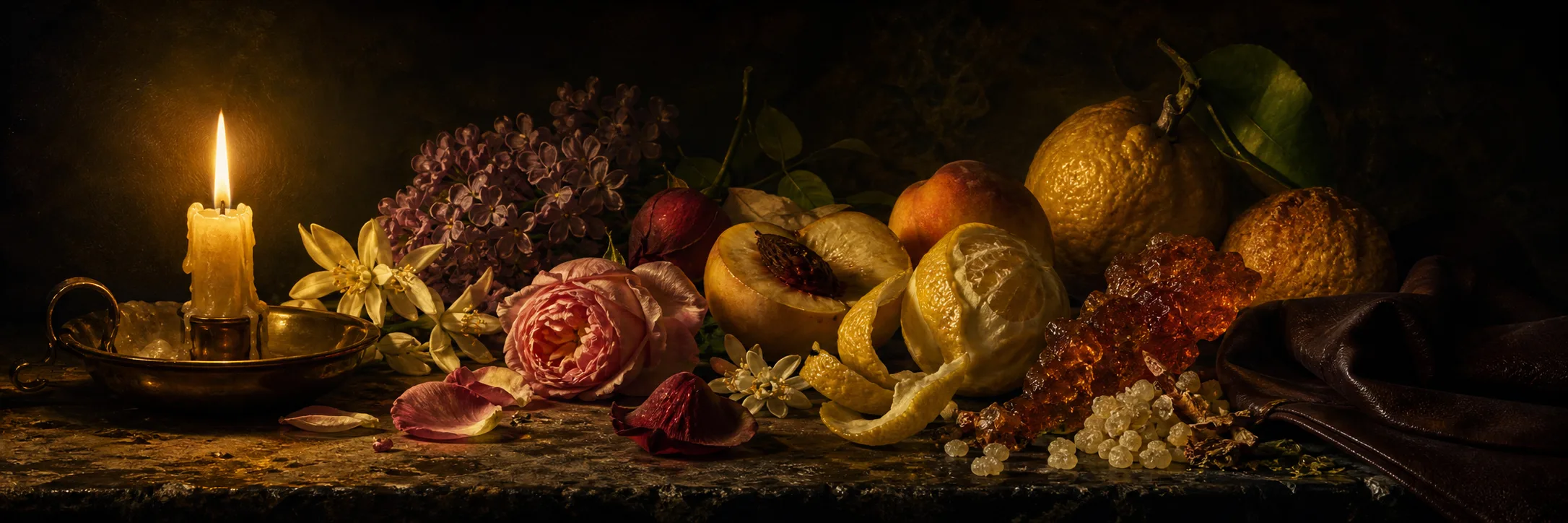
Habanita is famously a study in contrast: a brazen, sometimes pungent opening that softens into an elusive, powdery skin scent. The top can read sharp and bracing - citrus, a whisper of jammy/sour raspberry-leather, dry green - before the perfume settles into its defining character: a thick veil of makeup-powder florals (orris, heliotrope, rose, jasmine) over a smoky, dry vetiver that the nose reads as “powdered tobacco paper,” with a soft, worn, slightly carnal leather at the core and a vanilla-benzoin-amber drydown. Now Smell This describes it moving from “dry, bitter green and a whisper of jammy fruits” into woods and earth, then “a smoky, powdery, dusky-oriental blend, heavy on the amber and leather, and only lightly sweetened by vanilla.” It is more linear in spirit than its long note list suggests - many wearers report it maintaining “a rather singular identity all the way through,” with powder suffusing everything and individual notes surfacing and submerging. The most-cited divide: some get heavy talcum powder, some get smoky leather-vetiver, some get vanilla. Signature accord: Turin’s “vetiver vanilla” - the two materials fusing into something that is neither, wrapped in powder and smoke.
Performance
Habanita is legendarily tenacious - Molinard’s own marketing long called it “the most tenacious perfume in the world,” and that reputation broadly holds across concentrations. Wearer reports for the vintage and EDT versions describe huge sillage and 7-8+ hour longevity, with one anecdote of a leaking eBay bottle scenting an entire postal route. The modern EDT and EDP are still strong but with caveats: some report the 2012 EDP as comparatively lighter (“seems like an EDT by comparison”), and there have been wearer reports of inconsistent batches with markedly weaker performance (one wearer’s 15 sprays read as a near-skin scent and prompted an email to Molinard).
Wearing Context
Classed as an oriental/chypre-leather, Habanita is an all-season but cool-weather-leaning evening classic that several wearers find unexpectedly compelling in summer (the powder-smoke “surprise” in heat draws compliments). It carries a strong vintage, flapper-era romance and reads as mature, bold and characterful rather than easy or crowd-pleasing - “all woman: tough, sexy, flirty, comforting, mysterious.” It is also widely worn by men and considered easily unisex, given its tobacco/spice/leather/vetiver core. Social perception skews “classic/old-fashioned” in the best sense - some younger noses read it as “granny’s house,” others as a niche-modern-feeling powder bomb.
Comparisons & DNA
Habanita sits in a tight historical cluster of assertive female-smoker leathers: Caron Tabac Blond (1919) - to which its dry, medicinal mid-phase is repeatedly compared, with Habanita seen as softer and less perverse - and Robert Piguet Bandit (1944), “rougher” and more sinful, with Habanita the more playful and youthful-feeling of the two. Guerlain Shalimar and L’Heure Bleue are frequent reference points (Habanita as a darker, drier, less floral oriental cousin; “like if Shalimar were a heavy smoker”). Its leather core has been likened by one reviewers to Vero Profumo Onda “shaken clean of the powder.” Coty Emeraude (1921) shares its powdery-vanilla finish. Most notably, Habanita is documented as the literal inspiration for a modern classic: Denyse Beaulieu brought her bottle of Habanita to Bertrand Duchaufour during the creation of L’Artisan Parfumeur Seville a l’Aube (2012), and its “baume and tobacco-ed oriental accord” was reassembled into that fragrance - confirmed on both Grain de Musc and Olfactoria’s Travels.
Reception
Habanita is one of the most-reviewed and most love/hate fragrances online - responses range from “masterpiece” to “vile,” “heavenly” to “offensive.” Critics revere it: Turin gave it four stars in Perfumes: The A-Z Guide under the heading “Vetiver Vanilla,” calling it “the colossal Habanita,” which “juxtaposes vetiver and vanilla in such a way that both disappear, more like a vector product of the two,” and adding “I once described it as Arthur Miller arm in arm with Marilyn Monroe, but in truth it would be their gorgeous hypothetical child.” Bloggers including Now Smell This and Grain de Musc treat it as a touchstone classic. The wearer consensus central praise is its uniqueness, depth and the vetiver-vanilla base; the central criticisms are (1) the powder - many get “powder, powder, and more powder” and little else - and (2) on modern reformulations, a synthetic, headache-inducing harshness (Kafkaesque reports a burning sensation and quotes blogger Brian of “I Smell Therefore I Am” suggesting “current Habanita is probably so synthetic that the pyramid is pure fantasy”). Polarization axes: powder tolerance, and vintage-vs-modern formulation.
Versions & Reformulation
The version question is central, as the catalog notes. The 1921 original was a “Russian leather”-based leather/vetiver/vanilla oriental, soon (1924) housed in a Lalique nymph-decorated bottle when sold as a wearable perfume. It was reformulated in 1988 (the version many know as the powdery EDT), and again in 2012 with a new, stronger Eau de Parfum in a redesigned red-and-black Lalique-friezed bottle - a reinterpretation Molinard says keeps “the same 600 ingredients, distributed in different proportions,” with a revised pyramid foregrounding mastic/petitgrain/geranium up top and vetiver/nutmeg/heliotrope in the heart.
Acquisition Notes
Collectors prize vintage parfum/extrait and pre-1988 and 1988-era EDT for greater richness, but should beware reported batch inconsistency in modern bottles (wearer reports of a “bad batch” with weak performance and a strange drydown note). Molinard is the oldest continuously family-run Grasse house (founded 1849), and its Grasse factory/museum sells the current line.
Notable Facts & Lore
- Habanita’s origin is one of perfumery’s best stories: launched in 1921 as a product to perfume women’s cigarettes - sold as scented sachets to slip into a cigarette pack, or as a liquid applied with a glass rod (“A glass rod dipped in this fragrance and drawn along a lighted cigarette will perfume the smoke with a delicious, lasting aroma”), aimed at the newly emancipated flappers (garconnes) who smoked.
- By 1924 women were wearing it directly and Molinard released it as a fine fragrance.
- Molinard’s lore holds that the formula was partly the result of an error in the dose and quality of the vetiver - the very note that became its signature.
- Mae West is often cited as a devotee.
- The name evokes Havana/cigars though it contains no tobacco.
- Its cultural afterlife is significant: beyond inspiring Seville a l’Aube, it is frequently invoked as a candidate for the “first oriental” (predating Shalimar) and the first gourmand-adjacent classic, and Denyse Beaulieu’s book The Perfume Lover weaves Habanita through both her life and the creation of Seville a l’Aube.