Molinard — Habanita Eau de Parfum
Essence
Habanita is one of the genuine landmarks of 20th-century perfumery - Molinard’s first fragrance, launched in 1921, originally sold as a scented product to perfume cigarettes and women’s cigarette papers, and famously billed by Molinard at its 1924 perfumery relaunch as “le parfum le plus tenace du monde” (“the longest-lasting perfume in the world”). It is celebrated as a tobacco perfume that contains no tobacco, its smoky, leathery, powdery character built instead around an overdose of vetiver against vanilla.
Scent Profile
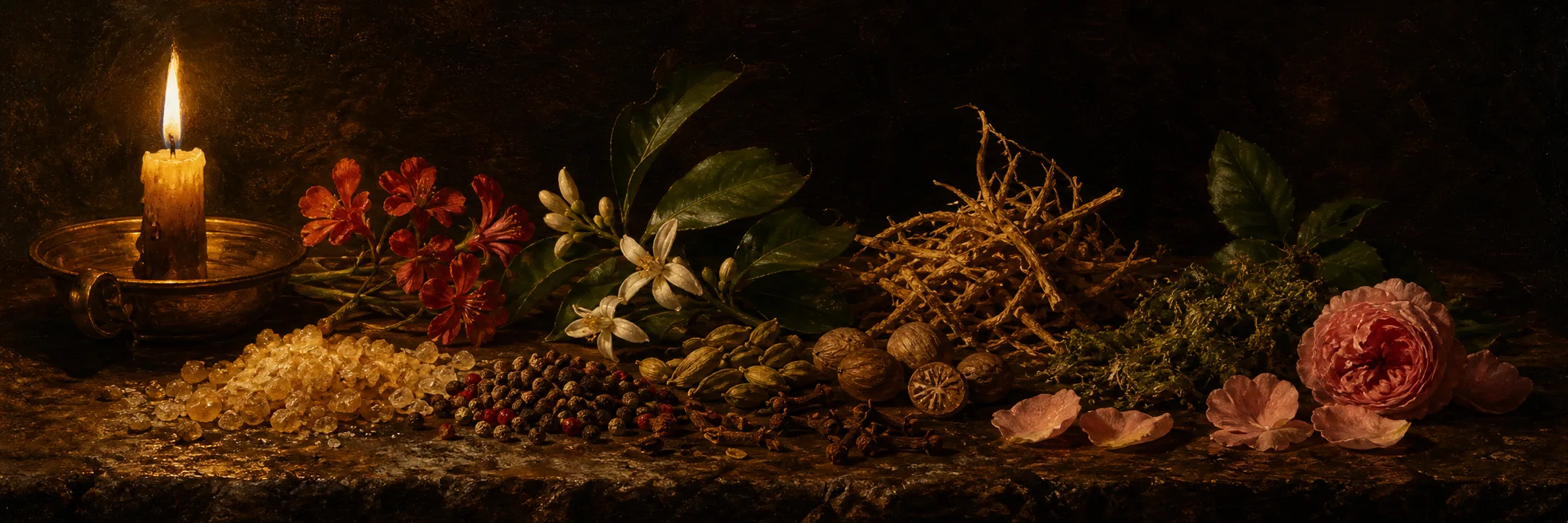
The 2012 EDP opens, to many noses, with something that wasn’t conspicuous in older versions: a blast of aldehydes plus petitgrain and a touch of geranium, lending a brighter, slightly soapy, almost Chanel-adjacent freshness for the first 45 minutes - Denyse Beaulieu’s Grain de Musc readers repeatedly flagged this aldehydic, “ink-drawn fashion sketch” quality as the clearest departure from the vintage. Mastic/lentisque gives a green, resinous, faintly tobacco-like bite up top. The heart is the powder: orris and heliotrope create Habanita’s signature veil of makeup/baby powder, through which rose, jasmine, ylang and a carnation-like spice drift. But the soul is the base - the vetiver-vanilla axis, with the vetiver’s smoky facet amplified so that vetiver and vanilla fuse into something that is neither, plus patchouli, amber, sandalwood, a thread of oakmoss and a soft, worn leather. The 2012 reads sweeter, drier, and more restrained than the vintage; some find it “borderline gourmand,” earthy and powdery, others find a synthetic, musk-heavy smoothness where the old leather and oakmoss used to snarl.
Performance
Despite the “world’s most tenacious perfume” heritage, the 2012 EDP’s performance is reported as inconsistent - and this is the single biggest wearer reports. Many get strong, above-average projection and 7+ hours; others report it turning into a near-skin scent in a few hours (one oversprayer at 15 sprays found it shockingly weak), and there is open discussion on public listings of “batch issues” and a worry about getting a “bad batch.” On a good batch it’s a powerhouse powder bomb for the first hours that becomes more intimate over time. The vintage EDT and extrait are widely held to be denser and longer-lasting than the 2012 EDP.
Wearing Context
A cool-weather, evening, statement scent at heart, though the 2012’s lighter touch makes it more day- and season-flexible than the vintage. It is emphatically not a shy, “safe” fragrance - it’s a powdery, smoky, vintage-styled composition that announces itself. Frequently described as easily unisex (many men wear and love it), and as a “comfort scent that projects perfumed luxury.” Best for those who want something with history and character rather than a modern crowd-pleaser.
Comparisons & DNA
Luca Turin’s framing is the canonical reference point: in Perfumes: The A-Z Guide he classes Habanita as a “vetiver vanilla,” awards it four stars, and writes that Molinard makes “only one serious fragrance worth mentioning, the colossal Habanita, it juxtaposes vetiver and vanilla in such a way that both disappear and are replaced with something that is not the sum, I once described it as Arthur Miller arm in arm with Marilyn Monroe, but in truth it would be their gorgeous hypothetical child.” Beyond Turin, the recurring comparisons are to other powdery/leather-chypre classics: it’s been called “the love child of Bandit and Shalimar” (The Non-Blonde), set against Caron Tabac Blond as a drier, smokier cousin, and its grimy leather core compared to Vero Profumo Onda (“Onda is the core of Habanita extracted, shaken clean of the powder,” per a reviewers). For the powder genre specifically, Bois de Jasmin commenters group it with Lorenzo Villoresi Teint de Neige and Frederic Malle Lipstick Rose. Habanita is also frequently cited as a candidate for “earliest gourmand/oriental,” and it shares its 1921 birth year and “ingredient-overdose-by-accident” origin myth with Chanel No. 5 (aldehydes for No.
Reception
Few fragrances are as openly polarizing - public listings summarizes the split as running from “masterpiece” to “vile,” “heavenly” to “offensive,” with the wearers verdict that whatever else it is, it provokes a strong response (“Habanita isn’t a perfume; it is an experience”). The 2012 EDP specifically deepened the divide among devotees. Some hail it as “a masterful reformulation” that updates the scent while keeping its ineffable identity; others, like industry blogger Octavian Coifan (1000 Fragrances), were unconvinced: “The composition is restrained and safe, the balance achieved is static and the musk that accounts for 70-80% of the olfactory impact is quite stifling. Every element seems to be sanitized (almost freeze dried), every possible ‘adult’ nuance has been hushed down.” Vintage loyalists generally find the 2012 thinner, sweeter and more synthetic than the EDT and extrait, while newcomers without that baggage often adore it outright.
Versions & Reformulation
Habanita is among the most reformulated classics in all of perfumery. Key waypoints: the 1921 original (and 1924 relaunch as a wearable extrait); a documented 1988 reformulation; a circa-2005 EDT widely regarded as the last “good” pre-IFRA-era version (drier, more leather/oakmoss, more obvious fruit); and the 2012 EDP relaunch - a stronger-on-paper concentration in a new bottle that nonetheless reads lighter, fresher and more aldehydic than its predecessors, and which effectively replaced the EDT (the EDT was quietly delisted from Molinard’s site around the relaunch, prompting widespread “grab it while it’s cheap” advice on Now Smell This and Perfume Posse). Molinard’s claim, as repeated on public listing’s EDP file, is that the 2012 retains “the same 600 ingredients as the original, only they are distributed in different proportions” (Molinard’s later centenary materials cite 680 essences - treat the exact figure as approximate brand lore).
Acquisition Notes
The 2012 EDP is current, in production, easy to find and inexpensive for a perfume of its stature - one of its long-standing virtues. Given the documented batch inconsistency, buyers concerned about performance should consider checking batch codes and buying from sources with fresh, well-stored stock. Those chasing the legendary smoky-leather density should hunt vintage EDT or extrait on the secondary market, but with the usual caveat that aged Habanita top notes can turn (one reviewer’s near-unused vintage bottle had gone “unwearable”). The 2012 is the safe, affordable, IFRA-compliant entry; vintage is the connoisseur’s deep dive.
Notable Facts & Lore
- The origin story is irresistible and oft-repeated: Habanita reportedly began as a product to scent cigarettes, sold in little sachets to tuck into cigarette packs - both a marketing of female emancipation (women smoking) and of clean, elegant aesthetics.
- Its “tobacco without tobacco” effect is a perfumery party trick achieved through vetiver and leather.
- The Lalique-designed frieze on the bottle is a genuine Rene Lalique association and a collectible point of pride.
- Habanita also has a documented place in modern perfume literature: it was the scent Denyse Beaulieu wore and wrote about, and a “Habanita accord” was deliberately built into L’Artisan Seville a l’Aube (Bertrand Duchaufour, with Beaulieu).
- Molinard itself, founded 1849 in Grasse, has occupied the same factory building - designed with Gustave Eiffel’s involvement - since 1900.