Molinard — Nirmala Baccarat Edition 2015
Essence
This is not a new perfume but a repackaging: the long-running Molinard Nirmala juice poured into a faceted, diamond-shaped “Baccarat” flacon for 2015. public listing’s own coverage is explicit that “the composition of Nirmala remains the same” - the edition exists to give the scent a luxury bottle echoing the historic Baccarat-made designs Molinard used in the early 20th century. So the dossier is really about Nirmala the fragrance (a tropical-fruity-floral oriental) wearing new clothes, and about the genuinely interesting legal lore attached to it.
Scent Profile
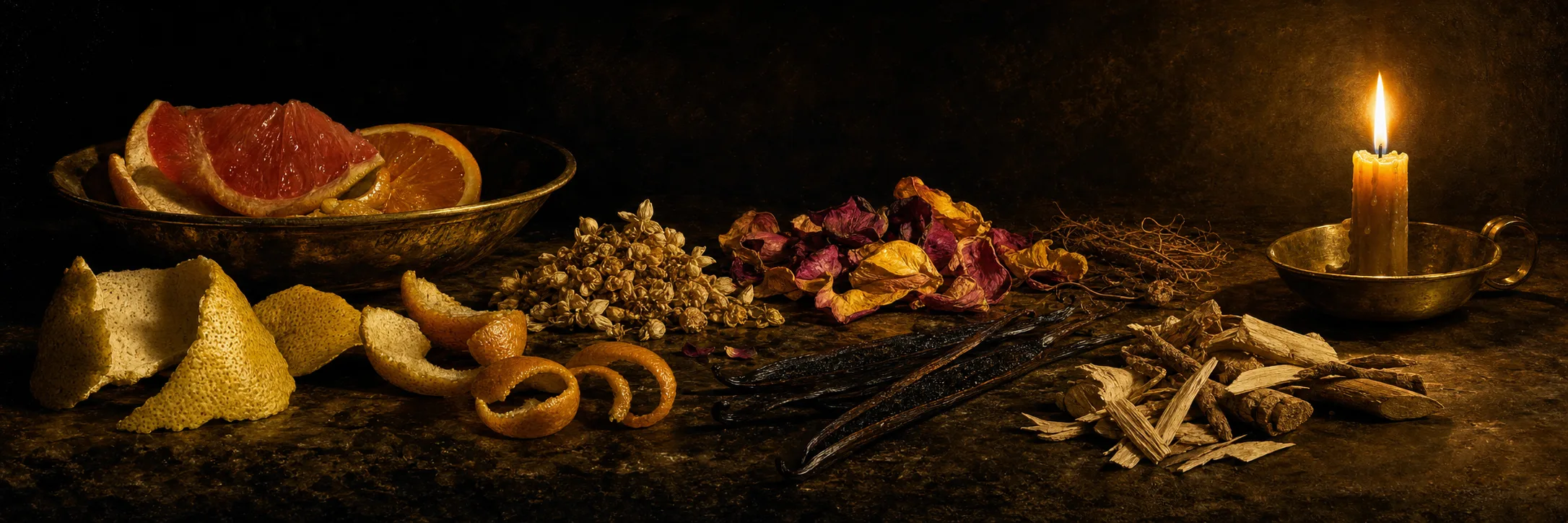
Nirmala is a sweet, tropical fruit-and-vanilla oriental. It opens on a bright, slightly tart citrus-and-tropical accord - grapefruit/pomelo and mandarin giving way fast to a vivid passionfruit-and-mango “fruit explosion.” A clean jasmine keeps it feminine through the heart. The base is the engine: vanilla and tonka over sandalwood, cedar and musk, producing a warm, candied, faintly powdery drydown. The signature criticism - and fascination - is a sweaty, animalic undertone some skins pull from it: reviewers report a “strange chloride note” or cumin-like facet (“ripe mango bathed in cuminesque sweat”), while others get only “a warm, complex, fruity patchouli.” It is fundamentally linear and not subtle.
Performance
Several wearers report it outlasting Mugler Angel on skin while projecting less aggressively. A minority find it fades disappointingly - likely a batch/concentration and skin-chemistry variable, an issue compounded by Molinard’s habit of frequent EDT/EDP reissues.
Wearing Context
A cool-weather evening fragrance for most, though its fruity brightness makes it wearable in warm weather if applied sparingly. Marketed feminine; some men wear it happily. Best deployed in small doses - over-application is where the sweaty-fruit risk lives.
Comparisons & DNA
The whole Nirmala conversation orbits Mugler’s Angel. Nirmala is repeatedly described as “Angel minus the patchouli and chocolate,” or “Angel minus the vulgarity” - fruitier, lighter, less baroque, the “go-between” version of that fruitchouli-gourmand idea. Comparisons also run to Mugler Innocent (whose pyramid some find even closer) and to Lancome Hypnose.
Reception
For the Baccarat edition specifically, coverage is essentially public listing’s new-flacon announcement and the broader body of Nirmala reviews; there is no dedicated major/major critical review of the 2015 edition. Sentiment on the underlying scent is polarized - devotees call it a “holy grail” and a hidden gem that predates Angel by decades, while detractors get cat-pee, bleach or BO. The diamond flacon itself was generally admired as the most attractive housing the juice has had.
Versions & Reformulation
Heavily versioned, and this is central to understanding it. Molinard has, by public listing’s account, reissued Nirmala repeatedly (commonly cited reformulation points: 1955, 1993 and 2003), across many bottle designs (deep blue “Les Feminins,” the Lalique-style frou-frou sprayer, the 2015 Baccarat diamond, the 2017 bow-decorated flacon). The 2015 Baccarat Edition is a packaging variant of the then-current EDP, not a reorchestration.
Acquisition Notes
The diamond flacon held 75 ml EDP and launched at roughly €76 on Molinard’s site, with a matching €22 body milk. Because the juice is (per Molinard and public listings) effectively unchanged across editions, there’s little olfactory reason to pay a premium for the Baccarat bottle over a standard current Nirmala unless you specifically want the flacon. Avoid the “type”/dupe oils that crowd search results.
Notable Facts & Lore
- The richest thread here is legal.
- As perfume historian Elena Vosnaki documented for public listings, Thierry Mugler Parfums sued Molinard over Nirmala being positioned as an affordable Angel “smell-alike,” and on 24 September 1999 the Paris Tribunal of Commerce accepted - for the first time in France - the notion of copyright protection for a fragrance.
- Molinard’s defense was that a perfume called Nirmala had existed in its catalogue since 1955, predating Angel by decades.
- The twist: when a collector’s genuine 1950s Nirmala was compared side-by-side, the original reportedly smelled nothing like the modern fruity version - it smelled “in the vein of Chanel No.
- 5.“ The modern Angel-adjacent Nirmala is thus a later recycling of an old name onto a new scent.
- Separately, lore holds that Thierry Mugler’s mother wore (an earlier) Nirmala - a story that, true or not, cemented the two perfumes’ entanglement in enthusiast memory.