Molinard — Molinard de Molinard
Essence
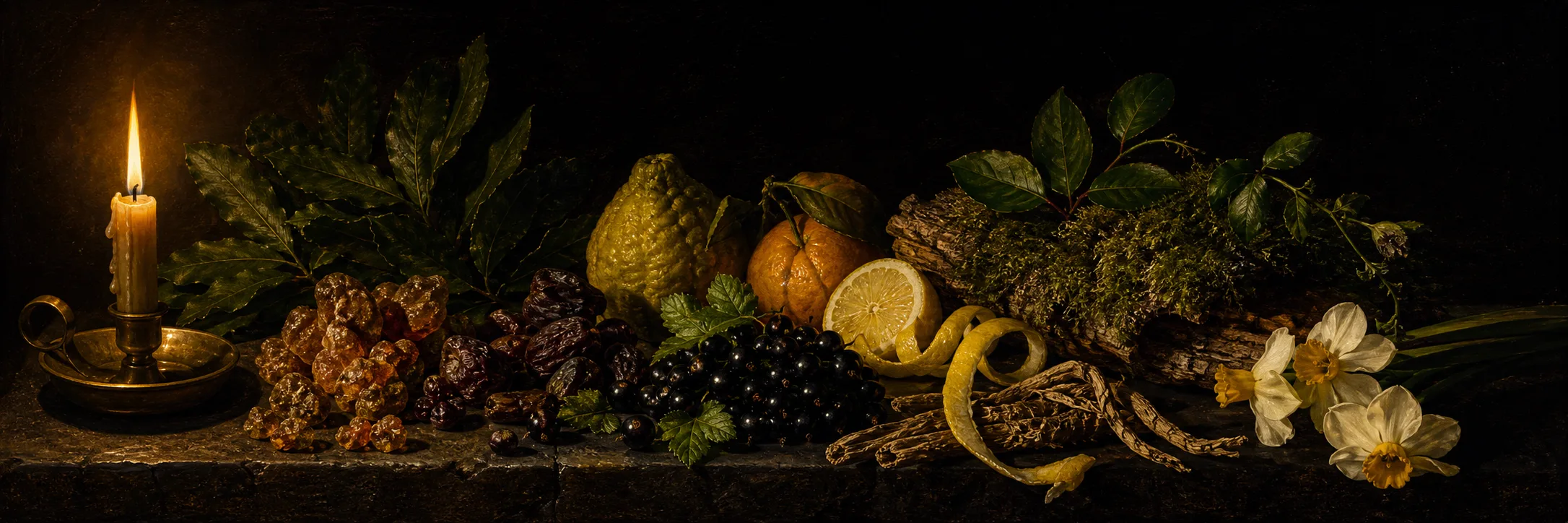
A 1979 green floral chypre from the historic Grasse house Molinard, famous almost as much for its frosted Lalique nymph bottle as for its juice. It is a sharp, galbanum-driven green floral with an unusual, distinctive top - asafoetida, cassis/blackcurrant and fruity facets over bergamot and lemon - settling into a muguet/narcissus/jasmine heart and a vetiver-incense-labdanum-patchouli base.
Scent Profile
The opening is famously, sometimes shockingly green: an “abrasive galbanum top note,” bitter and herbaceous, with a tart cassis/blackcurrant fruitiness and a sliver of citrus - one reviewers called it “THE SHARPEST GREEN I OWN!” The curious asafoetida/incense facet gives some wearers a smoky undertone early on; The Scented Hound describes the extrait’s opening as “all smoke and incense on top of bergamot and a muted fruit.” The sharpness softens fairly quickly into a “bittersweet green floral accord,” a soft-focus blur of lily-of-the-valley, narcissus, rose and jasmine - “crisp, sparkling and soapy,” like “soft focus, Vaseline on the lens, with a dry feel like Muscadet.” The drydown brings grassy vetiver, a powdery/soapy edge, and faint incense; critics of the reformulation find the base turns thin, soapy and synthetic-woody where the vintage stayed lush. It can read talcum-powdery and even masculine to some in the base. Note that catalog/public listings list it “Floral Fruity,” but the near-universal wearers read is green floral / green chypre - flag this discrepancy.
Performance
Concentration- and version-dependent, which is the key practical fact. The vintage parfum extrait and the older toilet water are praised for outstanding longevity - “a little goes a long way with Molinard, and longevity is outstanding.” The EDT, by contrast, is repeatedly described as fleeting: “the scent is extremely transient and dries down exceptionally fast,” and reviewers report the reformulated version “dries down a lot quicker than before and fades faster,” no longer leaving a trace on clothing by day’s end. The branded “M de Molinard” eau de parfum (red bottle) is singled out by one reviewers as having “abysmal” performance with too much vetiver. wearers tip: layer with the matching lotion to extend wear.
Wearing Context
A practical reading supported by wearer reports: a spring/early-autumn, daytime, warm-weather green floral - wearers call it “perfect for spring and summer,” an “Indian summer” scent for warm days with a crisp chill, “casual and carefree, all maypole fun and sunny picnics.” Its bitter-green character is office-safe and “inoffensive” (one wearer tolerated by scent-allergic colleagues), and despite the feminine label it draws unsolicited compliments from men and reads unisex/even masculine in the drydown to some. It can feel wrong to modern, sweet-leaning tastes - one reviewers bluntly says “these types of bitter green floral chypres went out of style ages ago” and doubts anyone under 50 would enjoy it.
Comparisons & DNA
This fragrance is best mapped by its peers. The dominant, repeatedly cited comparison is Jacomo Silences (and Lancome Yendi) - its “obvious precursors” - plus Chanel No. 19; a reviewers judged the Molinard “comparatively thin and soapy next to its more sumptuous predecessors” and would “sooner wear No. 19 or, track down Yendi or Silences.” Wearers note it is sharper/greener than Silences and less iris-y/cool than No.
Reception
Strongly affectionate among vintage-green lovers, with two clear axes of polarization. First, sharpness: many adore the “sprightly,” bracing galbanum green; others find it “very bitter,” soapy, even “old lady”/pine-y and abrasive. Second, version: near-universal lament that reformulation gutted it - “Another scent spoiled by the reformulation,” and a Perfume Shrine reviewer relaying that the “new formula sold under MdeM name/label is of the poorest quality, powdery odor that one may associate with pre-teen economy scents.” The Scented Hound, reviewing the vintage parfum extrait, was rapturous - “Beautiful and mysterious, mysterious, sensuous, radiant” - calling the Lalique bottle “an exquisite, beauty.” Note: no confirmed Luca Turin/Tania Sanchez book review of this fragrance exists (the widely circulated “four stars / Vetiver Vanilla” Turin quote is for Molinard’s Habanita, a different fragrance - do not conflate). Blind-buy verdict: yes for vintage-green fans who source vintage juice; the current EDT is a gamble many find disappointing.
Versions & Reformulation
Multiple versions and a significant, much-lamented reformulation. The original 1979 came as parfum extrait and eau de toilette in the Lalique frosted “dancing nymphs” bottle (the extrait widely considered the pinnacle). There is also a branded “M de Molinard” EDP in a red bottle that several reviewers dislike.
Acquisition Notes
Vintage commands collector prices and is volatile. The modern reissue EDT (100 ml, 3.3 oz) is sold new and inexpensively. Authenticity tips from the wearers: the original Lalique bottle has molded relief nymphs and a ground-glass stopper/beaten-gold filigree cap; buy well-stored vintage from reputable sellers, as old juice can be faded or turned. Habanita-style batch-code anxieties exist at the house level but no Molinard de Molinard-specific batch decoder was found.
Notable Facts & Lore
- The frosted Lalique bottle - molded with relief female nymphs, an original Rene Lalique design - is the object of genuine lust among collectors and is repeatedly named as a primary reason to own the fragrance; one wearer associates it with the now-vanished I.
- Magnin department store of her childhood.
- A persistent piece of wearers lore, unverified, holds that “Prince wore this.” The fragrance is frequently framed as the unfairly “sidelined” green sibling to Molinard’s far more famous Habanita (1921).
- Molinard is one of the oldest continuously family-run Grasse houses - founded in 1849 by Hyacinthe Molinard and operating since 1900 from an old perfume factory whose distillery structure was designed by Gustave Eiffel - context for the old-world craftsmanship reputation that surrounds this scent; the house is today run by fifth-generation director Celia Lerouge-Benard and carries France’s “Entreprise du Patrimoine Vivant” living-heritage designation.