Molinard — Les Fleurs Fleur De Figuer
Essence
Fleur de Figuier is a 1999 eau de toilette from Molinard, the historic Grasse house founded in 1849 by Hyacinthe Molinard and one of the oldest continuously family-run perfumeries in France - second in age only to Galimard (1747) and today a state-recognized “Entreprise du Patrimoine Vivant” alongside houses such as Guerlain and Caron. It belongs to Molinard’s minimalist Les Fleurs line, and it is a fig fragrance in the green-leaf tradition rather than the fruity-gourmand one.
Scent Profile
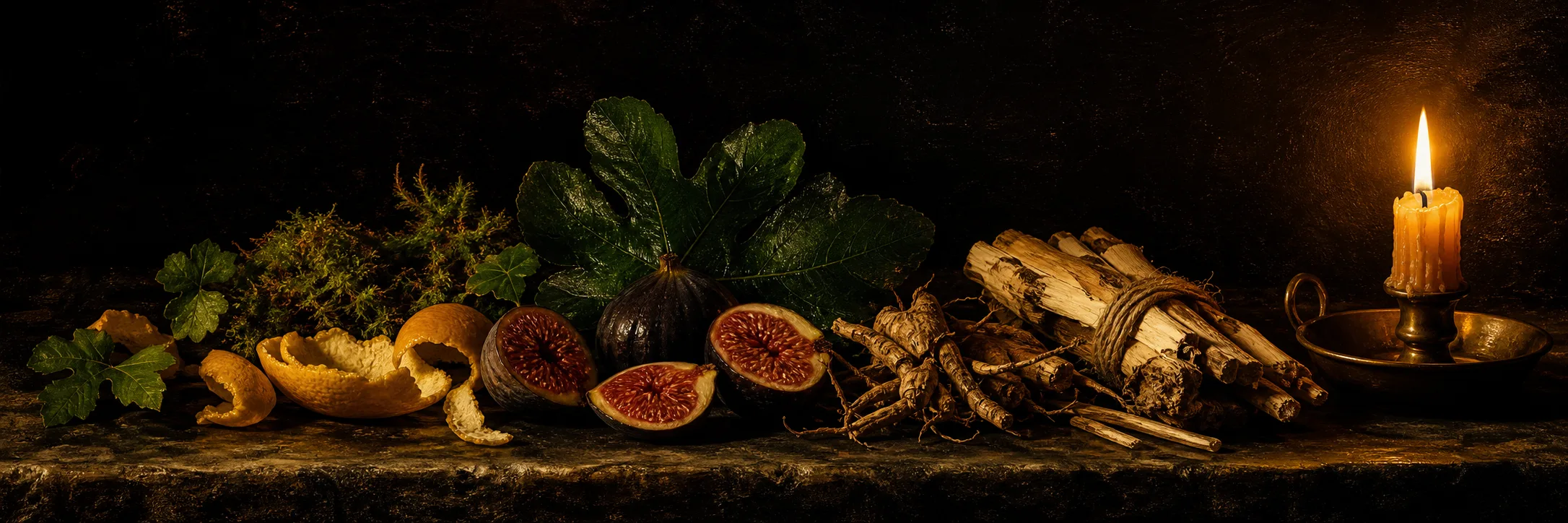
The opening is bright, citrusy and green - orange and a sharp galbanum bite that several wearers read as “fig sap.” The heart is the main event and the reason for its reputation: a green, leafy, slightly milky fig-leaf accord, often described as “one hundred percent green, like a real living fig tree,” with an underlying sweetness. It evokes “the branches and the fig leaves” more than the fruit. The drydown leans on mild, warm Virginia cedar - “non-obtrusive,” with the fig leaf reappearing softer and less bitter than the opening sap. There is meaningful skin-chemistry variance: some wearers get a distinct almond/flour-textured nuance (“a slightly sweet, flour-textured woody fragrance”), and a minority experience the base turning more synthetic-floral or “feminine” rather than green. A few perceive a sweeter amber-like facet they find slightly excessive.
Performance
Reports are mixed but lean toward respectable longevity and modest projection. One reviewers logged “8+ hours, and when it seemed like it was gone, it was still there,” maintaining “earthy fig and cedar combination for hours and hours, a smell that I wish projected more” - a recurring theme that the scent lasts but stays close. Another fig fan called the lasting power “amazing” on their skin.
Wearing Context
This is overwhelmingly a warm-weather and transitional scent. Wearers reach for it in spring and summer for its refreshing greenness - one specifically “to hurry spring up” in March - and into early fall. Its crisp, clean, slightly sweet character suits daytime, casual, and outdoor wear.
Comparisons & DNA
Fleur de Figuier sits squarely in the fig-leaf lineage pioneered by Olivia Giacobetti’s L’Artisan Premier Figuier (1994) and Diptyque Philosykos. The wearer reports is direct and frequent: one reviewers declared it “even surpasses - just - the wonderful Diptyque Philosykos and charming Jo Malone Fig & Cassis,” calling it a “holy grail” and “a cheaper alternative to Diptyque’s Philosykos.” Versus Philosykos and Premier Figuier - both of which add a creamy coconut/almond-milk roundness (Giacobetti’s signature) - Molinard’s version is drier, greener, and more linear, with a plain cedar base rather than Philosykos’s cedar-or-sandalwood creaminess. Note the disambiguation: Molinard later released a separate, fruitier, sweeter Figue (2015/2016 EDP, by Mathieu Nardin) that is a different, fruit-forward fig; wearers explicitly distinguish the green Fleur de Figuier from that sweeter Figue. public listing’s “reminds me of” cluster also lists Kiehl’s Fig Leaf & Sage, Zara Fig, and Hermes Un Jardin en Mediterranee.
Reception
Among fig devotees the reception is warm and the value proposition is the headline - repeatedly framed as “a cheapie that smells exquisite.” The most enthusiastic reviews call it “divine,” “a masterpiece,” and “pure green fig, nothing more, nothing less.” More tempered voices, while finding it “pleasant,” judge it “not a master creation,” with one detailed reviewers wishing for more “uniformity” because “the notes don’t blend well together, but remain separate and distinct.” A recurring critique is that it can feel “unfinished” or thin, a consequence of Molinard’s deliberately minimalist house style. The genuine point of disagreement is skin chemistry: a vocal minority report the green fig collapsing into a synthetic or generic-feminine base. major critic coverage is essentially absent; the evidence base is wearers.
Versions & Reformulation
The fragrance has appeared under closely related names and packaging over the years (public listings carry both a “Fleur de Figuier” and a “Les Fleurs Fleur De Figuer” entry for the 1999 EDT, with the Les Fleurs / Les Fleurs de Provence line branding), and Molinard has periodically updated its bottle/packaging to an Art-Deco-inspired design across the Les Fleurs range. No specific reformulation of the juice is documented in Documented sources; treat as effectively a single long-running composition with packaging refreshes.
Acquisition Notes
This is a value-tier fragrance and that is central to its appeal. Sampling first is wise given the documented skin-chemistry variance.
Notable Facts & Lore
- Molinard’s pedigree is part of the lore: founded 1849 in Grasse, the cradle of modern perfumery; an early adopter of soliflores (Jasmin and Rose from 1860 in Baccarat bottles); creator of the legendary Habanita (1921/1924); commissioner of Rene Lalique and Baccarat bottle designs; and, after moving into an old perfume factory in 1900, operator of a distillery building whose structure was designed by Gustave Eiffel and where Molinard perfumery is still based today.
- Fleur de Figuier itself rides the late-1990s wave of green fig fragrances that Giacobetti’s 1994 Premier Figuier launched - a genre that broke from the opulent 1980s powerhouses toward transparent, “cool” naturalism.
- Its persistent enthusiast reputation is as the genre’s great bargain: the fig scent you buy when you love Philosykos but not its price.