Molinard — Les Fleurs Jasmin
Essence
Les Fleurs Jasmin (sold as “Les Fleurs de Provence Jasmin”) is Molinard’s 1994 jasmine soliflore eau de toilette - one entry in the Grasse house’s long-running single-flower series that descends conceptually from the original Molinard Jasmin of 1860. It is a fresh, green, watery interpretation of jasmine: more “flower held to your nose in a field, grass and stems intact” than the heavy indolic white-floral bombshell.
Scent Profile
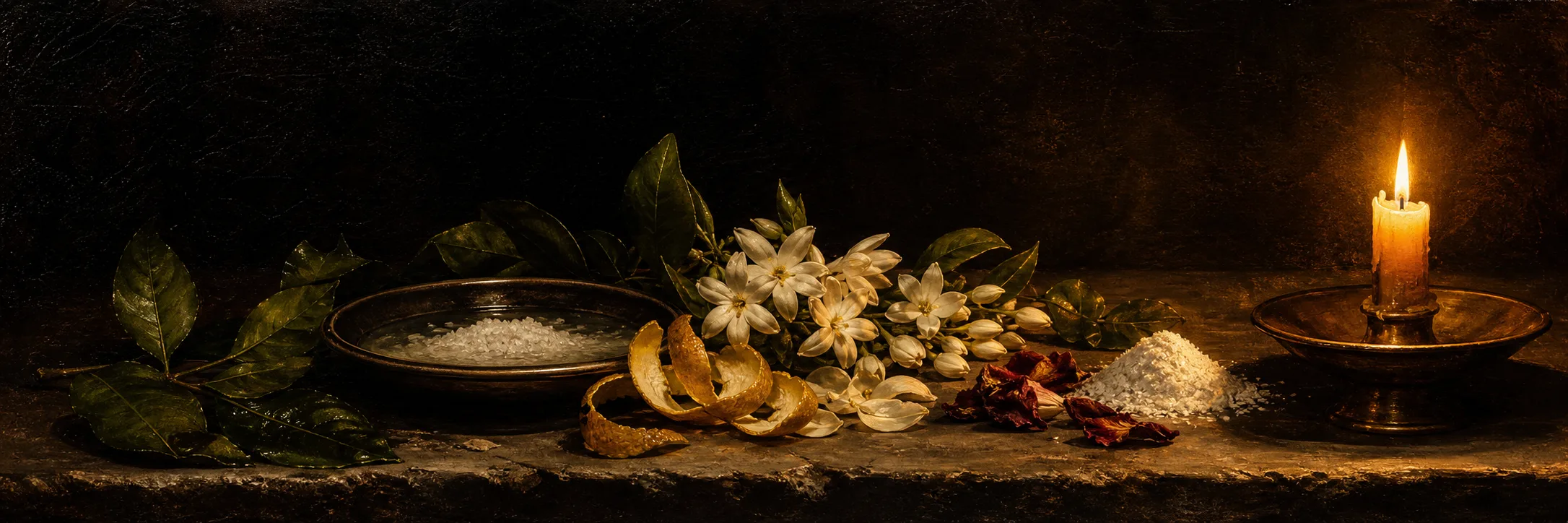
The 1994 EDT opens green and watery - public listings list green notes and water notes up top - giving a crisp, dewy lift before the jasmine arrives. The heart is jasmine softened and rounded by orange blossom and rose, and the base rests on a simple white musk. Named-critic and wearers descriptions of Molinard’s jasmine split along version lines: the older Les Fleurs de Provence style is repeatedly described as “utterly fresh, very essence/essential oil, botanic, it really, literally, smells like a flower held to your nose from the field” and “not sweet, as we’ve come to expect jasmine to be” (Perfume Emporium). Several reviewers detect an almost lilac-like facet and call it a “fresh watery jasmine” ideal for spring. The Scented Salamander’s review of the Molinard soliflore noted a more animalic reading - “the indoles, which belong to the flower, with their sexual scent, are present from the beginning, to the point where they start suggesting the scent of leather” - balanced by “fresh, sweet and soft floral notes.” So expect a true-to-flower jasmine with a green/watery freshness and only a moderate, shadowy indole rather than the screeching dirtiness of niche jasmines. It is fairly linear; the signature accord is fresh green jasmine-orange-blossom over clean musk.
Performance
Enthusiasts are more emphatic: one called it “as strong as Montale Jasmin Full but doesn’t smell so obviously chemically,” with “good longevity and sillage,” and another reported “killer sillage, the strongest among the Les Fleurs Molinard series.” Realistic expectation: solid for a soliflore EDT, with a couple of wearers finding it surprisingly potent at the opening. Best in warm, garden-like conditions; it evokes “a summer garden at night.”
Wearing Context
Spring and summer, daytime into warm evenings, casual to semi-dressy. It is feminine but, like all soliflores, effectively unisex. Its fresh, natural, non-cloying character makes it easy and inoffensive - a clean floral signature rather than a statement perfume.
Comparisons & DNA
The most-cited comparators are other jasmine soliflores, mostly via Molinard’s own 2015 EDP, which reviewers liken to Tom Ford Jasmin Rouge (described as roughly 90% similar but Molinard sweeter and less aristocratic), Nasomatto Nuda (Molinard tamer, less challenging), Montale Jasmin Full (Molinard less chemical), Lush Lust (Molinard far less raw and indolic) and Guerlain’s discontinued Jasminora (Molinard a reliable substitute). For the 1994 EDT specifically, the DNA delta is its green-watery freshness and lighter indole load - it is the “daylight,” botanic-realistic jasmine end of the spectrum versus the heavier, spicier, sandalwood-backed 2015 EDP.
Reception
Among jasmine lovers the Molinard soliflore is a quiet favorite - “this may be my favorite jasmine soliflore,” “part of my very perfume backbone, an essential” - praised for realism, value and a non-chemical naturalness from a historic Grasse house. Criticisms cluster around two axes: some find it too citrus-acidic or green for their taste, and a minority (mostly reacting to the more indolic later EDP) find the jasmine cold, austere or “drowned.” Polarization is fundamentally about how indolic/fresh you want your jasmine and which version you’ve sampled. Blind buy verdict: low-risk and inexpensive if you want a realistic, fresh jasmine - just be clear about whether you’re buying the older green-watery EDT or the spicier 2015 EDP, as they are not the same juice.
Versions & Reformulation
This is the key complication. The 1994 “Les Fleurs de Provence Jasmin” EDT (green notes/water notes/jasmine/orange blossom/rose/musk) and the 2015 “Jasmin” Eau de Parfum in the Les Elements / Collection Matieres line (jasmine/lemon/orange blossom/clove-carnation/rose/white musk/sandalwood) are listed by public listings as separate compositions with different note pyramids and concentrations; no source confirms identical juice. public listings flags the older Les Fleurs de Provence Jasmin EDT as “apparently discontinued” while the 2015 EDP is “still in production.” The Scented Salamander noted as early as 2007 that the older line’s packaging had been changed to an Art-Deco style, and Molinard “redesigned” its soliflore range in 2021 around three Collection Matieres tiers (La Fraicheur, Les Elements, Les Prestiges), effectively superseding the old “Les Fleurs de Provence” format with the newer EDP. Both descend from the historic 1860 Jasmin.
Acquisition Notes
The current in-production product is the 2015-launched Jasmin Eau de Parfum (Les Elements). Molinard fragrances are widely available, inexpensive and not a notable counterfeit target.
Notable Facts & Lore
- Molinard was founded in 1849 in Grasse by Hyacinthe Molinard, who ran it as “Molinard Jeune”; it is among the oldest family-run French perfumeries (after Galimard, 1747).
- The house built its early reputation on soliflores and eaux parfumees, gaining fame in 1860 with two new perfumes - “Jasmin” and “Rose” - presented in Baccarat crystal.
- Queen Victoria stayed at Grasse in 1891 and bought Molinard Eaux de Cologne there.
- The Les Fleurs (de Provence) line continues that tradition of single-note “wear your flower” scents.
- Jasmine itself, native to Grasse cultivation since the 19th century, is the house’s spiritual raw material.
- There’s a small naming/identity tangle worth knowing for collectors: public listings, public listings and Molinard list multiple “Jasmin” entries (1860 historic, 1994 Les Fleurs de Provence EDT, 2015 Les Elements EDP), and wearer reports frequently conflate them - so verify the bottle/packaging and concentration before assuming a given review describes the one you’re holding.