Molinard — Musc Eau de Parfum
Essence
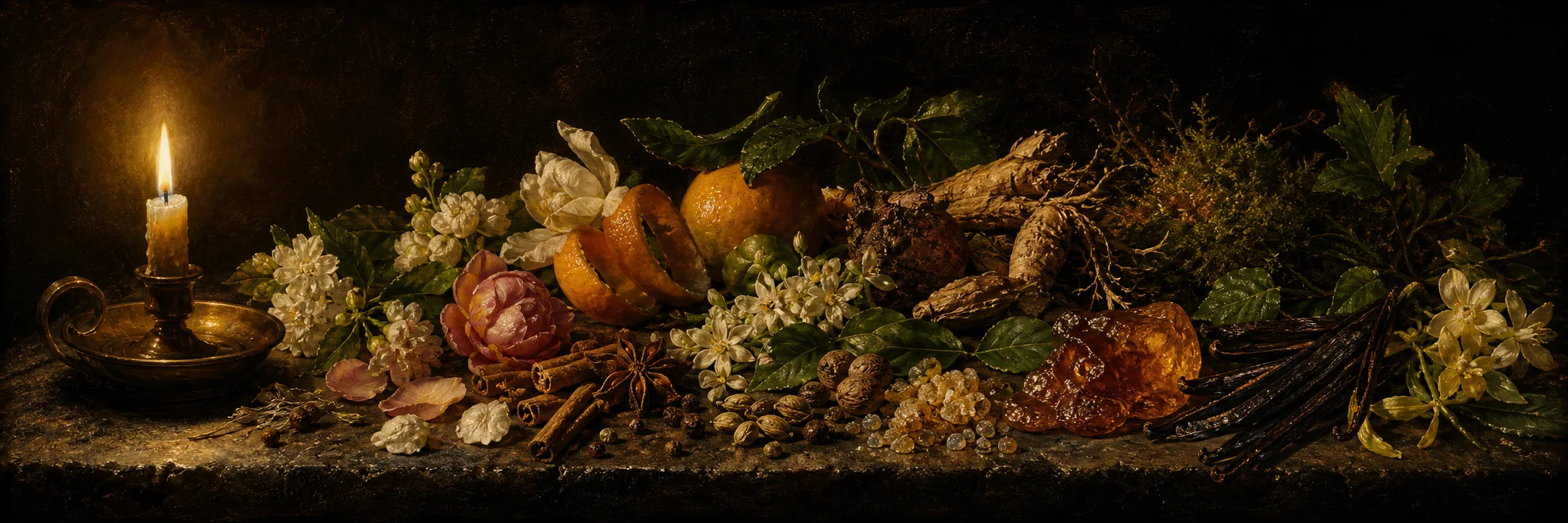
Despite the name, Molinard’s Musc (2015) is not a clean “skin musk” - it’s a dense, balsamic incense-and-patchouli oriental the wearers almost unanimously describes as a “head shop” or “nag champa” scent. Released by the historic Grasse house Molinard - founded in 1849 by Hyacinthe Molinard and one of the oldest French perfume houses still in operation (after Galimard, established 1747), still family-run - it pairs a citrus-neroli flicker up top with a heart of patchouli, amber and vanilla and a resinous base of opoponax, benzoin and musk.
Scent Profile
A brief, slightly sweet citrus opening (bergamot/neroli) is fleeting - several wearers report a fruity, almost grape-soda or “Pez” top note that some find synthetic before the resins take over. Within minutes it becomes its true self: incense, patchouli and sweet resin - “incense, nag champa, and peace, love, and rock n roll.” The amber-opoponax-benzoin core reads spicy, balsamic, only slightly sweet, discreetly smoky. One reviewers caught a “sticky cough syrup” association early that faded as incense gained weight. Fairly linear once settled. Signature accord: patchouli-and-opoponax incense over sweet resinous amber. Some detect an indolic, slightly “stinky” white-floral facet in the opening before the base smooths things out.
Performance
Documented performance evidence is genuinely conflicting and appears formulation- or batch-dependent. A cluster report strong, dense, long-lasting performance - “lasts all day 8+ hours,” sillage around three hours before settling close. A meaningful minority report only “an hour or 2 tops” of a weak scent.
Wearing Context
Best in cold weather - autumn and winter - and for leisure rather than office, given the heavy incense-patchouli character. Works day or night but rewards informal, cozy settings; genuinely unisex, “neither masculine or feminine, it’s own animal.” It reads as a deliberate, characterful incense scent, not a crowd-pleaser. A practical reading for the incense-averse: better sampled first.
Comparisons & DNA
The dominant wearer reports is to nag champa incense itself rather than another fine fragrance. Within Molinard’s own line reviewers recommend Molinard Patchouli and Molinard Ambre as siblings. One reviewer connected its musk, surprisingly, to the animalic musk of Yves Saint Laurent Kouros rather than any clean white musk. Broadly this is resinous-oriental / incense-patchouli; not a dupe of a specific designer scent, and no reliable 1:1 comparator emerged.
Reception
Consensus splits on expectation. Incense/patchouli lovers love it - “comforting,” “rich, balsamic, artistic,” a slept-on affordable niche oriental. Those expecting a literal musk are disappointed or put off by the loud, resinous, sometimes “harsh” top and middle; the grape-soda opening is a recurring minor criticism. Praise consensus from public listings frames it as one of the better affordable woody-oriental/incense buys.
Versions & Reformulation
Not a single clean composition: there is both an older Eau de Toilette (brown-label) and the 2015 Eau de Parfum (purple-label), described somewhat differently, with several reviewers preferring the EDT. Molinard has also revised bottle/label designs over time. No formal “reformulation” is documented as such, but the EDT/EDP distinction means buyers should specify the version.
Acquisition Notes
Affordable tier - frequently discounted well below an ~$84 retail to the $30s - typically a 75ml EDP in the tall purple bottle with a black Molinard-insignia cap (batch codes decode via CheckFresh; eg, a “51401B” code traced to 30 March 2015). One enthusiast reviewer noted they’re “yet to hear anyone has made a dupe of a Molinard perfume,” ie, counterfeiting is not a documented concern.
Notable Facts & Lore
- The house frames Musc as “a vibrating tribute to the heritage of the perfumer” and to Molinard’s Grasse legacy (brand dates to 1849).
- Beyond that heritage framing there is no celebrity association, viral moment, or controversy documented - its lore is entirely the wearer consensus “1970s head shop / nag champa” reaction rather than anything the house promoted.