Molinard — Nirmala
Essence
Nirmala is a fruity-gourmand floral that the wider fragrance wearers knows almost entirely as “the original Angel” - the fragrance whose name and juice became the centre of a landmark French perfume-copyright lawsuit. As sold today (the bottle most people own), it is a bright, juicy, passion-fruit-and-mango opening that warms into a vanilla-tonka-sandalwood base with an earthy, quasi-patchouli undertow, reading to most wearers as a lighter, more wearable, less chocolatey relative of Mugler’s Angel.
Scent Profile
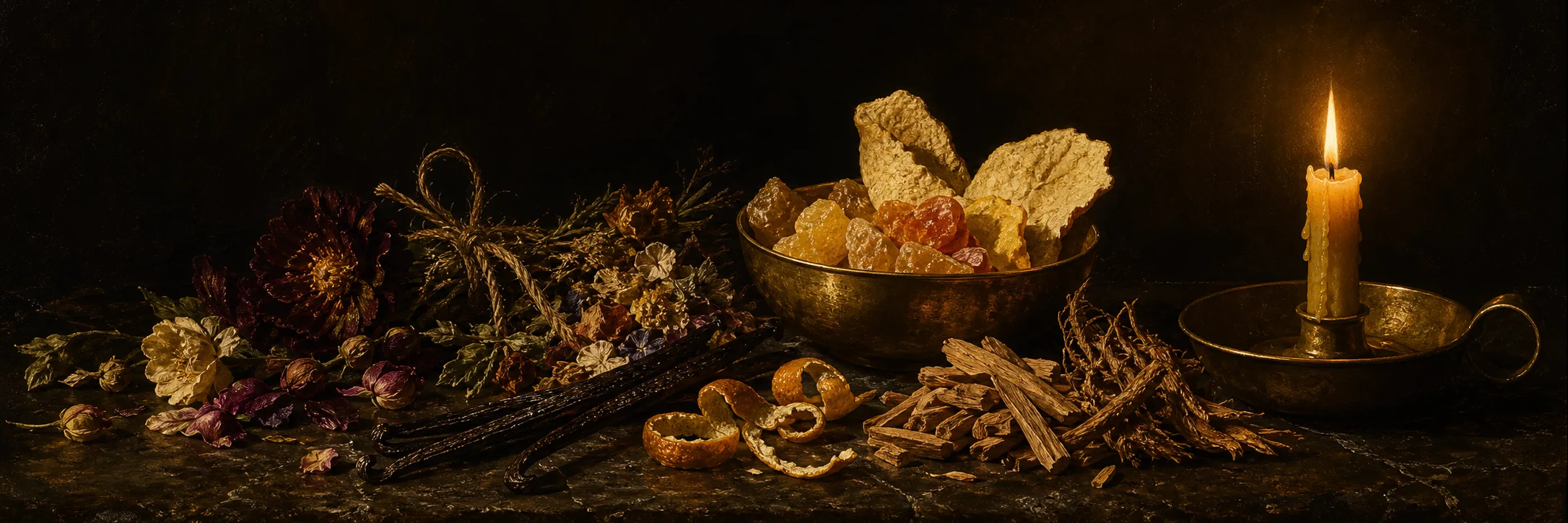
Working from the listed notes and consistent wearers reporting: the opening is the signature - a sweet burst of passion-fruit and mango with grapefruit/pomelo and mandarin giving tartness, though reviewers repeatedly note the citrus stays subtle while the tropical fruit dominates. The heart is where the Angel comparison crystallizes: the fruit settles onto vanilla and tonka, and a jasmine/exotic-floral facet keeps it feminine, while an earthy, “dirty,” pseudo-patchouli quality emerges even though no patchouli is officially listed (multiple public listings/reviewers independently report smelling “patch” here). The drydown is a warm, creamy vanilla-tonka-sandalwood with cedar and musk. The signature accord is “tropical fruit over creamy vanilla-tonka with an animalic shadow.” It is fairly linear - one reviewers calls the lack of development “slightly disappointing” - and a recurring polarizing facet is a sour/cuminic, sweaty or “chloride/bleach” note some skins pull from the base (one Nice-boutique reviewer described “bleach plus cumin plus super obnoxious fruit”), the same body-odour reaction some people get from Angel and Obsession.
Performance
wearers claims are mixed but lean positive on longevity. Many wearers report excellent longevity and “strong but not offensive” sillage, with several saying it outlasts Angel on their skin; one reviewer who bought in the Molinard Nice boutique found performance only moderate. EDT and EDP are widely reported as nearly identical - one Amazon reviewer with both says “there is virtually no difference, please don’t spend your money on the EDP.” A notable counter-signal: buyers who purchased online (vs. at the French boutique) sometimes complain of a weak, over-diluted, one-hour version, suggesting batch/source variability or counterfeit risk.
Wearing Context
Best in cooler weather and evenings per repeated wearers comment (“cool weather evening fragrance,” “love it on very cold days”), though a sizable minority wear it as a spring/summer tropical scent and find it cheerful and “youthful (not young).” It skews feminine but is comfortably worn by men who like gourmands (several male reviewers report compliments). Occasions: casual to smart-casual, date, or a comfort scent; the grapefruit-tinged opening makes it office-tolerable for some, while the animalic drydown makes it better for personal/evening wear for others. Social perception skews “warm, sweet, sensual, slightly retro.” This seasonal read is a practical synthesis of documented scent character, not a hard consensus.
Comparisons & DNA
The defining comparison, repeated in virtually every review and by major/critic-adjacent sources, is Mugler Angel (Mugler) and especially Mugler Angel Innocent (Mugler) - Nirmala is consistently framed as “Angel minus the patchouli/chocolate” or “Angel without the vulgarity,” fruitier and more wearable. Several reviewers also name Lancome Hypnose (Lancome) as a relative, with one arguing Lancome was itself inspired by Nirmala (“Angel minus patchouli mixed with Hypnose”). public listings critic-style reviews add Creed Spring Flowers (Creed) as a lighter floral-fruity cousin to the genuine vintage. DNA: fruity-gourmand oriental in the Angel lineage. The deltas vs.
Reception
wearers consensus is genuinely polarized along a clear axis: lovers find it a “hidden gem,” a more refined and natural-feeling Angel that draws compliments and questions (“what are you wearing?”); detractors get sour, sweaty, cumin/BO or “cat’s pee” facets and call it a cheap or “terribly wrong” Angel clone. On public listings the dominant narrative is the Angel-predecessor lore (see Lore); public listings hosts the most critical takes, including a sharp review noting the modern version smells “unfinished - even skeletal - next to its progenitor” and “Whatever Nirmala was in 1955, this isn’t it.” reviewers admire the passion-fruit realism and a “deep, natural creaminess” they attribute to good materials. Blind-buy verdict from the wearers: risky - skin-chemistry-dependent because of the cumin/animalic potential; sample first, but cheap enough that many blind-buy anyway.
Versions & Reformulation
This is the crux of the catalog discrepancy and is unusually well documented. Per Elena Vosnaki’s public listings investigation “Fragrance Sleuthing: The Three Faces of Nirmala (Mugler vs. Molinard),” Nirmala has had three distinct phases: (1) the genuine 1955 original, which a collector’s vintage bottle revealed to smell like an aldehydic Chanel No.5-style floral in an amphora-shaped flacon - totally unrelated to Angel; (2) a 1990s/2000s “Les Feminines” (deep-blue, then lilac Lalique-nymph) reformulation that deliberately mimicked Angel; and (3) the 2017 redesign (bowed vintage-style flacon, alongside “Le Reve de Nirmala”), which Molinard says keeps “the same composition” but which Vosnaki and reviewers say has distanced itself from Angel again.
Acquisition Notes
Documented evidence on counterfeits is thin but suggestive: multiple buyers report that bottles bought online (Amazon and elsewhere) smelled weaker, over-diluted, or “not the same” as boutique-bought juice from the Molinard stores in Nice/Grasse - so the safest authentic channels are Molinard’s own boutiques and website. No reliable Documented batch-code decoding guidance was found; treat very cheap online listings with caution and prefer sealed boxes from reputable sellers. Because so many bottle designs share the name, confirm which “phase”/packaging you are buying if formula matters to you.
Notable Facts & Lore
- Nirmala’s fame rests almost entirely on the Mugler vs.
- Molinard lawsuit, one of the most important episodes in perfume legal history.
- Per public listings (Vosnaki) and primary French legal records, Thierry Mugler Parfums (a Clarins subsidiary) filed its complaint in 1993 after its client-card system revealed customers were buying the cheaper Nirmala as an Angel “smell-alike”; after a roughly seven-year procedure, the Paris Tribunal of Commerce ruling of 24 September 1999 (case SA Thierry Mugler Parfums c/ SA GLB Molinard) became the first time in France that a fragrance was held protectable by copyright (droit d’auteur).
- The practical resolution was a mediation settlement: per the Swiss daily Le Temps, “Molinard a accepte de changer la fragrance portant le nom de Nirmala.
- Ce nouveau jus a ete approuve par Thierry Mugler Parfums“ (Molinard agreed to change the Nirmala fragrance, and the new juice was approved by Mugler) - which is exactly why later batches no longer smell like Angel.
- The commercial stakes were lopsided: per the Lextenso legal digest, “En 1994, le chiffre d’affaires du parfum Nirmala etait de 2,9 MF” (Nirmala’s 1994 turnover was 2.9 million francs), while per Le Temps, “Rien qu’en 1999, le groupe Clarins a realise un chiffre d’affaires mondial d’environ 125 millions de francs avec Angel” (Clarins did roughly 125 million francs worldwide with Angel in 1999 alone).