Serge Lutens — A La Nuit
Essence
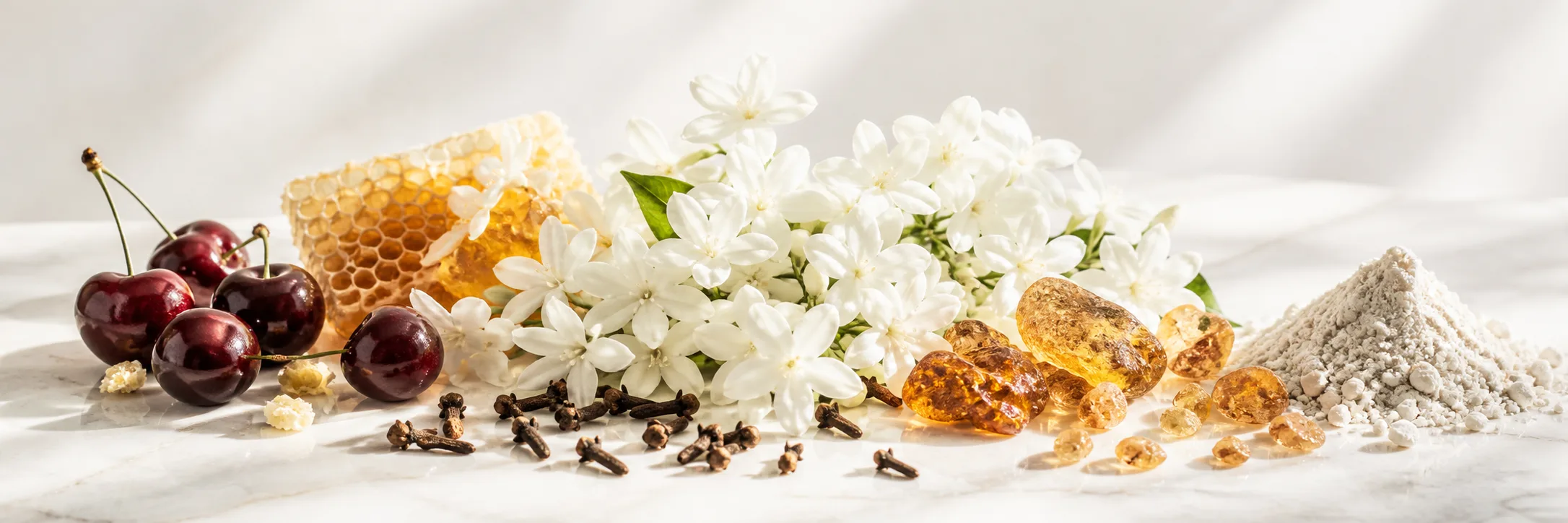
A La Nuit (2000) is a hyper-concentrated jasmine soliflore built on three jasmine varieties - Moroccan, Egyptian, Indian - pinned down with clove, honey, grenadine and a discreet musk. It is the maximalist’s jasmine: a saturated, indolic, almost narcotic rendering of the flower at night, with none of the soapy laundered cleanness that defines mainstream jasmines. Sheldrake’s stated aim was photorealism rather than abstraction, and the perfume reads as a single botanical statement held just shy of decadence by a thin green ribbon and a faint honey-grenadine sweetness.
Scent Profile
The opening ten to twenty minutes is the single most concentrated jasmine accord in mainstream niche: a wet, fleshy, almost waxen white-floral wall that arrives with the indolic edge most people learn to call “mothballs” or “diapers” on first sniff. There is a green-stem note up top (cut leaf, broken twig) and a subliminal clove warmth that keeps the flower from turning purely candied; honey and grenadine sit underneath as a faint syrupy halo rather than a flavor of their own. The flower is rendered with what reads as a high natural-absolute load - recognizably Sambac-and-Grandiflorum, not the laundry-detergent hedione fog of most modern white florals.
Performance
Projection is large for the first 15-30 minutes - a true room-filler - then collapses faster than expected for a Lutens EDP. Several critics flag this directly: Kafkaesque writes that on her skin “within 10 minutes, it starts to fade and become close to the skin.” Robin at NST notes that A La Nuit “doesn’t last even as long as average for an EdP” on her. Most users report 4-6 hours on skin, with 8-10 hours on fabric (jasmine clings well to wool and cotton).
Wearing Context
A late-spring through summer fragrance par excellence: the heat pulls the jasmine open the way the actual flower opens at dusk. It also works in the dead of winter as a deliberate counter-statement - wearing a tropical-flower perfume in January is a Lutens move. Avoid mid-range office temperatures where it neither blooms nor pulls in; it falls flat in dry air-conditioned offices.
Comparisons & DNA
Within the white-floral canon, A La Nuit sits between two poles. On one side is Frederic Malle Carnal Flower (2005, Dominique Ropion) - a tuberose with a green melon-leaf brightness and a brighter, more architectural feel; Carnal Flower is the sculpted modernist take, A La Nuit is the saturated naturalistic one. On the other is Robert Piguet Fracas (1948), still the benchmark big-white-floral, but tuberose-centric and powdered rather than indolic. Compared to Nasomatto Nuda, another famous indolic jasmine, A La Nuit is sweeter and warmer; Nuda is sharper, more rubber-glove animalic.
Reception
Critic consensus is high but with reservations about performance. Robin at Now Smell This called A La Nuit “the prettiest jasmine I know, although it isn’t girly-pretty in the least,” noting it “isn’t at all clean, in fact, it is more than a bit indolic.” Carmencanada on Grain de Musc, writing in 2007, treated it as a benchmark soliflore and the apex of Lutens’s white-floral period. Victoria Frolova at Bois de Jasmin has used A La Nuit repeatedly as her reference jasmine in monthly recommendation columns, citing it as the most realistic large-scale jasmine on the market. The Tania Sanchez “death by jasmine” descriptor - actually documented at Now Smell This as Robin’s own MakeupAlley testing note, which Sanchez later acknowledged using independently - has become the perfume’s de facto nickname. reception runs heavily positive among jasmine fans, with the standard caveat that “if you don’t love jasmine, scrub immediately.” wearers treat A La Nuit as one of the few mandatory jasmines to try, alongside Carnal Flower and (in the masculine canon) Tom Ford’s earlier Black Orchid Voile de Fleur. Polarization axes: (1) indole tolerance - anyone who picks up “cat pee” or “diaper” notes will scrub; (2) performance expectations - buyers who expect Lutens “beast mode” will be disappointed; (3) seasonality - winter wearers often complain it pulls flat where summer wearers rave. Blind buy verdict: yes if you have already loved any natural jasmine absolute or any indolic white floral; absolutely not if you have only worn mainstream florals like J’Adore or Coco Mademoiselle. The opening is enough of a shock that sampling is non-negotiable.
Versions & Reformulation
A La Nuit was launched as part of Lutens’s export line in 2000 and has remained in continuous production. sentiment - repeated wearers and Now Smell This comment threads - holds that the formula has been quietly thinned since roughly the late 2010s, with the indoles softer and the longevity reduced versus 2005-era bottles. Kevin at Now Smell This in 2018 wrote bluntly that the recent Lutens Collection Noire repackagings smell “shallow… miserly (the formula seems watered down, thin) and cheap” relative to vintage; this complaint maps onto A La Nuit alongside Ambre Sultan and Chergui. A limited engraved edition of 200 bottles appeared in 2001, and a “playing-card” series tying A La Nuit to the Clubs suit followed; both are collector items now.
Acquisition Notes
Availability varies by market; sample before buying when possible.
Notable Facts & Lore
- Sheldrake’s specific intent for A La Nuit, recounted by Carmencanada via interview material reproduced on Grain de Musc and Perfume Shrine, was to produce the definitive nocturnal jasmine - a finale to the white-floral cycle in Lutens’s export catalog.
- The blend of Moroccan, Egyptian and Indian jasmine varieties was unusual at the time because most large-house jasmine soliflores used a single sourcing region; the three-origin blend is the technical signature here.