serge-lutens — Cuir Mauresque
Essence
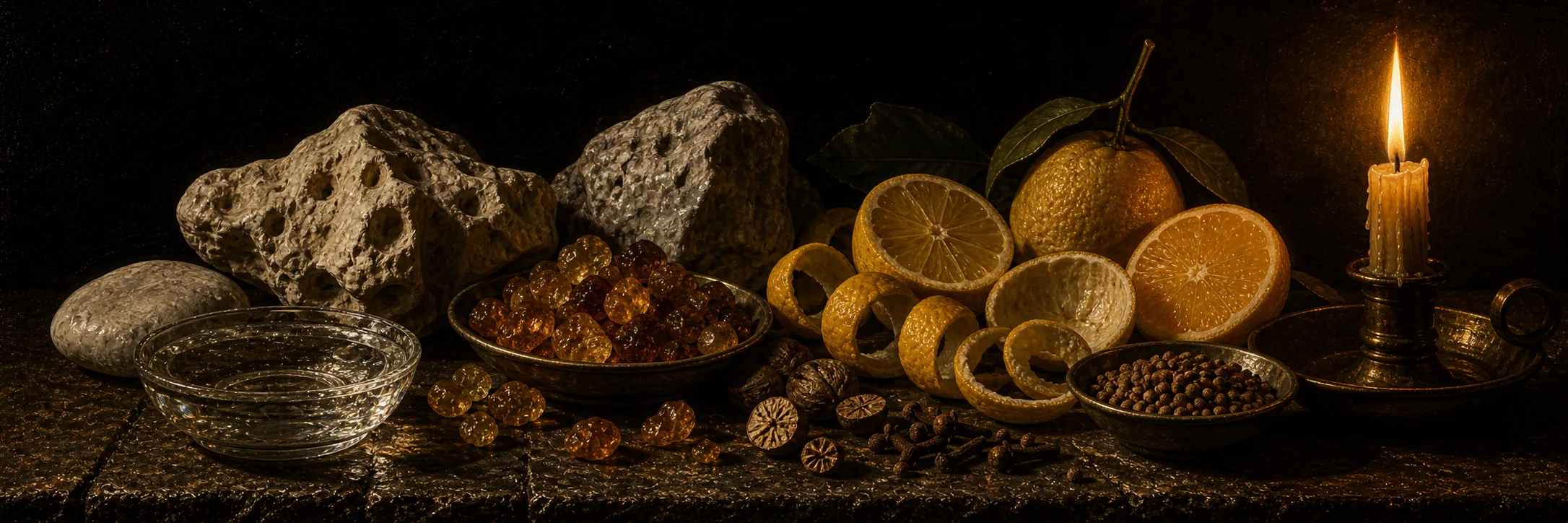
Cuir Mauresque (“Moorish leather”) is Lutens’s reading of leather through an Arabian-Andalusian filter - spices, orange blossom, animalic civet-musk, smoky styrax, and resinous myrrh wrapped around a leather note that is more atmospheric than literal. It is the warm, sweet, spiced antithesis to the dry austerity of classical European leathers like Knize Ten. Among the Lutens leathers, Cuir Mauresque is the most opulent and most controversial - Lutens himself, by Now Smell This wearers lore, reportedly douses himself in it before going out at night.
Scent Profile
The opening ten minutes are dense and surprising. Bright mandarin and orange blossom appear first - sweeter than expected for a leather, almost faux-patent-leather plasticky (Now Smell This’s Angela Sanders captured this in 2011: “the note is a sweet plastic that mingles with the fragrance’s leather to remind me of a 1970s faux patent leather purse”). Aldehydes provide a soapy lift. Cumin appears almost immediately - earthy, slightly dirty, the “Lutens cumin signature” that defines several of his orientals.
Performance
Projection is moderate to strong for the first 90 minutes - Cuir Mauresque has more presence than Boxeuses or Daim Blond. Sillage is restrained but consistent. Longevity on skin is 8-10 hours; on clothing the styrax and labdanum cling for days. Heat amplifies the cumin and civet - some wearers find Cuir Mauresque becomes too animalic in hot weather. Cold weather suits it best. Humidity adds to the dense feel. Best application: skin, 2-3 sprays. Spraying on collars or scarves amplifies the spices at the cost of the floral lift.
Wearing Context
Autumn and winter, evening, intimate or dramatic settings. Cuir Mauresque wears well to dinner parties, theater, dates, opera, evenings out. Bois de Jasmin’s Frolova framed it as a “complex, very medicinal niche leather” appropriate for sophisticated cold-weather contexts.
Comparisons & DNA
- Caron Tabac Blond - Tania Sanchez explicitly framed Cuir Mauresque (in Perfumes: The A-Z Guide) as “the great leathery classic, Caron’s Tabac Blond, [receiving] the Lutens treatment - more transparent, sweetened with jasmine and dried fruit. Lovely, but somehow less, and no match for, say, Knize Ten.”
Reception
Strongly positive among Lutens devotees, divisive among general audiences. wearers top reviewers treat Cuir Mauresque as a Lutens crown jewel; contributors split between leather-classicists who find it too sweet and Lutens fans who find it perfect. The most common wearers framing: “polarizing” - Cuir Mauresque is leather plus Lutens plus civet, and any of those three plus combinations can be a deal-breaker. reception: Sanchez gave it with the Tabac Blond comparison (above) in Perfumes: The A-Z Guide. Kafkaesque is a major advocate, calling it “classic sex appeal” and ranking it alongside Chergui in personal favorites. The Non-Blonde adored it. Now Smell This was positive. Bois de Jasmin treated it favorably (her 2005 review is the foundational blog review of the perfume). Blind buy verdict: Cautious yes for established Lutens fans and leather lovers; otherwise sample first. The cumin and civet are the failure modes - if you can tolerate them, Cuir Mauresque is one of the most rewarding modern leathers.
Versions & Reformulation
Launched in 1996 as a Palais-Royal exclusive bell jar - 75 ml, dab format. In 2010 it joined the export line as a limited-edition 50 ml rectangular bottle (around $140 at launch per Now Smell This pricing). It has subsequently moved between exclusive and wide formats, and as of 2026 appears at 260 for 75 ml in the Flacons de Table collection on sergelutens.eu. A Gratte-Ciel 100 ml version sold for approximately 305 per wearers user reports before that format was phased out.
Acquisition Notes
Availability varies by market; sample before buying when possible.
Notable Facts & Lore
- Lutens’s own framing: “Back when the Moors occupied Cordoba, leather acquired a particular odor: animal hides were tanned using acacia bark.” The fragrance references the historical Andalusian leather-tanning tradition - Moorish craft preserved in the cultural memory of Cordoba after the Reconquista.
- The name and concept tie directly to Lutens’s broader Orientalist aesthetic, and as a wearers reviewer pointed out, Lutens’s framing has “actual depth” compared to other brands’ superficial Middle-Eastern gestures.