Serge Lutens — Fumerie Turque
Essence
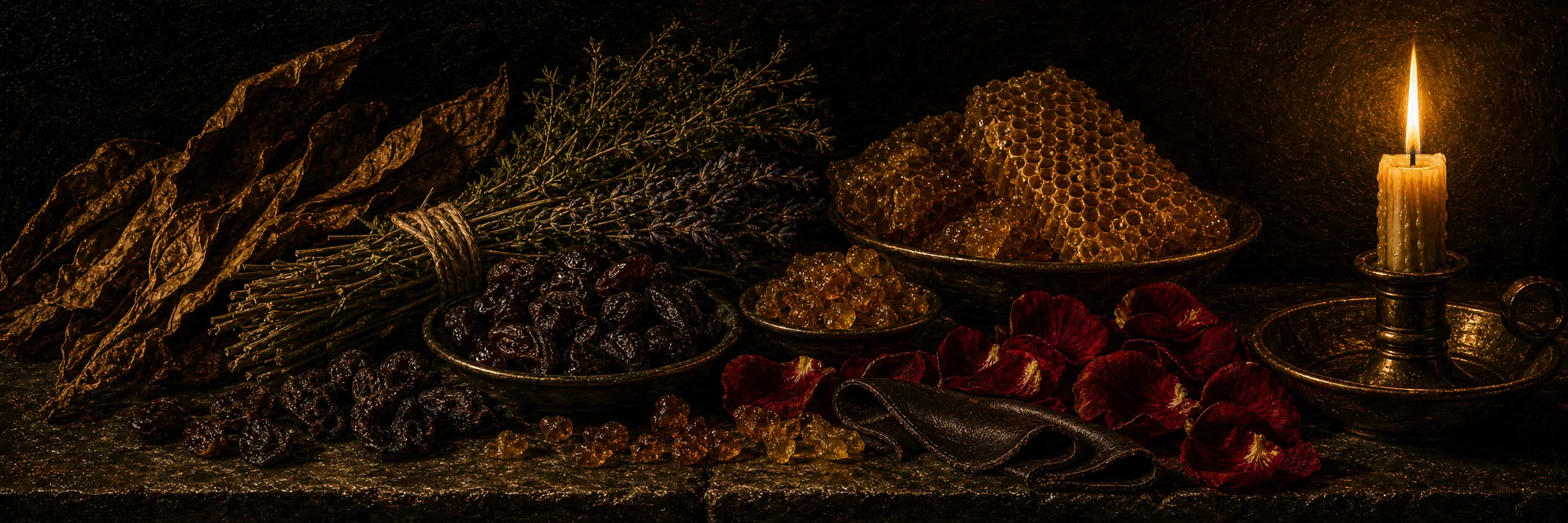
The Lutens tobacco - a candied-Turkish-tobacco-leaf composition built on white honey, beeswax, styrax resin, dried Balkan tobacco, suede, and a tiny vodka-soaked-currant top. Among the canonical Lutens releases of the late-1990s-to-mid-2000s baroque period (alongside Feminite du Bois, Ambre Sultan, Muscs Koublai Khan, Chergui), it is widely regarded as the best Lutens tobacco and one of the best tobacco perfumes ever made. Inspired by Turkish opium dens and rendered as Delacroix’s Women of Algiers in olfactory form.
Scent Profile
The opening is a strange, sour-bright moment: red currants and juniper berries soaked in something boozy (Lutens does not list rum, but reviewers consistently smell it), with a faintly chamomile-bitter edge that prevents the fruit from going jam-syrupy. Within 10-15 minutes the tobacco and styrax surface together - a smoky, dry, slightly leathery resin pressed against cured tobacco leaf. Kafkaesque famously found this stage rancid-sour on her skin; for most wearers it reads as smoky-balsamic and characterful.
Performance
Performance is moderate to strong by Lutens export standards but not “beastmode.” Projection is rich for the first two hours, then settles to a close-skin warmth. Sillage is perceptible at arm’s length in cool, dry air. Longevity is reliably 8-12 hours on skin and substantially longer on clothing - wool sweaters retain it for days. In cold, dry weather it shines; in heat and humidity the honey can dominate to the point of cloying. Best deployed in autumn and winter; misjudged in summer. Application strategy: two-to-three sprays on the chest and neck. The bell-jar-only era discouraged over-spraying (dab from the bell jar) and many veteran wearers prefer that ritual - applied to a single point, Fumerie Turque blooms more slowly and lasts longer than when sprayed.
Wearing Context
A cold-weather formalwear fragrance: dinners, after-hours bars, smoking jackets, the kind of velvet-and-mahogany setting Lutens himself favours. It works for date nights, candlelit dinners, jazz clubs, and any social context where a slightly anachronistic Orientalist warmth is welcome. It falls flat in offices (too dense), in summer (too heavy), and in any context where projection should be polite. Social-perception skew: leans masculine to neutral, though many women wear it confidently. Older wearers are the natural demographic but it has acquired a strong Gen X / millennial niche following via wearers, where it consistently ranks among the top three Lutens recommendations.
Comparisons & DNA
Within the Lutens house: Chergui (2001) is the closest sibling - also honey-tobacco-hay-and-iris, but Chergui is lighter, more dried-grass, and lacks the styrax smoke; Arabie the dried-fruit cousin; Borneo 1834 the patchouli-cacao parallel; Daim Blond (2004) the leather-suede companion. Cross-house: Mona di Orio Cuir addresses leather-honey but with more skank. Lattafa Velvet Oud and Maison Alhambra Saheb are sometimes proposed as budget alternatives but lack the styrax depth. Aramis Havana (1994), Burberry London for Men (2006) and Czech & Speake Cuba all live in the tobacco-spice-vanilla axis but without the Lutens honey-and-resin lift. L’Artisan Parfumeur Tea for Two is a lighter, smokier-tea sibling. Dior Tobacolor (2020, Francois Demachy) is the cleaner, more wearable modern interpretation. Naxos by Xerjoff shares the honey-tobacco angle but pushes the sweetness much further. A discussion famously argues that Royal Copenhagen for Men shares the powdery-honey drydown - reception disputes this, but acknowledges the texture similarity.
Reception
Critical reception is overwhelmingly positive. Victoria Frolova at Bois de Jasmin wrote one of the foundational reviews (September 2005): “Fumerie Turque, created by Christopher Sheldrake in 2003, is a composition of sensual character that develops slowly. Nevertheless, its every facet harmoniously segues into another, despite the dark and seemingly uncompromising nature of each accord.” Kevin at Now Smell This (17 September 2014) calls it among the most layered tobacco fragrances available and praises the “liquor-y, sweet, full-bodied tobacco mixing with balmy patchouli, benzoin, and background tonka bean (and not the obnoxious tonka-bean-on-testosterone that I smell in so many contemporary men’s perfumes).” On Persolaise’s site this is referenced as a touchstone tobacco comparator (he positions Ecrin de Fumee against it). wearers treat Fumerie Turque as a top-tier rite-of-passage Lutens; reviewers describe it as house-defining. Polarisation is real but small: some skins (notably Kafkaesque) turn the styrax-honey rancid and find it unwearable, but this is a minority. Blind-buy verdict: among the safer blind buys in the Lutens catalogue if you like honey-tobacco gourmand-orientals.
Versions & Reformulation
Released in 2003 in the rectangular Collection Noire 50ml bottle. Removed from the Collection Noire and made bell-jar-exclusive (Paris-only) at some point in the 2010s. Returned to the worldwide line in the new tall, slim 100ml bottle around 2019-2020 (alongside La Couche du Diable and L’Innommable). Long-time wearers (discussion, wearers) report that the original 50ml rectangular-bottle juice was tobacco-heavier and dryer; the current version is sweeter, more vanillic, with the tobacco less dominant. Kafkaesque’s 2013 review explicitly noted that her sample was “much softer, less tobacco-centered, more vanillic” than older descriptions implied. Lutens has not commented officially. EDP only.
Acquisition Notes
Availability varies by market; sample before buying when possible.
Notable Facts & Lore
- Lutens’ own copy is uncharacteristically blunt: “Smoking can kill you.” The fragrance is part of his thematic Orientalist arc - explicitly invoking Turkish opium dens - and is widely considered, alongside Ambre Sultan, Feminite du Bois, Iris Silver Mist, Muscs Koublai Khan, and Chergui, one of the six core house-defining releases.
- Sheldrake has not given a dedicated interview about it but has described his collaboration with Lutens generally as “telegraphic,” with Lutens directing emotional intent and Sheldrake translating into materials.
- The fragrance is referenced repeatedly in Denyse Beaulieu’s writing at Grain de Musc and was a focal point of the early-2000s “rediscovery of the Lutens line” that drove the house’s international expansion.
- No major celebrity association is documented, though it has appeared in multiple “best tobacco fragrances of all time” listicles.
- It is a recurrent gift among perfumers themselves - multiple industry threads document professional noses citing it as the tobacco reference.