Serge Lutens — Santal de Mysore
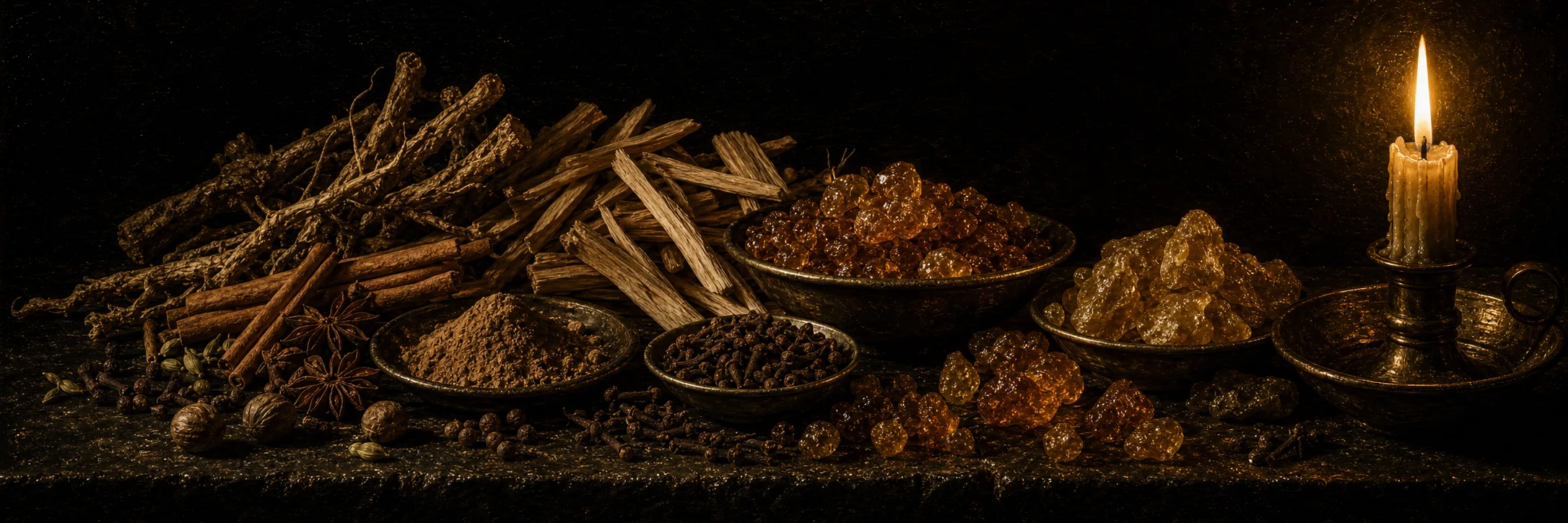
Essence
Santal de Mysore is one of the great “not what the name promises, yet somehow more interesting” sandalwoods: not a straightforward creamy wood, but a spicy, resinous, edible-seeming composition in which sandalwood sometimes hides behind cumin, benzoin, styrax, and curry-like associations before revealing itself in the drydown. Its cult status comes from exactly that tension. Critics and wearers writers alike describe it as antique, strange, warm, meditative, and often beautiful, but almost never simple.
Scent Profile
The opening is where the fragrance earns both its devotees and its detractors. Kevin at Now Smell This describes an edible start with nougat and coconut-cream sweetness rising from a faint wood note, dusted with cumin and other powdery spices; his shorthand is that it initially smells more like “Thai curry and coconut custard” than like a canonical sandalwood perfume. collector discussions rhyme with that, variously calling the opening coconut flan, Indian curry, sandalwood with cinnamon and cumin plus coconut milk, or simply a spicy oriental version of sandalwood. wearers reviews add more twists: whiskey, bourbon, chai-latte, tea, boozy woods, and even “Indian dinner served on a sandalwood table.”
Performance
Performance is one of the easier things to pin down. wearers rates longevity at 8.5 and sillage at 7.0 and explicitly labels the scent’s longevity above average. users call longevity “way above average” and sillage excellent, while wearers reviews commonly place it around the strong-moderate end rather than in beast mode territory: one user reports a good eight hours with recurring sillage bursts, another calls the projection moderate-to-heavy, while another says the deep spice sits fairly close to the skin after the opening.
Wearing Context
Santal de Mysore is overwhelmingly coded as a cold-weather or evening fragrance. Now Smell This once picked it as an apres-ski winter choice, calling it boozy, woody, and warm and pairing it with a fireplace image; users describe it as fantastic on cold days, potentially ideal for ski-resort luxury, and generally more at home in introspective or cocooning settings than in summer brightness.
Comparisons & DNA
The best comparison is probably negative: this is not the clean, legible sandalwood of Diptyque Tam Dao. users invoke Tam Dao specifically to argue that Santal de Mysore is denser, more spiced, more resinous, and less transparently sandalwood-forward, while a wearers reviewer basically says the same thing in reverse by insisting that this is “sandalwood with spicing,” not “curry with a tinge of wood.” If Tam Dao is sandalwood sketched in clean lines, Santal de Mysore is sandalwood seen through heat, spice, and balsamic smoke.
Reception
Reception is deeply positive overall but highly polarized in the reasons people give for that positivity or negativity. Kevin at Now Smell This calls it a delicate, smooth spicy-gourmand that smells antique and says it was love at first sniff, though he also implies that a side-by-side with Santal Blanc is prudent before purchase. wearers overall 7.6 from is strong, and some of its most detailed reviews are full-throated: one calls it “the spicy sandalwood love of my life,” another says that if you care about sandalwood it is highly recommended, and a third praises the cumin opening as one of the perfume’s most rewarding features. The praise is not subtle. Across wearers and wearers, fans call it one of the best sandalwoods they have ever smelled, a masterpiece, a true-to-life Mysore effect, comforting, meditative, warm without dead heaviness, and powerful without screech. Some explicitly say the curry angle is a feature, not a bug, because it gives the wood heat, texture, and cultural atmosphere rather than bland creaminess. The criticism is equally real. Plenty of people smell curry first and sandalwood second, or even never get past the cumin/caraway-spice effect at all. wearers reviews complain about sourness, literal curry, tea, too much cumin, or not enough sandalwood for a fragrance carrying the Mysore name; wearers includes the classic “curry-cherry” joke and a report from a husband who smelled sweaty locker-room facets three hours in. This is why even admirers repeatedly say it is not a safe blind buy. So the blind-buy verdict is easy: absolutely not, unless you already know you enjoy sandalwoods that blur the line between incense, dessert, spice market, and warm skin. If you do know that, Santal de Mysore is exactly the kind of fragrance that can become irreplaceable.
Versions & Reformulation
The dossier year is the messiest part of Santal de Mysore. wearers dates it to 1991, wearers dates it to 1997, and Now Smell This, in a 2010 review, says it was developed by Christopher Sheldrake and released in 2001. Exact first-release dating is therefore inconsistent across secondary sources and should be treated as unresolved rather than precise.
Acquisition Notes
This is an expensive, quasi-exclusive Serge Lutens purchase. The official site currently lists Santal de Mysore at $347 for 75 ml in the Flacons de table collection, which keeps it firmly in luxury niche pricing. wearers user commentary from recent years also describes availability as scarce and tied to bell jars or hard-to-find samples, so the practical acquisition picture is expensive, presentation-specific, and not always effortless.
Notable Facts & Lore
- A major piece of Santal de Mysore lore is the belief that Serge Lutens used genuine Mysore sandalwood secured before regulatory restrictions made that material especially hard to use.
- A wearers reviewer states that the house stocked up on real Mysore before the ban and continued to use it in this fragrance, while wearers raw-material article also singles out Santal de Mysore as a perfume containing “the real thing,” albeit hidden under a lot of “phantasmagoria” until the final drydown.
- That does not amount to a directly sourced house confirmation here, so it is best treated as persistent, well-circulated lore rather than a completely settled production fact.