Serge Lutens — Encens et Lavande
Essence
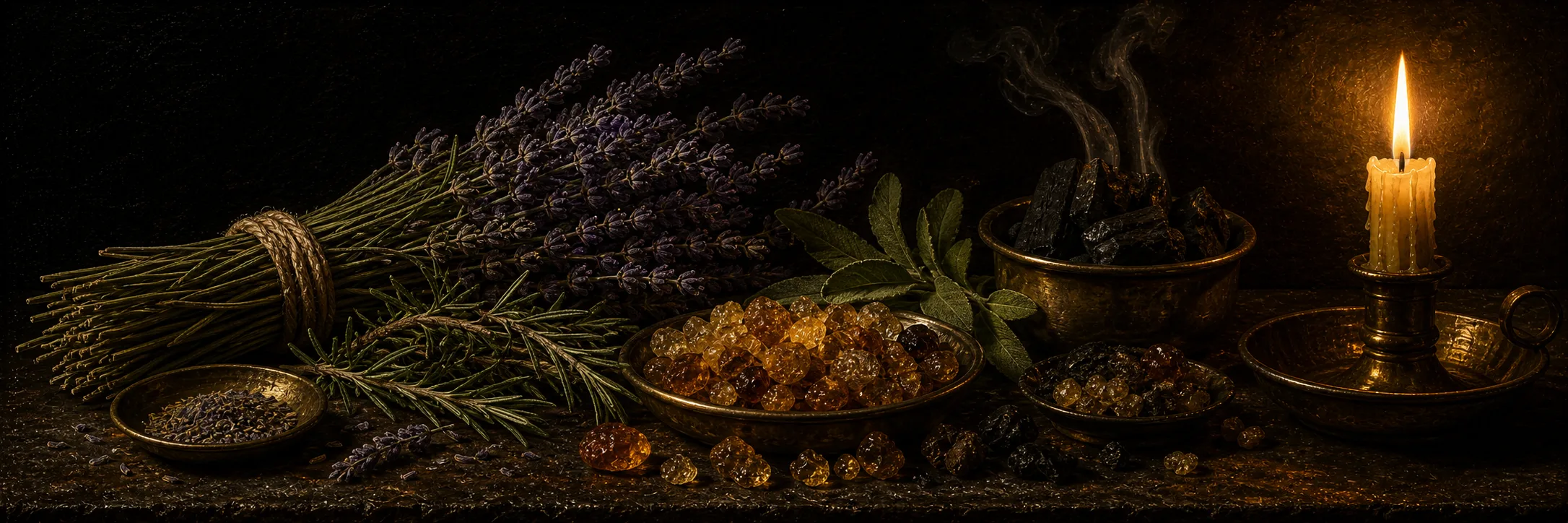
Encens et Lavande is Serge Lutens’ austere two-note meditation: a starkly literal pairing of raw French lavender and dry frankincense, with almost nothing else competing. Composed by Christopher Sheldrake in 1996 for the non-export “Les Eaux” line, it is the anti-Lutens Lutens - no candied fruit, no syrupy amber, no spice labyrinth. Instead it offers cold-church serenity: a fresh, terpenic lavender that slowly cedes ground to smoky incense and a quiet vegetal-amber base. Reviewers call it “comfort food” and “tranquil calm in a bottle.” Minimalist, contemplative, unmistakably elegant.
Scent Profile
The opening (first 10-20 minutes) is uncompromising raw lavender - slightly camphorous, terpenic, “living” rather than the dried-sachet or soapy lavender of air fresheners. A thin green underpinning of clary sage (and what many read as rosemary or juniper berry) gives it an herbaceous, eau-de-cologne brightness. Some skins read the first spray as sharp, “screaming,” even metallic or medicinal; give it time. The listed amber is barely perceptible early on, functioning as a structural floor rather than a sweetener.
Performance
Consensus reception is that performance is moderate, not a Lutens powerhouse. wearers scores it longevity and sillage against an overall scent score of from - solid but not commanding. Projection is light-to-moderate - an intimate-to-arm’s-length bubble rather than a room-filler - though a minority report strong longevity (“two sprays enough for 24 hours,” “still smelled it 12 hours later on my pillow”). Most place longevity at a moderate several hours on skin and considerably longer on clothing and hair, where the lavender and incense cling well. Sillage is described as “moderate at best, quiet at worst,” with gentle wafts rather than a trail.
Wearing Context
Best in spring and summer, and indoors year-round; its cool-church character is paradoxically a heat performer. Time of day is flexible, but its calm, focused, “academic” quality suits daytime work, quiet contemplation, and - for many - bedtime, as lavender’s relaxing reputation makes it a popular nighttime scent. Occasions skew casual-to-formal-neutral: office-safe, unobtrusive, dignified rather than seductive.
Comparisons & DNA
The inevitable comparison is Serge Lutens Gris Clair (2006), also by Sheldrake and the export-line lavender-incense counterpart. reception splits hard: Gris Clair is colder, ashier, more camphorous and “shrill”/austere with a hot-wool, burnt-cotton-iron facet and tonka sweetness; Encens et Lavande is warmer, softer, more aromatic and “contemplative,” with cleaner lavender and finer incense. Critics on Perfume-Smellin’ Things and wearers prefer Encens et Lavande’s incense as “the most satisfying incense accord in the Lutens lineup,” but note Gris Clair is half the price and far easier to find. For the budget-minded, Gris Clair is the closest legitimate “alternative,” not a clone.
Reception
Reception (wearers, MakeupAlley) is broadly admiring but polarized on simplicity. Admirers call it “a case study in simple beauty and elegance,” “the quintessential lavender,” and “an antidote to our current age of constant stimulation.” Detractors find it boring, overpriced, or “just incense and lavender, got it.” A second polarization is skin chemistry: a meaningful minority report it turning soapy, sweet, stale/acidic, or “bathroom spray”-like, while others get pristine living lavender. A third axis is gender perception. -2 coverage is unusually strong for an older Lutens exclusive. Colognoisseur’s Mark Behnke ranks it among his favorite incense and lavender fragrances, writing it “was the Serge Lutens fragrance which made me find a way to get a bell jar flown back here to me,” and describing how lavender is “buttressed by clary sage and an austere silvery frankincense” that “provide a chilly effect that carries an icy beauty” before “a healthy amount of amber thaws things out.” Perfume-Smellin’ Things preferred it to the export Gris Clair: “the drydown marries the disparate elements to a smooth amber base… the dark, cool interior of a perhaps abandoned stone church. Could there be anything more perfect on a scorching day?” wearers critics are split, one calling it uninspired material-pairing that “does not justify its price tag,” another deeming it a masterful exercise in restraint. “Blind buy?” verdict: reasonably safe for confirmed lavender and incense lovers who value minimalism - but because skin chemistry varies and the price/availability are steep, sampling first is strongly advised. Gris Clair is the cheaper, more available gateway.
Versions & Reformulation
Encens et Lavande launched in 1996 within the Shiseido-era non-export “Les Eaux”/“Les Eaux Anciennes” collection and has shifted between Lutens’ line organizations over the decades (now sold as a bell-jar “exclusive”/Flacon de Table format). Reviewers reference older “Shiseido bell jar” versions versus current production; while Lutens fragrances broadly are subject to IFRA-driven tweaks, no single dramatic, widely-documented reformulation of Encens et Lavande is reported in selected discussion the way Gris Clair’s bell-jar version is criticized for losing incense. Treat vintage-vs-current differences as plausible but not strongly documented here.
Acquisition Notes
Availability varies by market; sample before buying when possible.
Notable Facts & Lore
- Lutens’ own published gloss is characteristically poetic: “Under flower-blue heavens, the grey stones of a chapel called out to me.
- The limpid name of this fragrance came to me unbidden; I dared not change it.
- Incense and lavender; it was nearly fifty-fifty, until audacity got involved.“ This is one of the rare cases where a Lutens name is bluntly literal rather than enigmatic - a point critics dwell on.
- The church/monastery associations are near-universal in reviews; the Scented Salamander frames it as “the incense rendition of a civilized, polite person…
- Who occasionally likes to interrupt a promenade to step into empty churches in Paris.“ It belongs to the cult of Lutens bell-jar exclusives (alongside Iris Silver Mist, La Myrrhe, Sarrasins) that fueled the “Paris pilgrimage” mystique of late-2000s perfumery.
- No celebrity or viral-social moment is associated with it; its fame is strictly connoisseur-driven.