Serge Lutens — De Profundis
Essence
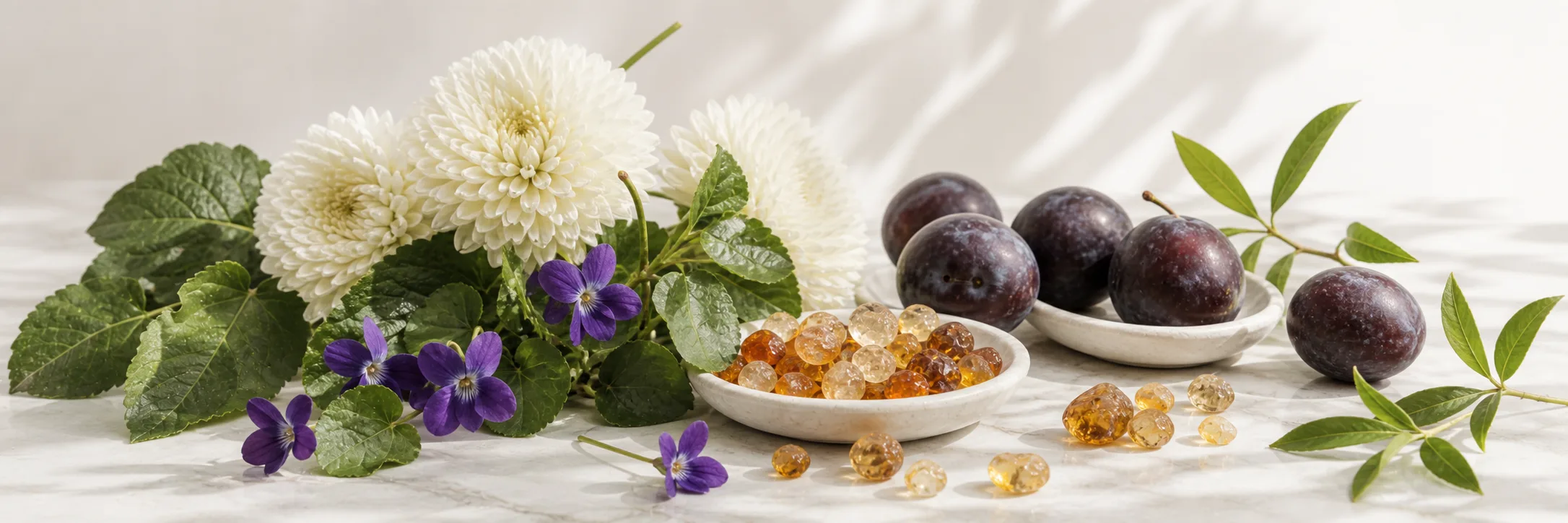
De Profundis is Serge Lutens and Christopher Sheldrake’s 2011 meditation on death, mourning, and resurrection, built around the chrysanthemum - the European funeral flower. Its name references Psalm 130 (“De profundis clamavi” - “From the depths I cried”) and Oscar Wilde’s prison letter. Despite the grim framing and Lutens’s famously morbid press prose, the actual scent is the opposite of funereal: a cool, ethereal, green-violet floral with damp-earth and incense facets and a luminous purple-twilight feel. It is one of Lutens’s “oddball” departures from his Middle-Eastern amber norm, beloved by a cult of fans as among the most beautiful and unusual florals in perfumery.
Scent Profile
The opening is sharply green - stemmy, leafy, slightly astringent, “like stepping into a flower shop,” with a cool dewy quality. Within the first ten to twenty minutes a wall of cold flowers emerges; chrysanthemum (dry, woody, faintly hay-like and green) is the conceptual star, threaded with violet and a watery, mineral chill. Some reviewers immediately read soap or aldehydic cleanliness here; the Perfume Shrine review calls it “a piercing, sharp, dusty and at the same time aldehydic ‘clean’ floral.”
Performance
Performance is genuinely bimodal across skin types, and the reception is split. Many report short-lived wear - “achingly ephemeral,” lasting “the precious few hours” - while others get extraordinary longevity, including one account of it remaining very much present 16 hours after spraying. Projection and sillage are generally moderate but described by some as substantial; several accounts note it can fill a room early before becoming introspective. The split appears tied to the soil/earth and floral materials behaving very differently per skin chemistry. It is best understood as an introspective scent - even fans who praise its early sillage call it “very much an introspective perfume, one beyond the comprehension of the masses, best worn for self-enjoyment.” Behavior skews to cool, damp conditions: multiple reviewers cite gray, damp, autumnal or “Pacific Northwest evening” weather as where it shines. Best application: spray generously given the variable longevity, and lean into cool-weather wear.
Wearing Context
De Profundis is an autumn, early-spring, and cool-damp-weather fragrance, and a contemplative, day-to-evening “mood” scent rather than an occasion-driven one. It excels worn for oneself - quiet, meditative, melancholic-but-soothing - and several reviewers (Kafkaesque, Now Smell This commenters) note it works surprisingly well as an office, business-meeting, or “walk in the park / tea at the Ritz” scent because of its restraint and elegance. It is not a date-night, club, or warm-weather crowd-pleaser; it is deliberately uningratiating, and even its admirers concede “I can’t imagine this scent finding much of a popular audience.” Social perception is unusual: because chrysanthemums are funeral flowers in France (and absent from most perfumery), French wearers especially read it as melancholy - one perfume-evening guest said it “smelled like fear,” reportedly reacting to a trace of cadaverine in the formula. That reaction is part of the lore, not the norm.
Comparisons & DNA
Within the house, the closest relatives are Lutens’s other ethereal, cool florals: Serge Lutens La Religieuse (incense-floral; one wearer found De Profundis’s violet drydown similar but says De Profundis “blows La Religieuse out of the water with that extra green note”), Serge Lutens Un Lys, Serge Lutens Bas de Soie, and Serge Lutens Vitriol d’illet - Frolova explicitly places it “right next to” these. The single most-cited external comparison is vintage Estee Lauder Private Collection and vintage Chanel No. 19 - green, cool, haughty florals; one reviewer calls De Profundis like old No. 19 but “the Philharmonic orchestra next to the local school’s line-up,” another finds Private Collection “more exuberant” while De Profundis is “more contemplative and broody.” For the dark, stony-mineral mood, a reviewer draws an “ambiental conjunction” with Durbano Black Tourmaline. Layering partners cited by fans include Profumum Roma Arso and Diptyque Tam Dao. Crucially, as an artisanal-concept Lutens exclusive built on chrysanthemum - a note almost no one else uses - there is no clone or dupe, and wearers treat it as genuinely inimitable. Lineage: it sits in the lineage of green funeral-flower abstractions (Iris Silver Mist’s cold-mineral school) and is frequently named among the most artistic, “oddball” creations of the Lutens/Sheldrake partnership.
Reception
De Profundis is a cult favorite with unusually devoted fans and a vocal “I get nothing” minority. Named critical coverage is rich and mostly glowing: Bois de Jasmin (Victoria Frolova) calls it a “soaring, ethereal vignette of green flowers” and credits Lutens and Sheldrake; Now Smell This’s commentariat and Kafkaesque both rate it among their favorite Lutens florals (“pitch perfect,” “probably my favorite Lutens I’ve smelled thus far”). The dissent comes from Perfume Shrine, which found it “underwhelming, after such build-up… piercing, sharp, dusty… aldehydic ‘clean’ floral” that “petters out,” and from wearers who get only “a bit of a dewy then soapy white flower” with “no soil, no violet.” Polarization axes: (1) does the earth/soil note materialize at all; (2) is the result hauntingly beautiful or merely a pretty-but-thin clean floral; (3) longevity (eternal vs. ephemeral). The melancholy-vs-serene divide is also real - many insist, contra the press release, that “De Profundis brings me more joy than grief” and “it smells like a garden, not sadness.” Blind buy? Risky given the perception variance and the high exclusive-line/bell-jar price; strongly sample first. For lovers of cool green florals (No. 19, Private Collection), it is among the most rewarding things Lutens has made.
Versions & Reformulation
De Profundis launched in 2011 as a Paris-exclusive bell-jar Eau de Parfum (75ml). There are meaningful version differences. A 2015 “Limited Edition” appeared with a notes profile listing ash and spices in place of the original soil tincture. More significantly, the fragrance was later rebottled into the Gratte-Ciel collection, and many wearers report that the Gratte-Ciel version smells different from and inferior to the original bell jar - one reviewer states flatly that replacing the earth tincture with ash “was a very bad idea” and that “synthetic chrysanthemum is easily detectable,” arguing the reformulation “has lost that cult fragrance status.” Others who have tried both report hearing of differences but lacking firm evidence. There were also limited engraved bell-jar editions at launch (reportedly only a handful of each design, at very high prices). Bottom line: original bell-jar/first-batch (July 2011) is the version cultists chase; current Gratte-Ciel is the accessible-but-debated reformulation.
Acquisition Notes
Availability varies by market; sample before buying when possible.
Notable Facts & Lore
- This is “the death perfume.” Lutens released it with a now-famous piece of purple prose beginning “When death steals into our midst, its breath flutters through the black crepe of mourning…” and the line “Clearly, Death is a Woman.” It was reportedly created at a time when Lutens was contemplating retirement, which colors its twilight/mortality theme.
- The chrysanthemum choice is deliberate cultural coding - the European (and especially French) funeral flower, and the East Asian flower of grief and mourning - making it a flower almost taboo in perfumery.
- A persistent and widely-repeated piece of lore is that the formula contains a trace of cadaverine (the compound associated with decomposing flesh), offered as the explanation for why some people react with visceral unease (“it smelled like fear”).
- Both Psalm 130 and Oscar Wilde’s “De Profundis” letter from Reading Gaol are the literary references; critics note the irony that Wilde’s letter is not actually about death.
- The bell jar’s amethyst-purple juice is itself part of the fragrance’s iconography.