Serge Lutens — Santal Blanc
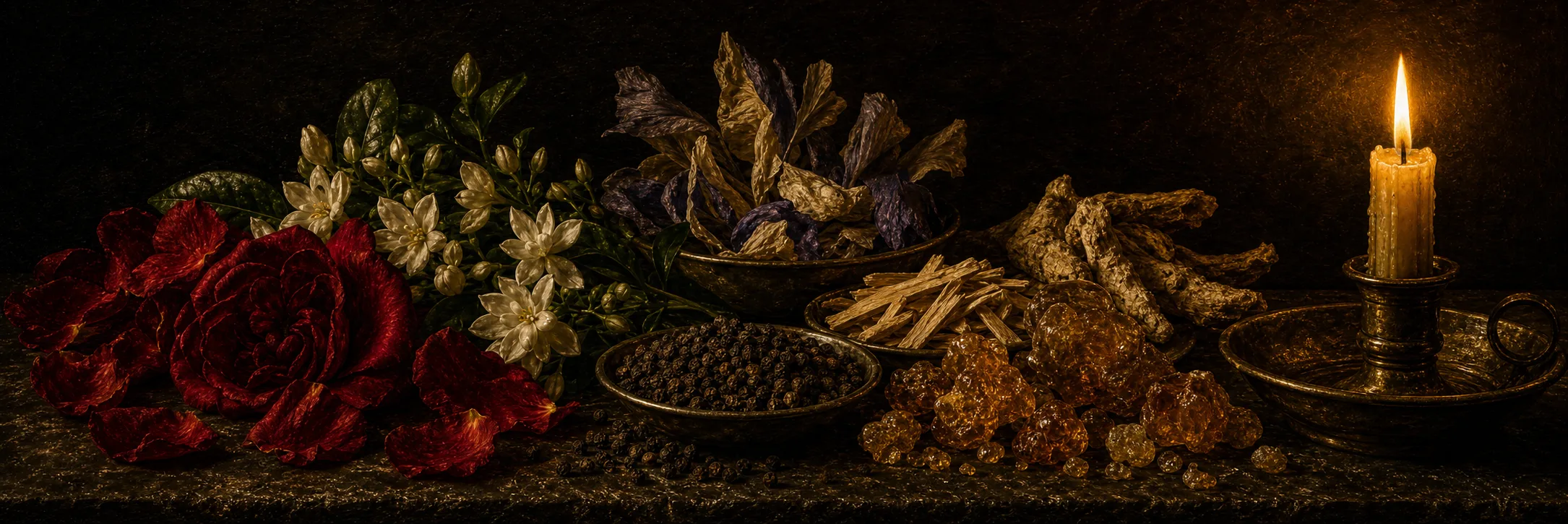
Essence
Santal Blanc (2001) is Serge Lutens’s “white sandalwood” study: a creamy, milky, lightly spiced sandalwood built on the Sheldrake stewed-fruit base that runs through the house, but turned bright, powdery and skin-close rather than dark and resinous. Its signature is texture — a buttery, almost doughy sandalwood threaded with fenugreek’s maple-syrup tang, pink pepper, cinnamon and a powdery iris-musk cushion. It is one of the most wearable and least confrontational Lutens, often called the brand’s most approachable sandalwood and a favorite of the house’s “weird but wearable” fans.
Scent Profile
It opens with the recognizable Lutens “potion”: a spicy, fruity, slightly boozy blast of stewed fruit and pink pepper that tingles the nose, with a citrusy-fresh brightness up top even though no citrus is listed. The defining accord arrives almost immediately — fenugreek paired with sandalwood, lending an unsweet maple-syrup tang that wearers variously read as immortelle-like, brown sugar, or even root beer.
Within minutes the fruit and spice give way to woods: a buttery, very white, milky sandalwood with noticeable cedar, the wood smelling faintly scorched in a way that cuts the early sweetness. Cinnamon and pink pepper keep the spice present. Notably, the rose and jasmine listed in the heart are rarely perceived by name; for most wearers the fenugreek, cinnamon and sandalwood dominate.
The drydown settles into a clean, powdery, soapy base of iris and a soft musk — engaging rather than animalic. The fragrance is largely linear once this milky-woody core sets in. A famous recurring descriptor is that it “smells like a pencil,” capturing its milky-woody-graphite quality, alongside cashmere and fresh-baked bread; noses who read the fenugreek as savory may instead get something curry-like.
Performance
Performance is divided and depends heavily on conditions. Many wearers find it soft, light and skin-close with modest sillage, lasting perhaps four to five hours with only the first hour projecting. A vocal minority experience it as potent and long-lasting, a difference that correlates strongly with cool weather and with the stronger non-alcoholic Fond de Parfum version. The practical read is a moderate-to-soft skin scent that rewards generous application and cold, crisp air; it can go faint in heat and reappear as the skin warms and cools.
Wearing Context
This is at its best in autumn and winter, where it works as a cozy comfort scent — a warm blanket on a cold day, well suited to home and quiet evenings. Some wearers find the brighter, soapier side works in spring or as an everyday clean sandalwood, so it is not strictly cold-weather only. It is unisex but leans slightly powdery and feminine on many skins, and it is intimate and understated rather than a room-filling statement. The one social risk is the savory fenugreek facet: anyone who reads it as take-away food will find it wrong for the office, while everyone else gets something cozy, characterful and distinctive.
Comparisons & DNA
The closest relative is Serge Lutens Jeux de Peau, a coumarinic, doughy, sweet sibling in the same stewed-fruit family, with Daim Blond and Miel de Bois also adjacent. Against Santal Majuscule (2012) it is muskier, woodier and far less sweet, despite sharing the same sandalwood material, and against Santal de Mysore it lacks that scent’s curried-coconut heaviness. The most-repeated external comparison is Tom Ford Santal Blush, which uses the same fenugreek idea and is often recommended as an easier-wearing, higher-performing alternative. It is also widely seen as a conceptual ancestor to the clean-sandalwood boom that Le Labo Santal 33 later epitomized.
Reception
Reception is genuinely polarizing within an otherwise beloved house. Admirers call it an original, high-quality woody-spice scent and the definitive milky, cashmere-like sandalwood, with many describing a slow burn from indifference to love. Criticism clusters on three points: soft or short performance for the price, the savory fenugreek and cumin facet that some find a hard no, and a sense that it is pleasant but not especially exciting relative to the rest of the Lutens catalogue. Tania Sanchez, in Perfumes: The Guide, described it as a more lighthearted study of sandalwood with bright floral charm and raisin sweetness — positive, if not ecstatic. The fair blind-buy verdict is to sample first, ideally in cool weather, given both the divisive fenugreek and the inflated secondary pricing.
Versions & Reformulation
The fragrance has a layered version history. It began as a widely available export-line scent in a thin rectangular bottle, then in 2012 was moved into the Paris-exclusive bell-jar collection, around the time Santal Majuscule arrived to fill the export-line sandalwood gap. As with many Lutens, its “discontinued” status really means it has drifted in and out of the bell-jar exclusives rather than vanished. An early non-alcoholic Fond de Parfum version is prized for stronger longevity. Reformulation is widely suspected but not documented for this scent; owners of older bottles report a heavier, more prominent rose. Note also a separate 2019 Santal Blanc in a square atomizer bottle with added citrus; the version described here is the 2001 EDP.
Acquisition Notes
This sits in the niche-luxury tier and has been pushed higher by scarcity. As an export-line scent it historically carried a standard Lutens price for 50ml; as a bell-jar or remaining-stock item, the 75ml jars now command secondary-market premiums and are frequently described as hard to find. The MSRP referenced here is in the low-300s. When in production, authentic channels are the Serge Lutens boutique and official webshops. Given the divisive profile, decants are widely available and the sensible entry point. For older bottles, treat photo-only authentication as unreliable and buy from reputable sellers and decant houses.
Notable Facts & Lore
- Serge Lutens reportedly compared Santal Blanc to the smell of fresh bread from the bakeries of Lille, his birthplace — the source of its recurring doughy, brioche-like drydown.
- The “smells like a pencil” descriptor became near-canonical in early reviews, a compliment to its milky-woody-graphite character.
- It belongs to the house’s informal sandalwood trio with Santal de Mysore and Santal Majuscule, considered different enough to own all three without overlap.
- It is frequently cited as a quiet ancestor of the 2010s clean-sandalwood boom epitomized by Le Labo Santal 33.
- An early non-alcoholic Fond de Parfum edition is sought out for its stronger longevity.