Serge Lutens — Nuit de Cellophane
Essence
Nuit de Cellophane is the unexpectedly easy Serge Lutens: a sweet, sheer fruity white floral in which osmanthus, jasmine, and lily drift through a clean, soapy veil. Released in 2009 with Christopher Sheldrake, it trades the house’s usual drama for polished prettiness, which is precisely why it has remained so divisive.
Scent Profile
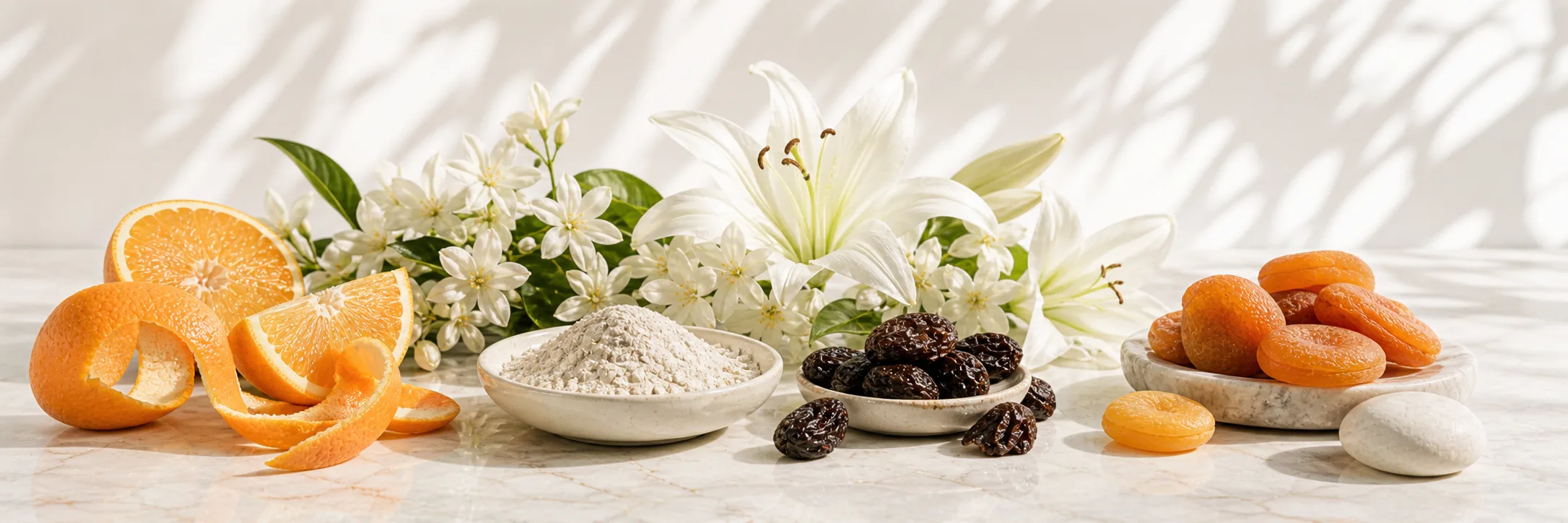
The opening is a bright, sharp fruit effect that can suggest plum, peach, apricot, mandarin, or even bubblegum. For many, it carries a synthetic clean-hair quality. That shampoo-like impression is the perfume’s most repeated description and its main point of resistance. As the first fruitiness settles, jasmine, lily, carnation, and osmanthus create a dewy white-floral heart. There can be a faint metallic glint and a light indolic undertone, but the flowers stay clean and gauzy rather than heavy. Osmanthus is the stated focus, though it can be difficult to separate from the fruit and white-floral materials until later in the wear. The drydown is soft and linear: musk, a trace of honey and almond, and pale woods leave a close, soapy floral finish. The result is less an osmanthus soliflore than a translucent floral-fruit composition built to feel freshly washed.
Performance
Performance is moderate to soft. The opening and floral heart often fade after the first hour, then remain as a gentle skin scent. Some wearers get much longer life with several sprays, but projection stays restrained. It works best with a generous application in warm weather. Older pre-black-label bottles are often considered more present than later versions.
Wearing Context
This is made for spring and summer days, casual plans, and offices. Its clean, easygoing character is much more approachable than the house’s usual dark signatures, and it can make a graceful entry point for someone new to Serge Lutens. It leans feminine, while remaining wearable by anyone who likes soft, clean white florals. Do not expect a nocturnal or cold-weather perfume despite the name.
Comparisons & DNA
Dior J’adore is the most familiar comparison: both work with polished fruit and white flowers, but Nuit de Cellophane adds a slightly gauzy, metallic cleanliness. J’adore Absolu is another reference for the fruit-and-flower profile, though the Lutens is lighter and more soapy in effect. For a clearer osmanthus focus, Osmanthe Yunnan, Ormonde Jayne Osmanthus, and Osmanthus Interdite are more direct studies of the flower. Within the Lutens catalogue, A La Nuit, Fleurs d’Oranger, and Fleurs de Citronnier provide floral context, while Nuit de Cellophane is the sweeter, more mainstream, and more linear outlier.
Reception
Critics have often been cool. Bois de Jasmin returned to its shampoo comparison even after retesting, and Luca Turin with Tania Sanchez regarded it as an overly dense J’adore-like fruity floral. I Smell Therefore I Am found it beautiful but too conventional for the house’s name. Its defenders enjoy exactly that restraint. They see a pretty, quiet, delicate floral that is easier to wear than the house’s more demanding work. The divide is therefore not about whether it is attractive, but whether its clean, uncomplicated attractiveness is enough to justify the Serge Lutens label.
Versions & Reformulation
Nuit de Cellophane has been reformulated. Collectors generally distinguish the original, more present version from a later black-label edition, which is often considered less satisfying. It began as a 50 ml Collection Noire export-line Eau de Parfum rather than a Palais Royal bell jar and remains part of the line.
Acquisition Notes
This is a standard export-line fragrance rather than a difficult discontinued exclusive. Official 100 ml pricing sits in the house’s upper tier, although lower non-official retail prices have long been common. Seek an older bottle if the earlier, stronger character matters; a current bottle is an easy way to try the house in a light, warm-weather mode.
Notable Facts & Lore
- The name imagines flowers behind cellophane, linked to a pre-material haute-couture idea.
- The contrast between that story and a plastic-wrapped-flower impression became a recurring joke.
- Its 2009 launch was often read as a move toward a more accessible floral style.
- It is a canonical example of a cult house making a designer-adjacent perfume.
- The difference between older and black-label bottles remains important to collectors.